Showing posts with label education. Show all posts

Thursday, October 11, 2012

What I'm Learning About Learning

I'm back at school! (More on that later)

As the first few weeks have rolled by, there has been a common theme running through the majority of my classes. Most of my profs having been talking about the ideas and problems centered around the academic world. I'd like propose a few questions that keep popping up in my readings and lectures, questions which have really started to get me thinking about the other side of the picture. They are presented here with a large degree of simplification, but my hope is that they get us thinking and talking about how academia is practiced.

Question 1: What is education for?

All throughout my life, I have been going to school to learn new things; new facts, new ideas, new theories, new ways of getting things accomplished, etc. This seems fairly self evident - that is until you ask the question, "for what reason am I learning?" So often we assume (or at least I do) that we learn so that we can contribute to our ever evolving story on this planet. A medical sciences student goes to school to learn how the body works so that she may learn how to help others when they are sick. An engineering student goes to school to learn how design buildings that we may some day live in. A history student learns how to categorize our past experiences so that she may continue developing the story that we come to understand ourselves by. The political science student learns theories of governing ourselves so that we may design a better system that works for us all. Essentially, we participate in academia in order to better the world.

David Orr - a professor of political ecology at Oberlin College - questions this romanticized view on academia in his book, Earth in Mind: On Education, Environment, and the Human Prospect by pointing out that it is people with their undergraduate degrees, Master's certifications, and Doctorates who are responsible for an economic system that degrades and exploits the environment. He even goes as far as to use Ellie Wiesel's analysis of those individuals responsible for the atrocities of the holocaust saying that they "were the heirs of Kant and Goethe, widely thought to be the best educated people on the planet" (Orr, 7). What is it about these individuals education that lead them to neglect moral judgement? Was something missing? Do ethics, morality and character building have a place within the academic world? What about action? Does education need to lead us to a place

Question 2: Who's knowledge?

The question implies two notions that, in my opinion, are often overlooked.  The first is that knowledge is a created thing. This idea has been around for a while but it's been most exemplified in my study of Hobbes' Leviathan. Hobbes spends the first few chapters of Leviathan explaining how our senses inform us of our surroundings and help us form an awareness of them. That is to say, our experiences shape our understanding and knowledge. Alongside with this is the obvious notion that we all have different experiences and therefore have different knowledges. My understanding is quite different than yours and collectively - assuming that we have both grown up in the same culture - our knowledge is quite different than someone's from say India. The question then becomes, who's knowledge do we present in University? Which knowledge gets privileged and why? 

I believe in the power of intersectionality. That is, the power of recognizing where two different knowledges intersect. I believe that where these intersects happen, a connection is made and a great deal is learned. Is it the academic world's responsibility to facilitate intersectional dialogue? If so, how do we open the classroom up to knowledges that are not the same as the professor's? What power dynamics are in the way when promoting intersectionality?

Question 3: Who get's to participate? 

Time and time again, I am reminded of how lucky I am to be here. There are many barriers to education, both seen and unseen. Although, I've struggled with the money issue, I've been lucky enough to have a government service provide me with the funding necessary to go to school, as long as I pay it back when I'm done. But what about those who can't? What about those where government funding is just not enough?

It's also important to examine the question of who excels in the academic world and why. I stumbled across a great meme that asks the same question. 
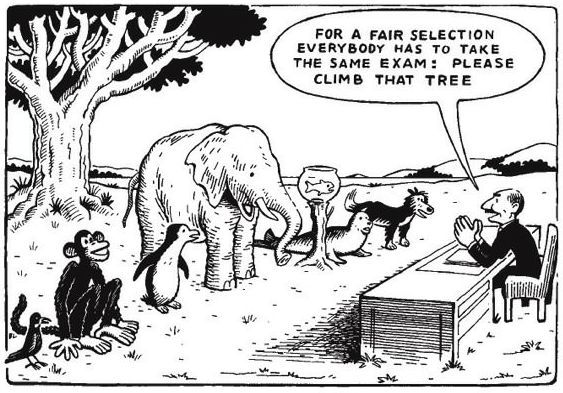
We're not all designed the same way and I think that our education ignores that, thus inhibiting the participation of others. We recently heard from both Kelsey and Danielle about the benefits and joys of learning beyond the classroom. Does the academic world make room for different types of learning? Is it emphasized enough or is it just payed simple lip service with the inclusion of a practicum class here and there?

As I stated in the beginning of this post, these questions are limited and quite simplified. These are questions that I hope I can explore throughout the rest of my academic career. I hope to encourage discussion and thought about the ways in which we approach academia and I hope to expose some of the power dynamics behind the institution. 

Thoughts?
 

Wednesday, October 10, 2012

Education – A Time of Slowing


            Being that it is reading week, I finally have some time to breathe. September seems to have dissolved without my knowledge and as the weather begins to turn, I am keenly aware that it is no longer the beginning of the semester.
            I am back at school, and boy am I glad to be back. I am starting a Masters of Christian Studies at Regent College, which means I get to see much more of Duncan and Amy as well as spending countless hours with my face in books.
            I am glad to hear from Danielle and Kelsey in their latest posts that education occurs in the work place and on the farm. I value these kinds of learning, and might even posit that these types of experiential learning have a longer lasting impact on us as persons, but that is not where I am at this moment in time. I have chosen to return to the academy. Why have I done so?
            Well because I love it and I am challenged by it. I think that wrestling with the mind is a worthwhile endeavour. The challenge to think in new ways, to consider information from previously untried angles, and the opportunity to test and reconsider beliefs and values is never a frivolous pursuit. 
            I also love the academy because at its best it makes a mockery of the capitalist system we live in. What I mean by this is that the academy, in its true form, makes a mockery of our prevailing worldview that time = money. In essence, I can waste vast amounts of time on a paper, which in reality will be read by one professor at one moment, probably not making a huge impact on that person, to receive a grade that does not matter all too much. This, to my knowledge, is not generally accepted in the working world. In some ways, academic pursuit acts as an extended period of the spiritual discipline of slowing. The discipline of slowing is to stop time, pause, think, reflect, realign oneself in order to act and live better in the subsequent moments.
            My goal in this extended period of slowing is to increase my ability to be self-critical. I think education at its best teaches and trains a contemplative mind, not only skills and content. It trains us to perceive the underlying questions, to show us how “facts” can be read and interpreted in various ways, and to open ourselves to other perspectives. In doing so we can approach the rest of life more humbly, acknowledging the complexities, the diversity, and the wonder of the human experience. So although education, specifically education in the academy, often does not feel like slowing, I think it largely emulates the discipline of slowing.

            This reading week has also given me time to finalize a paper I wrote at the UN this past summer, which was presented August 24th in New York at a conference in honour of Shi’a Muslim scholar Dr. Mahmoud Ayoub. I spent Sunday finalizing the citations and writing an introduction and brief critique on Christian just war theory, which now introduces the main argument of the paper. It is entitled “A Mennonite Vision for Tolerance and Global Peace” and it should be published by the end of this year. After sending off the final copy, I received an e-mail from Doug the MCC UN director. Here is an excerpt, “You should also know that Ed Martin [Ed Martin was Mennonite Central Committee area director for Central and Southern Asia from August 1989 through September 2007] borrowed freely from this (with my permission) for a short presentation he was asked to give in a meeting with Iranian President Ahmadinejad here in New York on September 25th.”
            This in no small way made my day! As I told my mom about it over the phone this evening, we reflected on the importance of sharing alternative perspectives. Specifically because without sharing them we remain limited to our own conceptions of reality. We wondered together if maybe, in some small way, my paper might have been an alternate perspective Ahmadinejad needed to hear. I am not sure, and there is probably no way of ever knowing. Nevertheless, as I wrote on education this example seemed to fit. For I think at the heart of education is hearing and perspective sharing, and then learning to think about what we hear. 

Friday, October 5, 2012

Much to Gain

This month, as back to school season transitions to midterm season, I will celebrate my first year on the job. The first year of my career, and one of the longest seasons of my life outside the classroom.

Though my days as an undergraduate are over and I do not know when I will embark on further studies, at work, my learning curve is on the rise. I am learning to write funding applications and to form community partnerships. I am contributing information to an author about the history of interfaith work in Abbotsford. I am building a cross-sector professional network and meeting others in my field. I am managing multiple contracts, deliverables and evaluations. I am becoming a confident facilitator, speaker and presenter. I continue to learn about diversity, discrimination and anti-oppression work from my colleagues as well as from our program participants and volunteers.

I was a "green" hire, fresh out of college with no direct experience working for a non-profit or with government contracts. The manager of our department and my supervisor took a risk to have me on their team and I could not be more thankful.  I am learning through experience and under incredibly knowledgeable and generous people.

Cheers to sharing knowledge and experience with others, to life-long learning and another year of work.

Monday, October 1, 2012

Year Two

Last year Amy and I moved to Vancouver and I started a Masters program at Regent College on the UBC campus. I was very naively surprised by the trauma and difficulty of that transition. The move, while small, was absolute. Unlike our move to Abbotsford, we had no friends or acquaintances near us in the city. While I knew a couple of CBC grads at Regent, they were second or third years and our paths crossed minimally. It was a difficult year of birthing and integrating into a new community, rhythms, and place.

As I start my second year, I am conscious of this challenge the many first year students are going through. I am thrilled to not be dealing with the chaos of moving and figuring out buses, shopping etc. We have become established in a place. We have routines and rhythms. I am comforted by the anticipated change in leaves as the canopy above out street becomes golden. We considered moving into a community house this year, which would have been exciting and challenging and the fulfillment of a dream and discussion that has been going on for the past 5 years. However, in the midst of what has felt like a whirl wind of change over the past year, I am convinced that choosing to stay in our place has helped create a sense of stability in our lives that has helped us to live through difficult decisions, such as Amy's transition in jobs. 

Silas, started at Regent this fall. Amy, Silas and I are all HIST 681: Mapping Gender - a look at gender in the 19th century. This is a highlight of my experience at Regent thus far. The class is amazing and is only made more so with such great friends to engage in it with. Every Thursday feels like a party! 

September has been busy! Despite established routines and familiarity with school and Vancouver, I have been blessed with lots of video work this month which has presented a challenge as I work to keep up with my readings and assignments and shoot and edit videos. This is a good problem but a challenging one.

Since kindergarten there has only been one fall when I was not in school... The stimulation and excitement of intellectual engagement and education, being part of a learning community, is something I love and am nervous about leaving... This blog as previously described, born out of post graduation anxiety and underemployment is a touchstone and reminder that neither community nor learning end at graduation. 

Friday, September 28, 2012

Back to School, and Back to the Land


For the first time since kindergarten, I did not go back to school this September.  

It feels odd, but I think I like it.  It’s time for me to use the knowledge I acquired in university for something other than doing more university.   

Recently, I’ve come across the opportunity to lease farmland on Vancouver Island.  Three friends and I intend to farm it next year.  

Talk about an overwhelming launch into the real world!  It will be one of the biggest learning curves I have experienced in my life thus far.  I don’t feel like I learned nearly enough in school to go out and start my own farm!  But I think that’s what my professors meant when they told me that it wasn’t necessarily what we learn in class that is important, but learning how to learn.  So here I go: not enrolling in any university classes, but leasing some land, growing some food, and finding people to buy it.  That’s the plan, anyway.  

My favourite part of school was spending time with friends.  That’s why I feel capable of starting a farm, because I have three friends to work with.  My least favourite part of school was having to sit still for long periods of time.

So as far as I can tell, it will be the best educational experience I could ask for: learning heaps about plants and soil and ecological farm management with three friends and working outside.  Best school I could ever ask for.   

Monday, July 16, 2012

6 Weeks: Part 1

So it's time for me to break the ice and write my first post. Let me start out by referencing something my roommate said to me today. He kindly pointed out that in just over 6 weeks from now, I will no longer be his roommate.

I am extremely excited!

You see, in six weeks I'll be packing up my belongings and moving to a city that is unfamiliar to me in order to continue my pursuit of an undergraduate degree. I've enrolled at University of Victoria where I hope to finish my degree in Political Science while pursuing a minor in Social Justice Studies.

It's not that I won't miss this place. I agonize over the idea of leaving this city prematurely. I feel as though I've just come to a place where I can start calling Vancouver home. I have a lovely community here who continue to teach me so much about the world, I live in the best house with the most amazing people, and I feel as if I've only begun to explore this place that I call home. But man, is it ever exciting to leave.

I've been putting off school for far too long now. When I finished my spring semester at community college and got a job in fundraising, it was only supposed to last the summer. I'm now in my second summer at this job and although I love the clients I work for and the people I work with, I need out of this job. It alone has been the biggest stress of my life as I have moved up and down that corporate ladder disguised as a tree full of hippies and good ideals. Not to mention the fact that a 40 hour work weeks get monotonous, stale, and utterly exhausting. Maybe I'm in the wrong job but at least in school my entire schedule changes every four months and with each change comes a change in focus.

I'm also very excited for a fresh start. I've been through a lot over the past few years and each time my life is faced with crisis, I've felt the urge to leave and start over somewhere new. I've done this in the past, it's how I ended up in BC in the first place. A combination of stagnancy, heart break, and wanderlust drew me to the west coast and it was here that I discovered new adventures, friends, and a whole wealth of knowledge and understanding of myself. I feel as though I've come to that place again. Victoria will be a chance for me to start afresh, meet new people, experience new things, and discover a whole lot more about myself and the world I live in.

How is this not one of the most exciting moments of my life?

Part 2 comes soon.

Thursday, March 15, 2012

Developing Patience Quickly...

Patience is a virtue, though not one that our culture either desires or cultivates. Speed is the virtue of contemporary culture. I have been impatient throughout my life. In fact I wonder if the past 6 year have not been primarily a rather extended lesson in patience. I did not want to waste time with education such as university... I wanted to do stuff, make stuff, make films, work, live life...

Recently I have wondered if my how much of my undergrad was a form of penance for my immature pride... I think I can say now that I regret my decision to do a 1 year digital film foundation program at CDIS/Ai Vancouver... If I wanted to work on big sets in the union then Capilano has the better programs... But what I really should have done was take the scholarship BCIT offered me and done their broadcasting program. The broadcasting program, however, was two years, rather than one and focussed on: Broadcasting...which I was not and continue to be uninterested in... BUT I am more interested in broadcasting than I am in cleaning cars with toothbrushes, which is what I spent 8 months doing last year. I could have had a career in broadcasting from which to pursue art. I am so damn uncompromising though and just wanted to pursue art and films. So what I really should have done, but didn't because I was impatient, was go to Emily Carr. I should have been an actual art student... I have repented and am repenting. I love education. I am happy to submit to the rigour and time of process and learning. I deeply value history and tradition and regret my previous dismissal of such courses, which have since proved to be the most valuable (perhaps especially for art and creativity). When I graduated high school I was looking for the quick and easy way to start life and as a result seem to continue to be waiting...

By the time I finish Regent...If I finish Regent... I will have spent at least 10 years attending school either part or full time... I could have become a doctor, or a dentist, or a lawyer in that time... I could have gotten a BFA, and MFA... I could have become a teacher... But I have and continue to have a 'flaw' in my decision making... I refuse to make practical compromises... I am working on making peace with the economic worthlessness of my education. Perhaps, my hypothetical BFA or English degree would have been equally worthless. Perhaps, with enough patience my life will eventually click into place.  Perhaps, meaninglessness and failure and poverty are also part of my penance. I have resigned myself to what I see as the inevitable reality that both education and in particular education in the school of patience are life long endeavours to be endured rather than accomplished.

I have made almost every single one of these educational decisions, whether later evaluated as good or bad, filled with faith and conviction regarding God's leading and providential care. How do you tell whether you have encountered God or are just chasing clouds through the desert?

This piece of this film reminds me of my life...


The Art of Compromise:
When does compromise cross the line and become unfaithfulness? Is it possible to live without compromise? Does God compromise? What compromises have worked out well for you? Which ones do you regret?

Wednesday, March 14, 2012

Hidden & Revealed

This is a post which contemplates identity, self and personhood...
I think it relates to previous posts of mine such as: Remember, Censorship, Out on a Limb, and Anxiety & Irresponsibility among others
And also Silas post Stories Collide Pt.1
And Danielle's Shake it like you mean it!

we are mixtures of light and shadow 
the hidden and revealed
both to ourselves and to others
we are both exposed and concealed

I was struck tonight by the vast number of ways I identify myself. Some of these identities are in conflict or at least seem to be. Many of the nuances of reality are simplified for various reasons. For example I am both proud and ashamed to identify as Scottish, part of my family heritage for which I am named and have since tatooed onto my body forcing the issue into conversation more than I really intended. I am in reality much more dominantly Dutch. However, when I did not receive the tall genes of my father and opa this became a sore point more than a source of pride or identity. I am defined precisely in paradox. 

What makes up our identity? We are a blender of nature, nurture, context, culture, history, tradition, narrative, and genetics... We are simultaneously unique and deeply connected. The book Beauty of the Lillies by John Updike, which I just finished reading highlights the intergenerational quality of the story of our lives. We are born into a story, continue it and pass it on... I think the Bible also highlights this intergenerational narrative of our lives of faith. "I am the God of you forefathers: Abraham, Isaac and Jacob" declares Yahweh... 

I try and situate myself in a intergenerational narrative: I am the fourth generation of film maker/photographer, following my father, opa and my opa's father. I am the fourth generation of my mother's family to worship God on the west coast of BC, following my mother, grandmother and great grandparents. It is this point that is interesting because it highlights the way we shape and mould our stories and identity. The way we edit. What we choose to reveal or hide, either by omission or intentional concealment. I rarely share my family's west coast history. This is at least in part because I am only minimally familiar with it and those who held this piece of my heritage died when I was young. My mother grew up in Sarnia and moved "home" to Victoria in her teens. My dad was born in Vancouver, but grew up all across America and in Holland, moving back to BC for University. British Columbia holds a gravity for my family that I tend to deny and have been trying to shake my whole life. I barely consider myself Canadian, identifying rather as European immigrant, having grown up on my Opa's stories of the Old Country, my Dad's stories of moped vacations in France, and my parents 6 month honeymoon of European travels. Stories held life and depth in contrast to the plastic and stick frame life of suburbia... My mother's father was born English and fought with the RAF in WWII. How I promote or demote these various facets of my life and many others deeply impact how I view myself and the story I find myself in. My dad's parents being still alive to participate and tell stories. This part of my history, therefore, has been in a bright spotlight for most of my life. This however, has cast into much deeper shadow, my mother's parents and family, shrouded in the silence of death. I find myself moving amongst the light and shadows of my own life desiring to explore and reveal parts and pasts hidden and to shade brighter spots. I am trying to both to understand and find my role in the intergenerational drama into which I have been born. Am I the heir to leap from amateur to professional in the photographic arts? I continue to try. Am I the exiled or prodigal son destined to return home to Europe? Or is escape to Europe merely another prodigal journey? Am I scholarly vindication of my frustrated grandfather, who didn't complete his Ph.D? With a family heritage of university education and teachers, education has been a value I was slow to embrace but now find that I love. Am I the white, educated, christian, suburban BC boy required to repent and and do penance for the sins of those before me responsible for residential schools and destruction of First Nations culture? Culture and history I share by direct family line and not only group association (I have at least one relative who taught in a school and my great grand father who worked for the government on reserves...)

I am unable to be seen completely by human eyes. Dark unknown spots and sins and shame merely shine brighter when revealed overpowering the rest. I experience my life as a frustrating puzzle with so many pieces I believe connect but I have lost the lid and cannot see the whole. I have moved more and more toward a desire for integration. All the jumbled pieces need to connect and as I search I find both connections and also more pieces... I feel like a tourist with amnesia searching through my suitcase trying to determine where I was supposed to go. 

i cannot hide but with revealing 
my revelation explicitly concealing
In my hiddenness I am most exposed
and in my nakedness remain unknown

Ok and now the theological question: How does God reveal himself in absence? Can God's presence be made known in absence? How? Why? etc.

Monday, February 20, 2012

Evolution...

As we listened to lecture, by Dr. Paul Teel, on evolution last week, a friend leaned over and whispered to me, "I'm going to ask, 'If evolution is true how come there are still monkeys?'" I suggested he casually scratch his armpits while he asked. He responded, "Yeah or shit in my hand then throw it at the lecturer..."

Evolution is a hot button topic for Christians particularly evangelicals so it seems fitting that we address it. Most of us are familiar with people the passionate Young Earth Creationist position: the earth is 5-10 000 years old Genesis 1-11 is concrete historical reality, evolution is lie perpetuated by sinful unbelieving scientists, if Genesis isn't "true" than why should we believe in Jesus...

I have sympathy for this position. I have held it within the past 10 years. And while I no longer hold this position and in fact, I would use words like "false teaching" to describe it. I want to affirm that these are people with good intentions passionate about their faith and scripture. 

Another group can be loosely described as the "It doesn't matter" group... This I think is approximately where my parents stand and where I was prior to my couple of years of fundamentalism. This group generally argues that creation "perspectives" are a non "salvation" issue and therefore not worthy of argument or broken relationship. The focus on "salvation" issues highlights our "salvation" priority that I pointed out and questioned in What is the Gospel? last week. 

The third position I present is Evolutionary Creationists. This is the position of Dr. Paul Teel. This would be how I categorize myself. This is is the position that recently got a Regent professor uninvited from preaching at the church he pastored for 10 years...! This position takes science, the Bible and theology very seriously. It affirms variation in breeding, leading to advantageous mutations which are paid off in increased reproduction (natural selection), and that this process is continuous and ongoing... This position affirms the authority of the Bible and argues that Gen. 1-11 are not concrete history (a position already held by Augustine) but mythic theological presentation and reflection. Thus this position considers creation to by a dynamic community of beings upheld through space and time by the Triune God. Evolution does not interpret itself and does not require one to be an atheist. 

Ok so these are three positions. There are a few more, which are nuances of these, but I am not going to address them.

I want to affirm that all truth is God's truth. I want to affirm science and scientist's pursuit of the truth and embrace with them their discoveries of the good creation God has created. I want to be aware of both the limits of science to speak to metaphysics and that the foundations of science rest on Christian theology. I want to be able to talk about faith and science without fear...

I have some friends who no longer identify as Christians. These same people are passionate seekers of truth and believe that evolutionary theory is true. While, like with everything, beliefs and conversions, either to or away from faith are complex, I wonder to myself would it have been as easy to walk away from a church deeply engaged with positive dialogue with science? Does the common Bible vs. Science binary, create a very strong sense that if one accepts science, one must reject faith? I think this perception is very common and unfortunately is unwittingly perpetuated by those who say, "it doesn't matter..." This group is very difficult to determine the size of because of their effective silence within the conversation. Usually this means that the YEC position gets the megaphone and the floor... From my perspective this is a problem on a number of levels. 1) it perpetuates poor literalististic/"first glance" Biblical hermeneutics and exegesis 2) Christian youth are either prepared by the church to be dogmatic fundamentalists or not prepared at all, and therefore liable to reject the church when they discover the church has largely rejected/not engaged "reality"... 3) Those outside the church most engaged in truth seeking are, not inaccurately, likely to be dismissive of a community that out of ignorance and misguided loyalty has rejected observed reality 4) Scientists inside the church are largely ostracised...

Therefore, the way we handle this issue in a very real way has consequences both in keeping and gaining community members... Of course taking a positive position towards evolution is liable to get you declared a heretic by someone, people might leave your church, if you are a pastor you might get fired, or you may be "uninvited" to speak at a church you previously pastored... I expect that someone will declare this post "heretical"... Given that Darwin was a Christian, and many early evangelicals such as Benjamin Warfield and Augustus Hopkins Strong were strong supporters of evolutionary theory... I think it is sad that we have subsequently allowed this issue to be divided and polarized in such an unfortunate way. So speak up next time it comes up and say, "I believe in evolution and I believe in God and I believe in the authority of the Bible."

If you are interested in further exploring the Evolutionary Creation position (for you doubters, yes this is actual science, I promise) check out:

BioLogos - founded by Dr. Francis Collins (head of the Human Genome Project)

The best would be if churches started having legitimate scientific symposiums with these guys...

Ok. My final comment is my dream of both Biologos and AnswersinGenesis being at Missionsfest Vancouver next year and engaging in a dance battle right in the middle of all the booths to some old school Hokus Pick or maybe DC Talk... 

Tuesday, January 17, 2012

True or False?

Here is something I am pondering but also that I think society is pondering at a number of levels...

I pose these as a number of questions.

Is it better to believe/know the truth or a non truth?
This one seems simple... the truth is a pretty high value fairly universally in our context.

Is it better to believe/know the truth because of a non truth or to believe a non truth because of truth?

To state it again: Which is preferable truth base on something false or something false based on truth?

Another question along these lines would be is it better to be right or to be rational?

Ok so now we add an interpersonal dimension.

Does non truth need to be corrected?
Probably a fairly simple agreement from most people...

Who is it more important to correct: Mr. Wrong Conclusion or Mr. Wrong Premise?

To place this in a faith context: would you destroy someone's faith over a false premise?

Would you tell a lie to convince someone of the truth?

I think these are harder and more complex questions than we think.

Obviously truth and non truth are often not easy to separate or discern... However this is in part why some of these questions arise...

Our society seems to be thematically repeating the idea that society needs to believe a lie to function... That order requires a certain amount of deceit. Batman: The Dark Night in particular highlights this. But I've noticed it come up in a few other things and contexts recently... (sorry I am failing to recall specifics).

Anyway, I would love to have some dialogue about this... It is particularly the value judgement that I find fascinating...

Thursday, September 8, 2011

Educational Ideals

As I mentioned in my last post, I will be starting graduate studies at Regent College next week. During this week, they have attempted to orient the new students. This was not a small 1-5 hour info session, this was a three day long, entirely exhausting, event. Yes, it has taken 3 days to become oriented and I am uncertain if I feel oriented or just overwhelmed. The orientation included a history lecture on the school, an educational mission lecture and a lecture on moral vision. We were also introduced to all the faculty, toured around, forced to meet each other and some returning students, discussed courses, concentrations, ate lunch, had coffee, had communion, sung songs, and were generally informed of very large number of things. During one of the lectures, Regent's view of education was discussed. Ian Provain railed against the modern view of education as a product and students as clients. He told an amusing story of a student complaining to Eugene Peterson for taking too many thoughtful pauses in class and not speaking enough words. Clearly an educational product that contains more words is of more value than one with less, and given the cost of Regent courses, was it really too much to ask for a little less silence and a little more speech? This rant was reminiscent of Zizek's accusation that western society has turned universities from places of education into factories, which produce experts. Provain went on to discuss education as a communal and relational learning experience which ought to be formative for all aspects of person hood and that when it is reduced to an information based product, one has immediately failed. Bruce Hindermarsh added that particularly with theological education to view it as a means to an end is also to fail from the start, for as disciples it is in itself, at least in many senses, the goal.

While I seem in good company at Regent, a last bastion of education for its own sake, I often feel like a dinosaur. Socially, education is viewed almost exclusively as means to a job. So with any education, vocation is the immediate question. And vocational success is also the measure by which we often evaluate the success of an educational investment... BCIT programs advertises their high percentages of graduate employment in a related field, and so they should; BCIT is the ultimate in efficient, expert factory. I say, I feel like a dinosaur because I simply seem unable to be "practical" about education. I keep going to expensive schools, with not obvious or specific job prospects. Furthermore, they are now mostly Christian schools and so barely hold even the value of just general education in the marketplace. I am doomed to be viewed by society as an idiot religious freak and by Christian's as one of those evil educated unspiritual, faith destroying, science believing people. Perhaps, as Zizek points out in the beginning of his book, Living in the End Times: when everyone hates you for opposite and contradictory reasons that perhaps you are on the right track. I will remain hopeful in both God and the ideals of education.