Showing posts with label Greg. Show all posts

Tuesday, June 11, 2013

Tolstoy – The Kingdom of God is Within You


Welcome to Summer Book Club 2013

Summary:
            Tolstoy develops an argument out of Matthew 5:39: “But I tell you, do not resist an evil person. If anyone slaps you on the right cheek, turn to them the other cheek also.” This is the premise, the argument, and the conclusion for Tolstoy – Christians are to be non-violent. Tolstoy then argues against a number of rebuttals levied against this assertion. He concedes that Church history largely does not point to a belief in non-resistance, but claims a minority always have believed it. Tolstoy then sets up Jesus as the moral Ideal that all humans are to strive towards and the infinite expansion of the sphere of love as the goal. This ideal will inevitably lead to dissonance between intent and actions - a constant inconsistency; which people try and resolve by changing their consciences rather than actions. This should lead to rebellion and revolution but we have enslaved ourselves to our own laws and have become oppressed by them. Military violence is then the authority that ensures this continued oppression. Therefore, Christianity as a new conception of life must inevitably be accepted; only this gift of a higher theory of life will emancipate humanity from misery. This emancipation destroys the state and is brought about by individual choice (from within), which will eventually reach a tipping point. Tolstoy concludes by  recounting some stories of how violence is perpetuated and how this individual choice is the means out of such violence.


Greg:
Impression:
           If there was one thing that was accomplished through my reading of Tolstoy's book, it was the discovery of two opposing forces within my own psyche. I found that - to his detriment - Tolstoy was writing to two very different audiences; those of Christian faith and those who are not of Christian faith (who he calls "men of science"). In my opinion, Tolstoy's argument could have been strengthened with sticking to the former audience. 
           I was pleased to hear his critiques of the institutionalized church and his identification of the hypocrisy of Christians who participate in systems of oppression. Although these are far from new critiques, they are ones that cannot be repeated enough. I believe that it is ludicrous for followers of a martyr for peace could themselves be involved with political, economic, and belief systems that rely on the institutionalization of violence, the systemization of oppression, and the embodiment of self-indulgence. If this is not ludicrous, it is at least disappointing to see apathy and lack of action to which Christians have subscribed themselves to. Tolstoy's often scathing critique of this hypocrisy pleased and invigorated the inner optimistic believer within myself.
           Tolstoy is also writing in order to bring the whole world into a Christian worldview which he believes will bring an end to human suffering. In fact, he is so optimistic in his argument that he believes that a global realization of "true Christianity" is inevitable and is already evident. I have a number of problems with this idea, two of which standout drastically. The first is that Tolstoy appears to deny his own fallibility while asserting that his conception of Christianity is universally true. However, Tolstoy is only a humyn who is writing from a very western point of view with what appears to be a limited conception of other belief systems that may claim - valid or otherwise - a similar claim to Truth. This leads me to my next point which is something that Silas touches on in his impression. That is, Tolstoy reduces his conception of Christianity to simply a moral code. Furthermore, I do not believe that this moral code is exclusive to Christianity. Perhaps it is the ex-missions student in me - the one who became fed-up with the neo-colonial attitudes of global evangelists - but Tolstoy's desire and expectation for a universal understanding of "true Christianity" sent the skeptical-Christian in me running. 

Importance:
           I was drawn to this book for two reasons; I have been increasingly captivated by the ideas of Christian Anarchists and because I had heard that this book was quite influential in the development of theories of non-violence. While reading, it became quite evident how influential Tolstoy was in both of those areas. His critiques of the institutionalized church, christians' participation in the state, and emphasis on the beatitudes are evident in the works and writings of figures such as early as Dorothy Day and as late as Shane Claiborne. Even the writings of the past couple of decades from more moderate (read "less-anarchist) and post-evangelist emergent authors  - those who call us away from the mega-churches and towards the intentional spiritual communities with their emphasis on social justice - echo the ideas of Tolstoy. The ideas of non participation in violence and using non-compliance as a tool for social change propagated by Gandhi, Martin Luther King, and other social activists of the 20th century are clearly evident in Tolstoy's writing. It is clear that the ideas contained within The Kingdom of God is Within You had and still have a far reaching impact in both our religious and political thinking today. 

Favourite Quotes:
           As I mentioned already, I really enjoyed Tolstoy's critiques of the institutionalized church. Here he (ironically) critiques the Church's claim to Truth:
"The follower of Christ, whose service means an ever-growing understanding of his teaching, and an ever-closer fulfilment of it, in progress toward perfection, cannot, just because he is a follower of Christ, claim for himself or any other that he understands Christ's teaching fully and fullfils it. Still less can he claim this for any body of men." P. 60
           Tolstoy goes on to show the ways in which the church enforces certain useless and silly rituals and practices in order to justify its existence and legitimate the profession and salaries of priests, monks, and other holy-persons. Here is his view on the rituals surrounding marriage. 
"If a man and woman want their physical union to be sanctified they must go to the church, put on metal crowns, drink certain potions, walk three times round a table to the sound of singing, and that then the physical union of a man and woman becomes sacred and altogether different from all other unions." P. 65
           Later, Tolstoy writes about the uselessness of international arbitration, treaties, and peace talks. He points out that although governments may show support for these endeavours, it is done insincerely. Governments are not at all interested in keeping the peace and when their sovereignty is threatened, all talks of peace are abandoned and replaced with actions of war.
"In the same way they pretend to support temperance societies, while they are living principally on the drunkenness of the people; and pretend to encourage education, when their whole strength is based on ignorance; and to support constitutional freedom, when their strength rests in the absence of freedom; end to be anxious for the improvement of the condition of the working classes, when their very existence depends on their oppression; and to support Christianity, when Christianity destroys all government." P. 130
           Finally, this quote is not actually from Tolstoy, but from his citation of Alexander Herzen. I found it particularly inspiring.
"If you are content with the old world, try to preserve it, it is very sick and cannot hold out much longer. But if you cannot bear to live in everlasting dissonance between your beliefs and your life, thinking one thing and doing another, get out of the mediavel white sepulchres  and face your fears. I know very well it is not easy."

Silas:
Impression:
            I had a difficult time entering into this book. It was not a page-turner and I had to force myself to keep reading. I think there were a few reasons for this: 1) The idea of non-resistance is not new to me. 2) I read it at the end of a semester and it was a little too similar to the material I had been reading for the past four months. 3) I picked up Game of Thrones again, finished book 4 and started book 5, so reading Tolstoy seemed liked work compared to easy fantasy reading. 4) The book starts a little bit slowly in my opinion and it does not really hit its stride until page 100 or 150.
            The book has left a bland taste in my metaphorical reading mouth. On the one hand, I appreciate what Tolstoy is attempting to do; on the other, I think he is uncritically reductionist in his Christianity. He ends up leveling Christianity to morality, that is primarily played out in politics and economics (these are elements I really appreciate, but he needs to say more). He ends up sounding like Kant, that religion is ethics, and all men need to do is follow the moral law (he takes a shot at Kant for this, but I feel like he ends up disturbingly close to Kant’s ethical commonwealth). I wish he had kept a little more wonder. I think this is evident as we are on the other side of the world wars and the spirit of optimism does not reign and we need a little more wonder to make pacifism and non-resistance tenable. So in addition to his Kantian moralism, he needs some Scleiermacher adding the sense and taste of the infinite into acts of non-resistance something to draw/lure/woo the actor into otherwise it is too bland a concoction no matter how exquisite his logical deconstruction of state and personal violence is in the second half of the book.

Importance:
            The most enjoyable part of reading this book for me was reading it in light of its historical context. I found myself continually reminding myself of when it was written and the context in which Tolstoy is situated. This is hard not to do as Tolstoy often cites political developments and recent history, current to his time. In this light, I think the true prophetic nature of this book can be appreciated. Writing pre-WWI the spirit of optimism that pervaded his context is evident. Tolstoy sometimes seems to partake in this spirit of optimism and sometimes criticizes it. It is a time heavily influenced by Hegel and the notion that the Nation State can do no wrong; in-fact, for Hegel, the State is what propels history forward. It is against this notion that Tolstoy’s work portrays and alternative path forward. He is eerily predicable at points as he foresees the militarization, posturing, and brinkmanship leading to the inevitable ends of war. War that eventually played itself out in WWI, the Bolshevik Revolution, and then again in WWI. Despite all of this, I found Tolstoy to be Ideologically elusive, which is probably to his credit (although it could also be interpreted as his position being slightly illogical). At points there are echoes of Marx, then of liberalism, then of biblical charity, as possible ways forward, yet at other points all of these are critiqued at one point or another (so I am left slightly confused as to what Tolstoy envisioned as the economic route forward – if you have it figured out please tell me in the comments below).

Favourite Quotes:
            I appreciated Tolstoy’s sarcasm against the objections against non-resistance that it is against the culture of the industrial age, “It is just as though drunkards when advised how they could be fought to habits of sobriety should answer that the advice is incompatible with their habit of taking alcohol.” P.41 I thought it captures that radical nature of non-resistance appropriately.
            I enjoyed when Tolstoy pit the Sermon on the Mount against the creed (though I think he misunderstands the creed) – “People who believe in a wicked and senseless God – who has cursed the human race and devoted his own Son to sacrifice, and a part of mankind to eternal torment – cannot believe in a God of love.” P.67
            Regarding the use of force, “In America there are fewer soldiers than in other states. That is why there is nowhere else so little oppression of the working classes, and no country where the end of the abuses of government and of government itself seems so near.” P.152 – A fascinating snapshot into Tolstoy’s historical moment.
            The self-defeating nature of violence, “Governments assert that armies are needed above all for external defense, but that is not true. They are needed principally against their own subjects, and every man, under universal military service, becomes an accomplice in all the acts of violence against the citizens without any choice of his own. P.156

Questions:
Did Tolstoy persuade you?
Were there new perspectives/arguments/ideas you had not encountered before?
Favourite quote?

Finally, if you did read the book PLEASE leave a comment (at least a small one) so we know that you were reading with us. We are curious as to who is reading which books.

Up Next: Post-Scarcity Anarchism – Murray Bookchin

Friday, April 26, 2013

This is how ridiculous this BoC stuff has gotten...

People are jumping at everything Boards of Canada does, including switching the order of their videos on their official YouTube channel.

For those of you not acquainted with Boards of Canada (or BoC, or Boards), this electronic duo is known for its mystery. Not much is known about these two Scottish brothers. What is known is that they spent part of their childhood in Canada. According to a few of the rare interviews with Boards, they draw a lot of inspiration for their music from National Film Board of Canada films that originated during the culture identity seeking era of the late 60s and 70s. The music reminds you of remote industry outposts, visiting Science North in Sudbury, watching outdated nature documentaries in grade-school, or driving along the Trans Canada Highway (which, incidentally, is the name to one of their EPs).

The brothers have managed to create a powerful and mysterious lore surrounding their music. They have a giant backlog of unreleased music that leaks from time to time sparking much debate about each track's authenticity. Their music contains references to numerology, obsessions with subliminal messaging, and mathematical formulas - all of which feed into the rumours surrounding the duo. Stories surround their personal lives that include rumours of cult involvement and wild Hexagon Sun parties. Very little is verifiable though, as the brothers don't ever really engage with the public.

BoC is nothing short of prolific. The chances of you being a fan of electronic music without being able to identify Board's unique sound are slim. Many electronic music artists point to Boards of Canada as a major influence in the development of their sound. However, the closest anyone has ever gotten to sounding like Boards is an artist named Tycho. Boards were creating music that was unheard of (albeit nostalgic) from the mid 90s to 2006.

And then they stopped.

Profound music, a devoted fan base, an alluring and elusive mythology, and a radio silence that has lasted eight full years has created a lot of desperate fans - and Boards of Canada is milking it.

They recently released a set of six audio snippets containing a track matching their characteristic sound. Each track is followed by a series of numbers. A couple of these tracks came from records released on Record Store Day, another was a radio clip on BBC, and still more were from mysterious youtube clips.


The series of numbers has formed a code which as of now is:

------ / 628315 / 717228 / 936557 / 699742 / 519225

Speculation as to what the code means has created a cult following that is both fascinating and frustrating. Does it indicate the release date of a new album? Does the code represent a new album name? Is it all just one big hoax? (Not according to Warp Records, but who said we can trust them?) 

As a lover of puzzles, I'm tickled. As a lover of Boards, I'm tormented. 

Either way, Boards of Canada - or whoever is behind this - are either incredibly brilliant when it comes to hype, or incredibly cruel when it comes to toying with the hearts of fans that have waited so long to hear from their beloved.

I'm going to come out and call Boards of Canada the biggest tease I know. Now excuse me while I go listen to Geogaddi for the millionth time. 

Tuesday, April 9, 2013

Summer Book Club


This summer, we (Greg and Silas) want to invite you to read a bunch of books with us. We've each chosen three books for a total of 6 books. We'll be writing posts about the books when we finish each one and we want to invite you to take part in a conversation about these books.

Greg brings some political thinking, Silas is bringing some theology, and we are mixing and matching in a big stew of summer goodness. We wanted to put together a list that would be a good way of bringing together some religious, anarchic, economic, political, and decentralized thought. The list below has come together and it might just accomplish that lofty goal.

So without further ado, here are our book choices.  

Greg's Choices:


The Kingdom Of God Is Within You - Leo Tolstoy


"Once, on being asked by the Pharisees when the kingdom of God would come, Jesus replied, “The coming of the kingdom of God is not something that can be observed, 21 nor will people say, ‘Here it is,’ or ‘There it is,’ because the kingdom of God is in your midst.” - Luke 17:20-21

Most know Tolstoy for his literary masterpieces including War and Peace and Anna Karenina. However, there are many who also know Tolstoy as a theorist of Christian anarchism. The Kingdom of God is Within You is considered to be Tolstoy's primary text in articulating the Christian anarchist way of life. This book was apparently influential in helping develop Ghandi's theories of non-violent resistance. I'm choosing this book because Christian anarchism fascinates me.

Post-Scarcity Anarchism - Murray Bookchin


Bookchin is an interesting character with an ideological history that flirts with socialist, anarchist and sometimes libertarian thought. Post-Scarcity Anarchism is a collection of essays that are said to be the beginning of his theory of Social Ecology. In his own words, "Social ecology is based on the conviction that nearly all of our present ecological problems originate in deep-seated social problems. It follows, from this view, that these ecological problems cannot be understood, let alone solved, without a careful understanding of our existing society and the irrationalities that dominate it."


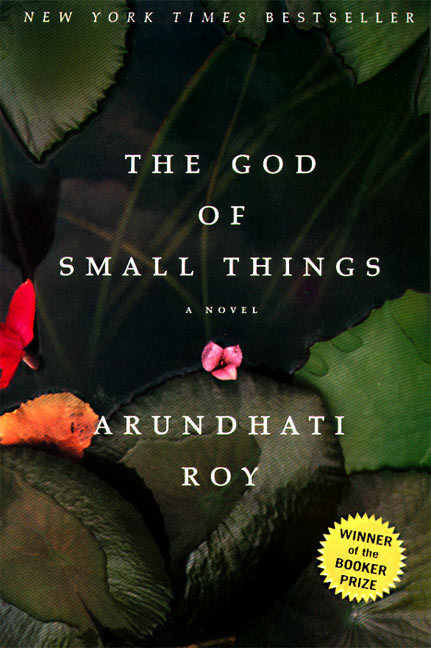
The God of Small Things
- Arundhati Roy


The God of Small Things is written by Indian activist Arundhati Roy. Roy, who won the 1998 Man Booker Prize for Fiction for this novel, is a strong critic of neo-imperialism and advocates for a number of environmental and anti-globalisation causes. The God of Small Things is listed on BBCs "The Big Read," a collection of 100 books that listeners of the BBC feel that everyone should read. According to Wikipedia, "It is a story about the childhood experiences of fraternal twins whose lives are destroyed by the "Love Laws" that lay down "who should be loved, and how."


Silas’ Choices:


The Darker Side of Western Modernity: Global Futures, Decolonial Options – Walter Mignolo


Greg and I came across this writer in Al Jazeera’s opinion pieces. He wrote a piece on non-western modes of thought, which was a very insightful piece on checking one’s ethnocentrism, privilege, and more specifically one’s epistemic (how you know what you know) context. As two white privileged Canadians compiling a series of books to read, what could be better than reading a book that looks into the future in non-western ways? The book itself critiques colonial logic, which has dominated the globe via modern project. That mono view of the world is fading as we have entered the 21st century, and this book examines some of the other ways of being and knowing that are challenging the western norm.


Living in The End Times - Slavoj Žižek


Leftist, Materialist, Atheist, Christian? Few people gain cultural prominence as philosophers, Žižek has
managed to do so. Yet it is not without controversy. Zizek has an almost cult like following, and on the other side people scoff when they say his name. This blog has linked, used, and alluded to some Žižek work with an occasional Youtube link. But there comes a time to move beyond Youtube; as such, it is time to read some of his work.

Living in the End Times is an examination of the global capitalist system. Žižek argues this system is nearing its nadir due to the ecological crisis, biogenetics, imbalances within the system, and social divisions (Amazon). As a cultural critic, he uses cultural references to make his point. The title can be read as an allusion to The End of History by Francis Fukuyama, who wrote about capitalism, democracy, and the nation state as the logical end of history that would eventually win out (1992). Twenty years later, I for one am a skeptic, and so is Slavoj.


The Weakness of God – John Caputo


For those who want to get their theology-nerd on! Caputo is a deconstructive philosopher influenced by Derrida, a Catholic, and pre-eminent scholar. How is that for a mix?! I have been looking forward to reading this for some time. I enjoy dabbling in pacifism, post-modernity, and theological liberalism. I anticipate these themes to collide within this work. In framing God as event, Caputo is able to re-conceptualize what/who/how of God. This may be a difficult read, but I figure that is why we are reading as a group!


THE CHALLENGE


Our goal: Two weeks per book. Finishing the first book by May 1st. This is an intense time-frame, we know that. For those quick at math you might be wondering, “Hey, six books, at two weeks per book, that only equals 3 months! Is summer not 4 months long?” And you would be correct in that calculation. But life happens! We might not make it through all our books in the time-frame we have set as our goal, which is why we give ourselves some wiggle room. If we do manage to keep to our time-frame, we may add two more books (there are plenty of books we had to cut for this reading list!) So if you are up to the challenge, start acquiring copies of these books, and get your read on!


Join Us For ONE Read


We also know that you are busy people, and you have reading lists of your own. So if you want to read just ONE of the books we have listed that would be GREAT. Join us and comment on the blog when we get to it! It will be super awesome.


The reading order:


The Kingdom Of God Is Within You - Leo Tolstoy
Post-Scarcity Anarchism - Murray Bookchin
Living in The End Times - Slavoj Žižek
The Darker Side of Western Modernity: Global Futures, Decolonial Options – Walter Mignolo
The God of Small Things - Arundhati Roy
The Weakness of God – John Caputo

Friday, March 29, 2013

Change Doesn't Just Happen Over-night...

Change doesn't just happen overnight, it happens both over-night and during the day. Change happens whenever people live it, not when we observe it.

The following is a piece I wrote for one of my classes this semester that attempts to capture this sentiment. It includes both a spoken word piece and a short explanation of the piece. Hope you enjoy!


Anyone who has been to an Occupy general assembly knows the true rate of change – slower than turtle slow. Yet, when one removes themselves from the frustration of this time consuming process, they are struck by the essence of the moment. In front of the individual is a group of people who are more than willing to suffer through the monotonous motions of consensus while actively participating in a demonstration of inspirational social change. Here, it is the moment that is of utmost importance, for it is in this moment that change occurs. A conversation is started that had been previously hushed, someone is made aware of an important issue, and individuals and groups are transformed into something new. Even if the process appears to be slow and arduous, change is happening and should not just be criticized (although it is important to be critical). Instead, it should be celebrated and affirmed.

I wrote this particular piece after a conversation with my roommate about the Idle No More movement. Specifically, we were discussing the perceived fractured and ambiguous nature of Idle No More. People are often quick to criticize the movement while denying it any credibility because members within the movement often disagree with each other. Furthermore, people complain that the movement’s goals are unclear and that their cause would be strengthened with a list of specific demands. Similar arguments have been made about other recent movements such as the Occupy movement. However, I believe that these movements represent a new kind of social movement. These movements are comprised of decentralized individuals who are committed to the idea of social change. Although these individuals may disagree with one another at times, they are all dedicated to seeing the end of oppression, domination, and suppression. These people refuse to wait for change to happen and instead live their lives with the idea that change is happening through them.

Poetry and spoken word are powerful tools for social movements and activism. Sarah Browning writes, “Poetry and other art forms can combat despair, inspire those working in the trenches of social change movements, humanize those we are taught to fear, and build bridges across our differences, telling our human stories” (see below for citation). In his lecture on poetry and activism given on January 22, 2013 to a SJS 200 class, Bud Hall talked about the seemingly magical moment when poetry is read aloud, allowing a transference of ideas from one to another in a way that often mystifies and astounds us. Poetry and spoken word go beyond communicating simple concepts, having the ability to communicate emotion and feeling. For example, Bud Hall read aloud a poem that addressed the criticism of Occupy’s lack of concrete demands. The poem itself listed many varying demands that were both personal to the author and universal to the movement. Instead of presenting a clear list of demands however, the poem was able to communicate the complexity of the movement while reasserting its credibility. I hope that my piece might serve a similar role for social movements such as Occupy and Idle No More. I hope to demonstrate these movements’ complexity and often-contradictory nature while reestablishing faith and hope in the change they bring.


Friday, November 30, 2012

My 2012 According to Instagram

Silas, Kelsey, Danielle and Amy all chilling on a really old bridge.
So it's that time of year when nobody has time to write blog posts because we're writing papers, studying for exams, getting ready for the holidays, out skiing, doing whatever it is that prevents us from blogging. My excuse, anything school related.

But no more excuses.

It also happens to be that time of year when all your favorite blogs prove how hip they are by posting things that were culturally relevant to the year just had. And because I'm sick of doing homework, I thought I would post something fun that is definitely culturally relevant to 2012 - Instagram. I understand that Instagram isn't a 2012 thing, (I've been using Instagram since October 2011, and I was late on the scene) but I would argue that 2012 is the year that it really caught on. For those of you who don't know what Instagram is, go to your neighborhood hipster hangout, wait for them to order their food and then observe the amount of iPhones being used to take pictures. This pictures will be edited to make their food look like vintage food, and then shared on the world wide web. Today Instagram is used for everything... literally everything. From maintaining hipster cred, to photojournalism.
Yep, I'm guilty of it too. But in all fairness, I make EXCELLENT perogies. Ask Silas
So without further ado, I present to you 20 (additional) Instagram photos that not only characterize important and fun moments of my 2012, but also out me as a total nerd hipster with no hopes of hiding it.

Pancake Tuesday is not a new thing, but a delicious thing. This years highlight was the banana-rum-chocolate-chip pancakes.

Adventure Time, also not a 2012 thing. That being said, it's the year I really got into it. Haven't watched it yet? You should!

Although started in 2011, the majority of the work done on my tattoo was done in 2012. If your on the lower mainland, check out Caleb's work at Capstone Tattoo.

Every Easter, I go on a hiking trip with a bunch of lovely folks. This year we hiked along the Olympic Peninsula in Washington.

This summer was characterized by many afternoons spent at Trout Lake where we would do all sorts of things the East Van hippies do, like hula-hoop, slack-line, play instruments, and sneakily drink beers in public. Don't tell anyone.

This album will end up on my "Best Albums of 2012" list. Listen to Zammuto.

My Vancouver roommates got me really into gaming this year. Small World is by far one of the most fun and dynamic games I have ever played.

This is on our way to Bowen Island to do some hiking. BC Ferries has become a huge part of my life ever since I moved to Victoria. I'm always blown away by the natural beauty that accompanies these trips.

Tash turned 20. If you know Tash, you know this is a big deal.

I used to live in this place called the Matador. It's a magical place that more resembles a community center than a place where people live (then again, I like the idea of living in community centers). Needless to say, we were horrible at cutting the lawn and the city threatened to fine us $4000 for having grass over 3 feet tall. We caved and bought a lawn mower. I was so proud, I had to Instagram it.

2012 is the year I that I tried my hand at modeling. The straightened my hair beyond what I thought was naturally possible. The show was the launch of my friends' company that fixes and recycles used clothing. Check out Rise Upcycling.

2012 is the year that Creemore Springs started showing up in Vancouver. It's a beer from home (middle of nowhere Ontario) and definitely worth checking out.

I threw a big ole Party at the Matador called Summer Fest at the Matador. We had over 20 bands play from 1am-1pm... and zero cops. I'm a big fan of DIY, and Jamison Troy who is pictured here making sweet sweet tunes.

This summer, I was invited to play with the kids band Go Go Bonkers at the festival Arts Wells. The festival takes place in the secluded town of Wells BC where the entire town is taken over for the weekend by music and art.  This is the coolest folk festival around and one of my highlights for the summer.

2012 was the year for forts. Here's one we made in our back yard.

Some friends and I drank some "mind enhancer" tea and then proceeded to find a news paper from the 1940s hidden between the walls of the house. The result was having our "enhanced minds" blown.

I built a bike! Not much to say about that other than I'm super proud of myself.

In September, I put all of my things in the back of my friends truck and moved to Victoria to finish my undergrad. Here is all my stuff, literally.

Then I was in Victoria, which happens to be quite the beautiful place!

This picture is from a massive demonstration against the proposed pipelines that would carry diluted bitumen to our coast. Read what I have to say about it here.
And there you have my year in Instagram pictures. I hope to have more 2012 lists for you soon!

Sunday, October 28, 2012

My Problem with Penal Substitutionary Atonement and How it Relates to Politics.

The following is a response to a piece written by a very eloquent and insightful friend. Garret Menges recently wrote a piece examining the theological concept of penal subtitutionary atonement and the underlying truths it covers up. The piece - entitled "The Power of Myth" - examines the obsession our society has created around the ideas of scapegoat and sacrifice. Garret points to a cultural invention that attempts to solve the inter-communal conflicts that have threatened our existence. When peace is threatened within a community, that community will attempt to find a scape goat, blame all of their problems, sins, illnesses, etc on that individual and sacrifice that individual in order to restore peace. Garret sums it up the following way:
Perceived threat to the community –> Innocent victim is chosen and accused of crimes related to the taboos of the community –> Victim is sacrificed –> Myth is told in order to validate the sacred violence –> Peace is restored to the community for a time –> Repeat
Garret points to the obvious connection between this repeated tradition and the popular Crucifixion story. In much the same way, Christ was chosen as our scapegoat and sacrificed on the cross. Because of this, our sins have been absolved and we may carry on with our lives with a new sense of inner peace and sanctity. This theological concept is known as penal substitutionary atonement (PSA).

Although PSA remains as the dominant theological doctrine within the modern church, it is beginning to see it's share of criticism. Garret takes issue with PSA because it disguises the fact that we are responsible for the murder of a sinless being.
This myth has glorified the violence of the cross to the point that we have forgotten what lies behind it: our participation in the senseless killing of an innocent man.
Not only do I agree with Garret, but I would argue that PSA is a continuation of our flawed and dangerous perception of human nature. PSA argues that violence is needed in order to preserve peace among human beings. It assumes that human beings are inherently at war with each other and will constantly be violent towards one another unless we have an external source to focus our violent energy upon.

This "scapegoat myth" is also why I have a problem with the way in which we exercise modern politics. Thomas Hobbes argued that if humans were left with complete freedom and autonomy, we would constantly fight with each other in a natural state of war. This state of war is a direct result of the combination of our unlimited self interest mixed with a scarcity of resources. Hobbes solution was to create the sovereign - the ultimate authority on the use of legitimate violence. The idea is that we subject ourselves to the laws of the sovereign in fear of its threat of violence in order to establish peace amongst ourselves.

However, I take issue with the idea of the sovereign for a number of reasons. First of all, the sovereign must rely on law, which is based on the idea of universal truths, a concept that is infinitely impossible. Although he would not have been able to even perceive the concept of nation states as we experience them today, Hobbes attempted to solve the problem of universality by drawing boundaries on the power of the sovereign. In this way, laws only need to apply to those within the sovereigns boundaries. Still, I argue that this kind of thinking only solidifies our "us and them" perception on our fellow human beings across the world. It focuses our attention on the perceived differences of each other in an exclusionary way as opposed to way of inclusion and empathy. Furthermore, I take issue with the sovereign's use (and often abuse) of violence, either threatened or actuated. When someone breaks a law, it is the responsibility of the sovereign to punish and make an example out of that individual as opposed to exploring the reasons and motivations behind that individuals crime and addressing them. In other words, the sovereign, through the use of coercion and violence, uses a "band-aid" solution in order to create short term peace - I find that dangerous, lazy, short-sighted, and only serves to promote an unhealthy perception of each other.

So what is my solution? Of course there is no easy answer to this question, although I believe it lies in a closer examination of the perception of human nature that both PSA and the model of sovereign politics builds their theories upon. That is, we believe that we are inherently competitive and self interested individuals who would rather be violent towards one another than cooperate with one another. It is fairly obvious that we make significant advances when we co-operate with each other. I could use a number of examples to prove my point; ranging from family life, to teams working on the next technological advance, to our cooperation with one another in times of extreme crises. However, I think the best example is found within the conception of human, a truly cooperative effort that has kept our species in existence for so long. In this way, we have evolved into social beings who constantly need to be connected with one another, whether that's through friendship and family, or through the social networking sites of our age. We have too much empathy built into our system to be in a constant state of war. The only way we are able to harm another human being is if we blind ourselves from their common humanity and block our empathic neurons.

My biggest problem with PSA and the sovereign model of politics is that it further perpetuates the myth that we are inherently violent creatures and that we will constantly be at war with each other. Instead, I prefer to view our violent tendencies a form of illness that have corrupted our human nature. One central thing we forget when we talk about the story of Jesus is that he is not dead. This tiny detail has huge implications when we examine his life. Jesus taught us to love one another, to recognize the common humanity within us all, and to cut out the violence towards one another. This message was so threatening to our traditional and comfortable way of thinking that we put him to death. However, Jesus resurrection demonstrated that his message cannot be extinguished even by death. Jesus took away the power of violence and coercion and replaced it with one of mutual cooperation and love.

Thursday, October 11, 2012

What I'm Learning About Learning

I'm back at school! (More on that later)

As the first few weeks have rolled by, there has been a common theme running through the majority of my classes. Most of my profs having been talking about the ideas and problems centered around the academic world. I'd like propose a few questions that keep popping up in my readings and lectures, questions which have really started to get me thinking about the other side of the picture. They are presented here with a large degree of simplification, but my hope is that they get us thinking and talking about how academia is practiced.

Question 1: What is education for?

All throughout my life, I have been going to school to learn new things; new facts, new ideas, new theories, new ways of getting things accomplished, etc. This seems fairly self evident - that is until you ask the question, "for what reason am I learning?" So often we assume (or at least I do) that we learn so that we can contribute to our ever evolving story on this planet. A medical sciences student goes to school to learn how the body works so that she may learn how to help others when they are sick. An engineering student goes to school to learn how design buildings that we may some day live in. A history student learns how to categorize our past experiences so that she may continue developing the story that we come to understand ourselves by. The political science student learns theories of governing ourselves so that we may design a better system that works for us all. Essentially, we participate in academia in order to better the world.

David Orr - a professor of political ecology at Oberlin College - questions this romanticized view on academia in his book, Earth in Mind: On Education, Environment, and the Human Prospect by pointing out that it is people with their undergraduate degrees, Master's certifications, and Doctorates who are responsible for an economic system that degrades and exploits the environment. He even goes as far as to use Ellie Wiesel's analysis of those individuals responsible for the atrocities of the holocaust saying that they "were the heirs of Kant and Goethe, widely thought to be the best educated people on the planet" (Orr, 7). What is it about these individuals education that lead them to neglect moral judgement? Was something missing? Do ethics, morality and character building have a place within the academic world? What about action? Does education need to lead us to a place

Question 2: Who's knowledge?

The question implies two notions that, in my opinion, are often overlooked.  The first is that knowledge is a created thing. This idea has been around for a while but it's been most exemplified in my study of Hobbes' Leviathan. Hobbes spends the first few chapters of Leviathan explaining how our senses inform us of our surroundings and help us form an awareness of them. That is to say, our experiences shape our understanding and knowledge. Alongside with this is the obvious notion that we all have different experiences and therefore have different knowledges. My understanding is quite different than yours and collectively - assuming that we have both grown up in the same culture - our knowledge is quite different than someone's from say India. The question then becomes, who's knowledge do we present in University? Which knowledge gets privileged and why? 

I believe in the power of intersectionality. That is, the power of recognizing where two different knowledges intersect. I believe that where these intersects happen, a connection is made and a great deal is learned. Is it the academic world's responsibility to facilitate intersectional dialogue? If so, how do we open the classroom up to knowledges that are not the same as the professor's? What power dynamics are in the way when promoting intersectionality?

Question 3: Who get's to participate? 

Time and time again, I am reminded of how lucky I am to be here. There are many barriers to education, both seen and unseen. Although, I've struggled with the money issue, I've been lucky enough to have a government service provide me with the funding necessary to go to school, as long as I pay it back when I'm done. But what about those who can't? What about those where government funding is just not enough?

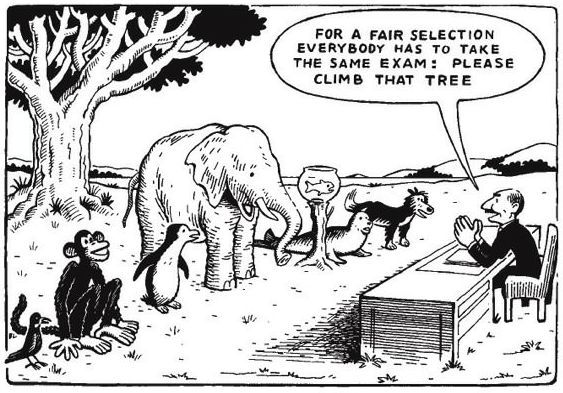
It's also important to examine the question of who excels in the academic world and why. I stumbled across a great meme that asks the same question. 
We're not all designed the same way and I think that our education ignores that, thus inhibiting the participation of others. We recently heard from both Kelsey and Danielle about the benefits and joys of learning beyond the classroom. Does the academic world make room for different types of learning? Is it emphasized enough or is it just payed simple lip service with the inclusion of a practicum class here and there?

As I stated in the beginning of this post, these questions are limited and quite simplified. These are questions that I hope I can explore throughout the rest of my academic career. I hope to encourage discussion and thought about the ways in which we approach academia and I hope to expose some of the power dynamics behind the institution. 

Thoughts?
 

Monday, September 10, 2012

The Human Impact

I want to talk about something that does not get near enough discussion in Canada. Sure, the Tar Sands (Oil Sands if you're on the other side of the debate) is a hot topic issue, but discussion is limited to issues surrounding politics, economy and the environment. Instead, I would like to talk about the direct human impact that the Tar Sands have had.

Not many people know that in April 2011, Alberta experienced one of it's largest oil spills when the Rainbow Pipeline burst and spilled nearly 28000 barrels of oil into the boreal forest. For those of you who don't know, 28000 barrels is the equivalent of 4.45 million liters of oil. The spill happened close to the community of Little Buffalo, home of the Lubicon Cree. The spill not only shut down their public school after children started getting sick, the spill contaminated their water supply and now the people of little buffalo have little access to safe and clean drinking water. May I remind you that this is in Canada.

Greenpeace recently teamed up with Melina Laboucan-Massimo, a young activist from the Lubicon Cree community who grew up in Little Buffalo, to create a photo essay describing the human impact that the tar sands have. I encourage you to watch the video and ask the question, why is the human impact not talked about in Canada? Why is it that we only hear about how the tar sands will strengthen our economy and bring jobs to northern Alberta?