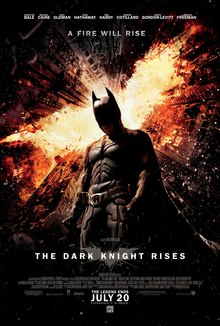
I recently watched the new Batman movie and the final instalment in Christopher Nolan's trilogy. To be fair I was reasonably entertained through the 164 minutes... However, the more I have thought about the movie and the trilogy the more disappointed I am. First of all, I was not expecting the fairy tale ending that the final instalment delivers. Each storyline wraps up neatly and everyone is happy even the villain... While this feel good ending felt good as I watched it, I left the the theatre with a bad aftertaste in my mouth -very much like Inception where you want to believe something is real but you just don't quite buy it....

Lets just check in with everyone:
Batman - saves the day but dies.
Bruce Wayne - saved the day, got the girl, immortalized Batman and both dies and doesn't die...
Commissioner Gordon - also saved the day.
Selina Kyle - saves Batman, wipes her record, vacations with Bruce.
Alfred - Has a glass of sherry and sees Bruce has found a "life"
Miranda Tate- Dies. But dies believing she succeeded in destroying Gotham.
Bane - Dies. Ok not quite everyone is happy.
Let me recap the basic plot of the trilogy:
Batman Begins:
"Its what you do that defines you."
"as a symbol I can be incorruptible. I can be everlasting"
- Bruce Wayne's parents are killed.
- Bruce wants vengeance.
- Rachel is disgusted.
- Bruce leaves Gotham.
- Bruce in trained by the League of Shadows.
- The League of Shadows wants to destroy Gotham.
- Bruce burns the League temple and tries/thinks he has killed Ra's al Ghul.
- Bruce returns to Gotham.
- Bruce becomes Batman with the help of Lucius Fox.
- Batman saves Rachel.
- Batman thwarts a plot to infect Gotham's water supply.
- Ra's al Ghul shows up with a plan to vaporize Gotham's water.
- The League of Shadows burns down Wayne Manor.
- Batman saves Rachel.
- Batman defeats Ra's el Ghul.
- Batman saves the city.
- Batman is a hero.
- Bruce loses Rachel.
The Dark Knight:
"You either die a hero or live long enough to see yourself become the villain"
"Madness... is like gravity"
"Nobody panics when things go according to plan. Even when the plan is horrifying."
"Sometimes the truth isn't good enough."
- Gotham gets tough on organized crime.
- Joker offers to kill Batman.
- Joker begins a terror campaign to discover Batman's identity.
- Harvey Dent claims to be Batman.
- Harvey and Rachel are kidnapped.
- Batman accidentally rescues Harvey and Rachel dies.
- Harvey becomes Two Face.
- Gotham Citizens refuse to kill each other to save themselves.
- Batman defeats Joker.
- Batman defeats Two Face.
- Batman is blamed for Harvey's death.
- Rachel was engaged to Harvey.
The Dark Knight Rises:
"Maybe its time we stopped avoiding the truth and let it have its day."
"Hope is really the key to torture"
"The fear will find you"
- Bruce/Batman are in hiding/isolation.
- Bane has taken over the League of Shadow and is doing construction under the city.
- Bruce bankrupted and loses control of Wayne enterprises.
- Bruce gives Wayne Enterprises to Miranda Tate.
- Bruce has sex with Miranda.
- Selina Kyle leads Batman to Bane/gives Batman to Bane.
- Bane defeats Batman breaking his back.
- Batman/Bruce imprisoned.
- Bane takes over Gotham.
- Batman/Bruce escapes.
- Batman is stabbed by Miranda Tate, Ra's el Ghul's daughter.
- Selina saves Batman and kills Bane.
- Miranda Tate is killed in car crash.
- Batman saves Gotham by flying the reactor out into the bay but dies.
- Bruce is 'buried'.
- Alfred sees Bruce and Selina in Italy.
One of the things that was quite enjoyable in the first two movies was Christopher Nolan's commitment to realism/plausibility. This seemed to drop off significantly in the last movie, especially in the whole prison sequence. It also, I think, shows up in the plot. While in the first two movies when Bruce "wins" there is always a cost, a personal and painful cost, that calls Batman into question. However, in the final movie the cost of victory is "exile," the death of "Batman," the fake death of Bruce, (which also doesn't make sense/wasn't necessary, since it was Batman and not Bruce that died) BUT the whole movie has been spent setting up this move to be viewed positively. To end the tale of vigilante justice so cleanly is both disappointing and inconsistent to the trilogy. The real death of Bruce/Batman would have been far preferable and consistent. Perhaps Nolan was pressured by the studio???
In the first two films I was alway able to suspend my disbelief regarding Gotham. Perhaps someone could clarify this for me but I always imagined Gotham as kind of an "every city" and that while perhaps implicitly was located in the USA that it was never explicitly located in the USA. Anyway, that may be my mistake being not super familiar with the comics. Either way, I found saturation of America and New York to be overwhelming. Perhaps because I have been to New York since the second film came out I was more aware as I was watching this one... But I think that Nolan was significantly more brazen/patriotic in his use of iconic daytime New York shots. I found this to be distracting both visually and contextually.
One of the interesting themes that is explored in the trilogy is order vs chaos. The Joker in the second film describes himself as an agent of chaos. The police and politicians like Harvey Dent of course represent order. Batman/Bruce Wayne is and interesting and complicated combination, scarred by violence, trained by the League of Shadows, Batman beats chaos at its own game/defends order with the power of chaos, all the while with evangelical self righteousness regarding his refusal to use guns. One of the questions in the midst of these struggles is the nature of humanity. Especially in the second film the Joker is continually placing Gotham's citizens on trial. Will they make the moral decision or will they destroy each other to save themselves? Is life sacred? What is most fascinating and terrifying in the second film is, as pointed out by Slajov Zizek, that the conclusion suggests that lies are required to maintain order and for the good of society.
This was something I had on my mind as I watched Dark Knight Rises and was initially encouraged to see the lie, while perhaps to a certain degree effective was eating away at Gordon, had destroyed Bruce, and failed to created any lasting peace or order. Alfred's words, "Maybe its time we stopped avoiding the truth and let it have its day," were particularly poignant. Officer Blake's rebuke of commissioner Gordon was initially also a strong statement. However, any reconsidering or successful undermining of the idea of the necessary lie was demolished by the ending of the movie. The "non-working" autopilot which required the noble sacrifice and would mean that Bruce would have given everything to Gotham, turned out to be a fiction, which Bruce keeps a secret and in the most spectacular crisis imaginable, immanent nuclear explosion... he still keeps it a secret and then unfolds an impressively complex fake my own death plot, which has Alfred in tears. So regardless of how believable this sequence is (its not), it maintains the premise put forward by the second film that society needs a lie it can believe in for its own good. In the second film this was Harvey Dent in the final film it becomes Batman, as we see statue unveiled.
I also found myself more aware of Bruce's entanglement with the American military industrial complex. Wayne enterprises is built on military development and contracts. So while Bruce can get all upset about organized crime, Bane's reply to his breaking into the stock exchange and being told their was no money for him to take, "Then what are all you people doing here," was a great piece of critique. There was very clearly a rich vs. poor dynamic that was played out in the last film. Selina Kyle's character is interesting in that she repeatedly switches sides and indicates that her criminal activity is morally superior to the games played by super rich and corporations. All this put together makes it difficult for me see Bruce as a moral human being rather than an angry, super rich, defender of the status quo and thus his own fortune and privilege. The capitalist narrative of trickle down economic appears to be explicitly perpetuated in the film as Fox explains the boys home no longer receives support since Wayne Enterprises supports it out of profit and is no long turning one. The donation of Wayne Manor to be used as a boys home for orphans, further affirms the story's encouragement of the viewer to trust in our benevolent super rich overlords, who while getting rich by the blood of our children at war will ensure that orphans have homes so that we can raise up another generation to fight wars and thus make more money...
Others have commented on similar themes and echoes of the Occupy Movement, which, if accurate, is clearly vilified in this film as either actually anarcho-terrorists bent on total destruction or at least secretly motivated and organized by atomic levels of intended destruction. The message is clear: do not oppose the current system or in so doing you will aide terrorists and annihilate yourselves and everyone else. While I suppose I am not surprised to find these perspectives in the film, they remain, however, ultimately disappointing.
Batman presents us with our own world and we should be horrified. A world in which corruption is rampant, and the system has failed. However, we are told that "the system/city" is above all else to be defended, despite its massive flaws. The status quo must be maintained by whatever violence is necessary and whatever lies are necessary because there are only two options "the system/city" or "'total destruction" and we "must" choose life and submit to authority and wealth, which will maintain order... Obviously, I disagree with this and find its presentation disturbing.
Anyway, those are some of my thoughts. How about everyone else? Did you like it? Am I being overly sensitive? Are there other nuances I am missing?