Showing posts with label movies. Show all posts

Tuesday, August 21, 2012

Batman : Truth and Lies

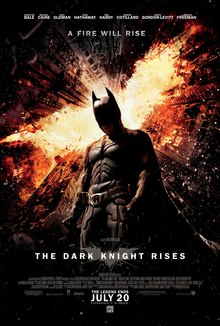
I recently watched the new Batman movie and the final instalment in Christopher Nolan's trilogy. To be fair I was reasonably entertained through the 164 minutes... However, the more I have thought about the movie and the trilogy the more disappointed I am. First of all, I was not expecting the fairy tale ending that the final instalment delivers. Each storyline wraps up neatly and everyone is happy even the villain... While this feel good ending felt good as I watched it, I left the the theatre with a bad aftertaste in my mouth -very much like Inception where you want to believe something is real but you just don't quite buy it....

Lets just check in with everyone:

Batman - saves the day but dies.
Bruce Wayne - saved the day, got the girl, immortalized Batman and both dies and doesn't die...
Commissioner Gordon - also saved the day.
Selina Kyle - saves Batman, wipes her record, vacations with Bruce.
Alfred - Has a glass of sherry and sees Bruce has found a "life"

Miranda Tate- Dies. But dies believing she succeeded in destroying Gotham.
Bane - Dies. Ok not quite everyone is happy.

Let me recap the basic plot of the trilogy:

Batman Begins:
"Its what you do that defines you."
"as a symbol I can be incorruptible. I can be everlasting"
  • Bruce Wayne's parents are killed. 
  • Bruce wants vengeance.
  • Rachel is disgusted.
  • Bruce leaves Gotham.
  • Bruce in trained by the League of Shadows.
  • The League of Shadows wants to destroy Gotham. 
  • Bruce burns the League temple and tries/thinks he has killed Ra's al Ghul. 
  • Bruce returns to Gotham.
  • Bruce becomes Batman with the help of Lucius Fox.
  • Batman saves Rachel.
  • Batman thwarts a plot to infect Gotham's water supply.
  • Ra's al Ghul shows up with a plan to vaporize Gotham's water.
  • The League of Shadows burns down Wayne Manor.
  • Batman saves Rachel. 
  • Batman defeats Ra's el Ghul.
  • Batman saves the city.
  • Batman is a hero.
  • Bruce loses Rachel. 
The Dark Knight:
"You either die a hero or live long enough to see yourself become the villain"
"Madness... is like gravity"
"Nobody panics when things go according to plan. Even when the plan is horrifying."
"Sometimes the truth isn't good enough."
  • Gotham gets tough on organized crime. 
  • Joker offers to kill Batman. 
  • Joker begins a terror campaign to discover Batman's identity.
  • Harvey Dent claims to be Batman.
  • Harvey and Rachel are kidnapped. 
  • Batman accidentally rescues Harvey and Rachel dies. 
  • Harvey becomes Two Face. 
  • Gotham Citizens refuse to kill each other to save themselves.
  • Batman defeats Joker.
  • Batman defeats Two Face.
  • Batman is blamed for Harvey's death.
  • Rachel was engaged to Harvey. 
The Dark Knight Rises:
"Maybe its time we stopped avoiding the truth and let it have its day."
"Hope is really the key to torture"
"The fear will find you"
  • Bruce/Batman are in hiding/isolation.
  • Bane has taken over the League of Shadow and is doing construction under the city.
  • Bruce bankrupted and loses control of Wayne enterprises.
  • Bruce gives Wayne Enterprises to Miranda Tate.
  • Bruce has sex with Miranda. 
  • Selina Kyle leads Batman to Bane/gives Batman to Bane.
  • Bane defeats Batman breaking his back.
  • Batman/Bruce imprisoned.
  • Bane takes over Gotham.
  • Batman/Bruce escapes. 
  • Batman is stabbed by Miranda Tate, Ra's el Ghul's daughter. 
  • Selina saves Batman and kills Bane.
  • Miranda Tate is killed in car crash. 
  • Batman saves Gotham by flying the reactor out into the bay but dies.
  • Bruce is 'buried'.
  • Alfred sees Bruce and Selina in Italy. 
One of the things that was quite enjoyable in the first two movies was Christopher Nolan's commitment to realism/plausibility. This seemed to drop off significantly in the last movie, especially in the whole prison sequence. It also, I think, shows up in the plot. While in the first two movies when Bruce "wins" there is always a cost, a personal and painful cost, that calls Batman into question. However, in the final movie the cost of victory is "exile," the death of "Batman," the fake death of Bruce, (which also doesn't make sense/wasn't necessary, since it was Batman and not Bruce that died) BUT the whole movie has been spent setting up this move to be viewed positively. To end the tale of vigilante justice so cleanly is both disappointing and inconsistent to the trilogy. The real death of Bruce/Batman would have been far preferable and consistent. Perhaps Nolan was pressured by the studio???

In the first two films I was alway able to suspend my disbelief regarding Gotham. Perhaps someone could clarify this for me but I always imagined Gotham as kind of an "every city" and that while perhaps implicitly was located in the USA that it was never explicitly located in the USA. Anyway, that may be my mistake being not super familiar with the comics. Either way, I found saturation of America and New York to be overwhelming. Perhaps because I have been to New York since the second film came out I was more aware as I was watching this one... But I think that Nolan was significantly more brazen/patriotic in his use of iconic daytime New York shots. I found this to be distracting both visually and contextually. 

One of the interesting themes that is explored in the trilogy is order vs chaos. The Joker in the second film describes himself as an agent of chaos. The police and politicians like Harvey Dent of course represent order. Batman/Bruce Wayne is and interesting and complicated combination, scarred by violence, trained by the League of Shadows, Batman beats chaos at its own game/defends order with the power of chaos, all the while with evangelical self righteousness regarding his refusal to use guns. One of the questions in the midst of these struggles is the nature of humanity. Especially in the second film the Joker is continually placing Gotham's citizens on trial. Will they make the moral decision or will they destroy each other to save themselves? Is life sacred? What is most fascinating and terrifying in the second film is, as pointed out by Slajov Zizek, that the conclusion suggests that lies are required to maintain order and for the good of society. 

This was something I had on my mind as I watched Dark Knight Rises and was initially encouraged to see the lie, while perhaps to a certain degree effective was eating away at Gordon, had destroyed Bruce, and failed to created any lasting peace or order. Alfred's words, "Maybe its time we stopped avoiding the truth and let it have its day," were particularly poignant. Officer Blake's rebuke of commissioner Gordon was initially also a strong statement. However, any reconsidering or successful undermining of the idea of the necessary lie was demolished by the ending of the movie. The "non-working" autopilot which required the noble sacrifice and would mean that Bruce would have given everything to Gotham, turned out to be a fiction, which Bruce keeps a secret and in the most spectacular crisis imaginable, immanent nuclear explosion... he still keeps it a secret and then unfolds an impressively complex fake my own death plot, which has Alfred in tears. So regardless of how believable this sequence is (its not), it maintains the premise put forward by the second film that society needs a lie it can believe in for its own good. In the second film this was Harvey Dent in the final film it becomes Batman, as we see statue unveiled. 

I also found myself more aware of Bruce's entanglement with the American military industrial complex. Wayne enterprises is built on military development and contracts. So while Bruce can get all upset about organized crime, Bane's reply to his breaking into the stock exchange and being told their was no money for him to take, "Then what are all you people doing here," was a great piece of critique. There was very clearly a rich vs. poor dynamic that was played out in the last film. Selina Kyle's character is interesting in that she repeatedly switches sides and indicates that her criminal activity is morally superior to the games played by super rich and corporations. All this put together makes it difficult for me see Bruce as a moral human being rather than an angry, super rich, defender of the status quo and thus his own fortune and privilege. The capitalist narrative of trickle down economic appears to be explicitly perpetuated in the film as Fox explains the boys home no longer receives support since Wayne Enterprises supports it out of profit and is no long turning one. The donation of Wayne Manor to be used as a boys home for orphans, further affirms the story's encouragement of the viewer to trust in our benevolent super rich overlords, who while getting rich by the blood of our children at war will ensure that orphans have homes so that we can raise up another generation to fight wars and thus make more money...

Others have commented on similar themes and echoes of the Occupy Movement, which, if accurate, is clearly vilified in this film as either actually anarcho-terrorists bent on total destruction or at least secretly motivated and organized by atomic levels of intended destruction. The message is clear: do not oppose the current system or in so doing you will aide terrorists and annihilate yourselves and everyone else. While I suppose I am not surprised to find these perspectives in the film, they remain, however, ultimately disappointing.

Batman presents us with our own world and we should be horrified. A world in which corruption is rampant, and the system has failed. However, we are told that "the system/city" is above all else to be defended, despite its massive flaws. The status quo must be maintained by whatever violence is necessary and whatever lies are necessary because there are only two options "the system/city" or "'total destruction" and we "must" choose life and submit to authority and wealth, which will maintain order... Obviously, I disagree with this and find its presentation disturbing.

Anyway, those are some of my thoughts. How about everyone else? Did you like it? Am I being overly sensitive? Are there other nuances I am missing? 

Sunday, January 22, 2012

A List of My Life

Rather than writing on this blog, I have been reading and discovering the wonder that is Netflix. Consequently, here is a list of things that are awesome/terrible/a waste of time/thought provoking/a general list of my life recently.

Nomad By Ayaan Hirsi Ali – A MUST read. You may recognize the name because I wrote about her memoir “Infidel” at the end of last summer. As an ex-Muslim, now a professing atheist, she writes a timely critique of multiculturalism, blind tolerance, and the undercurrents of our culture. If I were to summarize this book, it is her reflections on “why”. Why did her life turn out as it did, why could her father never leave Islam, why was her mother so angry, why are immigrants stuck in cycles of poverty and isolation, etc. Probably most interesting for readers of this blog is her call to the church, the Christian church, the moderate, non-liberal, and certainly non-fundamental church, to act as a necessary agent in settling and socializing Muslim immigrants. In addition, her rebuke of feminism is astonishing, as she claims the path feminism is now taking is effectively neutering its own cause, rendering it useless to promote its cause in other countries.

The New Testament and the People of God – N.T. Wright. I am just beginning, and I love it. Academic, sharp, challenging in terms of allusions to Greek literature and mythology, and postmodern (did I say that?). He certainly shies away from it, but his critical realism only truly makes sense for those who have dabbled in postmodern thought, because it certainly lacks the hard and fast linear rationalism of the enlightenment thinkers. So far, so good.

Underworld – movie. Still awesome years after it was made.

Love and Other Drugs – movie. Worthwhile. Anne Hathaway has had a little piece of my heart ever since “Rachel’s Getting Married” and in this film, there are segments that show the same calibre of acting. Moreover, it is a sappy love story, with unadulterated sex, disease (not what you think), and really F***ed up people who somehow come together and are messed up together.

Dexter – TV Show. Not that I need another series to watch, but Netflix draws me in. So far, intrigued.

Criminal Minds – Season 1 & 2. When I started dreaming about serial killers, I knew I needed a break. I have watched a lot of this show in the past, but never in order. It is better following the character development, because lets be serious crime shows are all the same.

How I Met Your Mother – This season has been awesome.

The Apocrypha – Still a must read. Spending time on my lunch breaks at work reading this has been a lot of fun. Tobit is just a good story, and Judith dominates on behalf of women. Lots of weird stuff, it helps me return to other literature, the Bible included, with a more critical eye.

Spy Game – Movie. Fun flick while it lasted, but completely non-memorable.

Skiing – yes please. A fantastic weekend last week up at the Deep Winter Photo Challenge in Whistler, watching my brother take home 3rd prize, and winning most banger shot of the entire show. The snow was also great, wind loaded slopes with up to knee-deep powder. Extra fun was had showing my older brother around the mountain, he flew out from Edmonton. Tonight I am driving back up to Whistler to chase the snowstorm and take some pictures with my brother tomorrow.

Thus concludes the whirlwind trip through my life of late.

Friday, January 13, 2012

Relationship Advice from Alfred Hitchcock - The Birds

This is the conclusion to this series:
Part 1 - Rear Window
Part 2 - Vertigo
Part 3 - The Birds

The movie The Birds (1963) presents, what in many ways is typical of a great Hitchcock film, a brilliant relationship study set against a backdrop of extraordinary, horrific, and deadly events. The film begins with Melanie Daniels in a pet shop. This starts with a short game of foiled deception with Mitch, centering on the topic of lovebirds and thus immediately suggesting the the subtext of a possible love relationship. During this encounter, they are held in frame together through a series of over-the-shoulder reverses that immediately begin to create a sense of connection. Finally, with the escape of a canary, which Mitch catches and then refers to as Melanie Daniels as he returns it to its cage, the relational subtext is fully confirmed. In the final verbal confrontation in this sequence, Mitch's shot also contains Melanie, signaling his desire and intent to catch her. The reverse of Melanie frames her alone, suggesting her freedom and authentic outrage at Mitch.

This defeat leads to Melanie attempting to pull one over on him by bringing him the two love birds he claimed he wanted. Thus, in the world of the film, their relationship is sealed. Melanie drives up to find Mitch in Bodega and tracks down Annie Hayworth to confirm Mitch's sister's name for whom the birds are for. Annie appears in a red sweater, already marked for death, and is helpful if perhaps aloof and judicious. Melanie enters into the Brenner house successfully, delivering the surprise love birds. This intrusion foreshadows the birds' later invasions of the house. Melanie escapes back across the bay and as she approaches the dock, and is greeted by Mitch, who has raced around the bay to meet her, a sea gull swoops down hitting her head. This is the first of the mysterious and terrifying bird attacks. While no direct explanation is given, at this point it appears to be a manifestation of Annie Hayworth's conscious or subconscious jealousy. The gift of the love bird, which is tantamount to a relational proposal, is an explicit intrusion and cannot be tolerated. However, it may be in response to the both physical and relational invasion of the Brenner house. Mitch then questions her presence and accuses her of liking him. She feigns to have disinterest and the pretext of having been old college friends with Annie and coming up for a visit with her. It is at this moment that Mitch's mother enters. Perhaps to increase the Oedipal tension, she looks strikingly like an older version of Melanie. The rest of the conversation that occurs with Mitch is framed with his mother and Melanie framed alone with occasional reverses to Mrs. Brenner, spelling out visually for the audience exactly what the relational dynamics are. The blocking of the scene before dinner with Mrs. Brenner on the telephone is also masterful. While Mitch and Melanie are able to share the background space briefly, when they finally settle into the room, Melanie sits on one the couch framed to the left of Mrs. Brenner and Mitch stands by the fireplace to the right. Mrs. Brenner stand talking on the telephone in the foreground as a wall between them. However, before the phone call is over, Mitch moves across the room again and, sitting down, is now framed with Melanie.

Mrs. Brenner is Mitch's domineering mother, a figure not uncommon to Hitchcock films. Most notably, Psycho (1960) alludes to this sort of figure, as well as Marnie and Notorious, both to a lesser degree. Slajov Zizek argues that the birds represent a foreign dimension that literally tears apart reality. In this sense, he suggests that they are manifestations of the the mother' raw, incestuous energy attempting to prevent the sexual relationship between her son and Melanie.1 It should be noted that throughout, Melanie is wearing a green skirt suit, highlighting her positively. In contrast, Mrs. Brenner's bedroom is that repeated yellow. This seems to signal the aggressive subtext of jealousy, mistrust, and aggression below the relatively benign conversation, which sends Melanie off to the school where she encounters a large group of crows, aptly named a murder of crows.

Within the film itself, it is suggested that the birds are a plague and a sign of the apocalypse. Furthermore, P. Adams Sitney has noted that the names Melanie (in Greek) and Daniels (in Hebrew) have the combined meaning “the blackness of God's judgment.” 2 The birds provide a terrifying sense of “The Other” ominously watching, often from above, referencing again the theme of voyeurism. Thus, the trademark high angle anxiety shot, which are used to spectacular effect in this film find their fulfillment in The Birds. Hitchcock's Catholicism obviously allows for the possibility for this to be interpreted as God. During the attack in the town, people identify the attacks as beginning with Melanie and thus accuse her effectively of being Jonah. However, Hitchcock has clearly taken pains to identify Melanie with the birds, beginning with the opening scene and including a reference to her breaking a window, which the birds then do in the movie. Thus we must understand the birds as generally manifesting in physical symbolism, the destruction of reality that Melanie represents for Mrs. Brenner as well as Mrs. Brenner's response. The echoes of Psycho support this dual representation, as the stuffed birds in Norman's office represent both his mother, whom he has killed and effectively stuffed, as well as the aptly named Miss Crane, whom he is about to kill and whom he compares to a bird. The final moments of horror in The Birds are those of Melanie again entering the mother's bedroom, only to find it filled with birds. What follows is best described as a crucifixion scene as Melanie receives innumerable wounds as well as the distinct emphasis on the piercing of her outstretched hand. She appears to die due to these attacks. However, Mitch and his mother rescue her and she is revived. Whether it is that God is satisfied with Melanie's sacrifice, or nearly the dead girl snaps the mother's super ego out of its jealous rage, Melanie is finally allowed to be integrated into the family as is noted by the shared hand squeeze with Mrs. Brenner, shown in a close cut in, before they all drive off to the hospital. Mrs. Brenner has come to accept that she is not going to be abandoned and embraces Melanie as a new daughter, being able also to be the mother that Melanie never had. As the new family escapes taking along the love birds that started it all, Mitch and Melanie's love and fidelity throughout the film is highlighted. Thus with relationships established and resolved, there is a happy ending that was not possible in Vertigo, or Psycho.

Hitchcock placed a great deal of priority on relational dynamics in his films. By examining his body of work, we see clearly that people cannot succeed or, at least not well, on their own. The trap of independence is one that men are particularly susceptible to as is clearly shown in Vertigo and also addressed in Rear Window. It is the strong, independent women such as Midge, Lisa, and Melanie that Hitchcock truly honours, perhaps because this is how he viewed his wife and the amazing partnership they shared in their work. Ultimately, it is the truth of these relationships that allow us to weather life's storms. Hitchcock reminds us that life is short and fleeting, with death lurking in every corner and on the end of every telephone call. However, it is precisely our insecurity which must energize us to commit deeply to that love relationship now, rather than waiting for the perfectly “compatible” person or for financial circumstances to create a false sense of security (a la Psycho). It is the outrageous grace of the love relationship in Spellbound (1945) that vindicates an innocent man and convicts the guilty. If only more characters were so faithful, perhaps less people would wind up in the awful predicaments they do. However, our voyeuristic appetites and creativity would be sadly disappointed by such a turn of events.

1Sophie Fiennes, The Pervert’s Guide to Cinema, Documentary, 2009.
2Kent Jones et al., The Hidden God, First Edition. (The Museum of Modern Art, New York, 2003), 249.

Thursday, January 12, 2012

Relationship Advice from Alfred Hitchcock - Vertigo

Again it is probably sensible to have watched at least Vertigo before reading this analysis...
Vertigo examines relationships in a much more complicated sense, both directly and indirectly, as seen in Rear Window. Also similarly to Rear Window, the protagonist, Scottie, is an injured man, whose cane suggests the subtext of impotence. He is introduced with the female counterpart, Midge, in the second scene. However, it becomes clear that despite the clear sexual potential and also history to the relationship, it is, at present, an arrangement of convenient companionship rather than faithful partnership. Hitchcock keeps the two framed separately for almost the entire scene, except for a brief moment when Scottie pokes a bra on Midge's desk with his cane – one that she is designing advertising for. Midge's desire for a relationship is made clear by her comment that there is only man for her, indicating Scottie. Midges distress regarding their relationship is highlighted in Hitchcock's typical high angle shot, indicating the anxiety of the person or situation, and cued by Scottie's comment, “We were engaged once. Weren't we?” This trademark high angle anxiety shot is found in Hitchcock's films as far back as The Lodger (1927). In fact, much of “Hitch”'s visual brilliance as well as his innovation was born out of the fact that his career was developed in the era of silent film making, forcing him to learn to tell the story primarily visually and value this ability of cinema. According to Hitchcock, this sense of visual cinema was mostly lost with advent of sound to, “photographs of people talking,” and effectively transformed cinema into theatre.1

Thus Vertigo begins with what ought to be a relationship but isn't spelling disastrous results from the very outset. Scottie becomes involved in an investigation regarding a college friend's wife, Madeleine, after rescuing her from San Francisco Bay in what appeared to be an attempted suicide. Hitchcock now show us in reverse the couple that ought not to be. Scottie sits on the couch in a green sweater framed by red curtains signaling a sense of stage. Green used here echoes the green used to highlight Madeleine in her debut at the restaurant. The fact that Scottie is now in green framed by the red curtains suggests both that this scene is the reverse of the other in that this is when Madeleine first sees Scottie. However, it also serves to indicate Madeleine's psychological possession of Scottie. Green is often used by Hitchcock as a colour to indicate something positive. It is with subtle reinforcement such as colour that the audience is aided in liking and identifying with Scottie and Madeleine as well as warned of their fate. The camera pans and dollies across the room revealing Madeliene's clothes hanging across Scottie's cane in the kitchen and Madeleine, now understood to be naked, through a doorway in a bed. Scottie gets up and walk toward the bedroom, stopping and staring at the woman across the threshold. A telephone call draws him into the room. Telephones are a common device used by Hitchcock across a number of his movies. The telephone represents, in a very real way, an intrusion into one's life or equally significant, a manner in which to intrude on others. In this way, the telephone is often used to underscore the insecurity of our lives, perhaps hinting at the fact that death could call at any time2.

Madeleine's bare shoulders further add eroticism into the situation as she hides herself under a yellow blanket. Yellow has only been seen significantly in Midge's apartment, thus there is the subtext of Madeleine being where Midge ought to be. Yellow is also usually an aggressive colour in Hitchcock films, as most clearly displayed in Marnie(1964). Mark Rutland, while on his and Marnie's honeymoon, clothed in a housecoat of an identical yellow, is frustrated by Marnie's pathological inability to consummate their marriage. He and Marnie, who is clothed in a green dressing gown, have a strained conversation in the front room after which he storms after her into the bedroom becoming verbally aggressive and tears her nightgown off, in the most sexually violent moment of the film, an act which he immediately regrets and apologizes for. Thus we should be alerted and concerned by the yellow colour of the blanket, which also confirms the violation already suggested by the drying clothes. Furthermore, when Madeleine enters the front room in a red dressing gown, it echos the red restaurant in which Scottie first saw her, highlighting the passion he feels for her but also marking her for death. Again, going back to Marnie  and her pathological fear of red because of its psychological connection to murder, is key here. Also the red carpet in Frenzy (1972), running down the stairwell of Rusk's apartment, is significant. It is seen just after he and Babs enter to, what the audience is certain via a dialogue cue, will be her doom. The slow camera moves away from the closed door and down the stairwell, highlighting the red carpet, suggesting a waterfall of blood, and serving to underline the audience's horrified awareness of the present rape and murder in a long string of rapes and murders that have taken place in the room above. Vertigo's use of colour remains consistent within this framework and thus Scottie's presentation of two yellow pillows for Madeleine should be understood to maintain the subtext regarding Midge as well as perhaps foreshadowing his responsibility for Madeleine's death. In the course of Vertigo we discover that Madeleine is not actually Madeleine but rather Judy, an aid in a deception so as to make the murder of the real Madeleine, by her husband, look like a suicide.

The death of Madeleine at the Mission, in spite of Scottie's futile attempt to cure her psychosis, plunges him into a catatonic state. It is in the hospital that we have one of the final moments for redemption slip away as Midge is unable to coax him out, acknowledges his ongoing love for Madeleine, and leaves the hospital. She is unable to save Scottie in the way that Lisa is able to save Jeffries in Rear Window. Her exit of the hospital marks her last appearance of the film. When he emerges from the hospital he is alone, a point consistently emphasized by the camera framing throughout the film. He blunders once again down the trail of his torrid affair with Madeleine only to discover Judy, in front of the flower shop, wearing a green outfit, matching that of the flower shop's cart and definitively drawing the connection between her and Madeleine.

Scottie discovers Judy by accident and is unaware of the truth and sets about recreating her into Madeleine. The final moment where their doom is sealed is Judy's renewed resolve to restart their relationship in reversed deception in order to make their love true, in contrast to her initial intention to reveal the truth. There is significant echoes between this process of transformation and that which occurs in Rebecca (1940) and Scottie's makeover of Judy – both explore the desire for transformative deception in a lover. In Rebecca, it is the perception that transformation is desired that is, in reality, false. Whereas, in Vertigo, the desire is real and instead it is the unanticipated truth of the deception which reveals its own horror. Furthermore, what in Rebecca is more or less dressing up, Vertigo reverses into a slow erotic undressing.3 The scene after Scottie and Judy first have dinner, when Scottie proposes another meeting as he drops her off in her apartment, demonstrates further Hitchcock's genius at being able to tell the story through image. The scene is lit in low key and Judy disappears into the shadows early in the scene. Scottie stands lit, proposing a 'non sexual' relationship to her dark, haunting silhouette, as he lusts with necrophilia for the ghost she reminds him of. She remains hidden in the shadows of her own secrecy and love for Scottie. She, Judy, loves Scottie, but Scottie loves the non-existent shadow called Madeleine, whom Judy pretended to be. This division of person is perfectly captured in the shot of Judy sitting looking out the window away from Scottie, her face cut perfectly in half by shadow. Scottie sees her only in shadow but longs for greenish lit side of her which evokes Madeleine. When, later, Judy exits from the green light fully reversed back into Madeleine she stands finally naked before Scottie for his necrophilliac fantasy.

The film concludes with the horrifying repetition of the earlier death scene. Scottie has once again transformed Judy into Madeleine and Madeleine will once again fall to her death, only this time Scottie, in the midst of the madness of his psychotic obsession, has become Gavin Elstor. Scottie, while not wanting to be alone and lamenting his availability in the opening scene, is also unable to admit dependance or need for a woman. Because of this, he is blind to Midge's consistent assistance, clarity and love, unable to stand her independence, he instead drowns in his own obsessive desire for the illusion of love, power, and control presented to him in Madeleine. An illusion, which when revealed, results in a fit of erotic rivalry4, ultimately causing Judy's death, albeit indirectly. Interestingly, this theme of illusion, deception and artifice, while worked out most often in relationships, has also a definitive reflexive nature that casts judgment on both the desire to and watching of films as well as the creation of them.

It is this exploration of the desire to be deceived that I continue to find most haunting. In what ways do I reject reality around me and pursue illusion and delusion toward my own and others destruction? In what ways do I construct those around me into false personae, related to my own neurosis? In what ways do I allow myself to be constructed by the neurotic fantasies of others?

1François Truffaut, Hitchcock, Rev. ed., 1st Touchstone ed. (New York: Simon & Schuster, 1985), 61.
2Dial M for Murder
3Truffaut, Hitchcock, 244.
4Jones et al., The Hidden God, 256.

Tuesday, January 10, 2012

Relationship Advice from Alfred Hitchcock - Rear Window

The following posts were taken from a film paper I wrote this past semester. Fortunately or unfortunately, you may find yourself needing to watch a bunch of Alfred Hitchcock movies... which I am suggesting will be not only enjoyable but good for you.


Part 1 - Rear Window
Part 2 - Vertigo
Part 3 - The Birds

Hitchcock specialized in high-anxiety thrillers and suspense-laden plots that strung the audience along on a tight rope. In the course of his oeuvre as a director, he developed a number of distinctive techniques, and explored a small number of particular themes repeatedly in his work. Crime, espionage and theatre are the common backdrops for Hitchcock to work out his thoughts on deception and artifice, both our propensity for it and its destructive power. Death lurks in every corner of the world according to Hitchcock and is unlikely to be avoided alone. It is this treatment of relationships, particularly sexual relationships, juxtaposed and intertwined into the plots, crimes and crisis of the various films, that universalize Hitchcock's films and provide perhaps his most poignant commentary on the human condition. 

Right from the beginning of his career, marital relationships were prominent in his work beginning with his first break finishing the two reeler Always Tell Your Wife (1923) and his full directorial debut The Pleasure Garden (1925). The themes of marriage, sex, infidelity and a murder, in particular of a spouse, are already present and will recur in numerous of his subsequent films. In fact, the murder of a spouse occurs, is attempted, or is otherwise referenced in a shocking number of Hitchcock's films. While perhaps contributing to the accusations of misogyny, this ultimate violent betrayals fits into Hitchcock's oeuvre on a number of fronts. Marriage, like all relationships, is open to deception and artifice. Furthermore, marriage is intended to be a life long loving and committed relationship, the epitome of safety and support. Thus it is not surprising at all that Hitchcock exposes us to the devastating violence and horror that is possible in our closest relationships - reminding us, as always, that we are never safe and secure. Three films which capture some of the breadth of Hitchcock's address of relationships are Rear Window (1954), Vertigo (1958) and The Birds (1963).

Rear Window is one film in which the setting is confined exclusively or primarily to a single location. James Stewart stars as L.B Jeffries along side Grace Kelly (his girfriend Lisa), as an impotant photographer confined to a wheelchair in his apartment due to a broken leg and reticence to get married. His impotence is most notably signified by the enormous and phallic lens on the camera he uses to spy on his neighbours. An impassioned speech made by Jeff's nurse, Stella, early in the movie presents the 'Hitchcockian' expectations regarding appropriate relational behaviour: When a man and a woman see each other and like each other, they ought to come together, wham!- like a couple of taxis on Broadway - and not sit around analyzing each other like two specimens in a bottle. Hitchcock's positive view of this statement can be seen in the positive outcomes of the relationships in his film that manage to follow this advice. The 39 Steps (1935) is a similar an example to Rear Window in a number of respects. Both films center around a relationship that has been added to the original story by Hitchcock. Furthermore, both films require the resolution of some initial relational conflict in order for the other external plotlines to resolve well. The lead male character would have been quite incapable of success without the assistance of his female partner. Grace Kelly makes this point explicit in the final scene of To Catch a Thief (1955) saying, “ Were you afraid to admit you just can't do everything by yourself? You needed the help of a good woman. You aren't the lone wolf you think you are.” To which Cary Grant responds affirmatively. In The 39 Steps, Hitchcock literally insists on the relationship, having the two handcuffed together and holding them in frame as a couple for three full scenes forcing them to learn to live together. Rebecca is a lovely example of this plot idea of a couple liking each other and then coming together and getting married rather quickly ultimately being a positive way to enter relationships. In contrast, the relational premise of Psycho is exactly the opposite.

Rear Window makes a full treatment on the topic of voyeurism, along with its relationship to film. Rather than handcuffs, it is Jeffries' broken leg which confines him to his apartment. He, however, transfers this sense of confinement onto his relationship with Lisa, which he suggests is incompatible with his adventuresome photography. Grace Kelly is treated with some of the most beautiful film ever created, brilliantly undermined by the foreboding shadow she casts over James Stewart as she leans in for a kiss. An axis jump to a slow motion shot of the kiss disorient and overwhelm the audience in such a way as to draw them into the kiss. The axis jump provides that element of surprise and spontaneity that is important in great kisses and romance. Holding the couple closely in frame, we are informed of the goodness of their intimacy regardless of Jeffries' earlier evaluation regarding their compatibility. The treatment of this kiss further underlines the importance of this relationship to a happy ending. Jeffries' final question, “Who are you?” breaks their intimacy and frames the relational question of the film. To the audience's relief, Lisa is not to be deterred by Jeffries' analysis regarding their compatibility. She returns as seductress and accomplice, entering into his current adventure even more deeply than he is able, becoming the subject of his voyeurism and successfully regaining his affection.

Even the neighbourhood, which becomes Jeffries' soap opera, is a study of relationships. There are the newlyweds who are continuously having sex, the ballet dancer being hounded by men, the suicidal Miss. Lonleyhearts, the childless couple with the dog, the man who murders his wife, and the musician. How does one move from the lustful, infatuated fidelity of the newlyweds to the unfaithful, murderous action of a criminal? Hitchcock's placement of these couples close together and in the apartment block around Jeffries highlight his own relational dilemma regarding marriage and both its potential joys and horror. I think it is important that he and Lisa address this horror together and conquer it, in a sense, despite it coming very close to killing both of them. They are however, ultimately, successful in their adventure and reinvested into their relationship.

The film successfully raises a number of unnerving questions below concrete realities of the plot such as, “Are you being watched?” but even more disconcerting for an audience is the implication also of being discovered as a voyeur and the potential consequences of what one sees. The film very distinctly reminds the audience that death and violence can invade your own backyard and even your home. We are safe only insofar as our relationships of love and trust are real. If, however, our marriage is filled with deception, as is the case in Notorious (1946), one is not unlikely to wind up murdered or dead, as in the film Rebecca (1940).

I found myself recently reflecting that Jeffries strong sense of calling and identity as a photographer, which prompts his hesitancy in relationship is distinctly reminiscent of Kierkegaard. Kierkegaard breaks off his engagement to a woman he loves, Regine Olsen, near the beginning of his career to pursue his sense of call. This decision, which may be celebrated as a tremendous self sacrifice for the sake of calling, he later reflects on in Fear and Trembling, where he celebrates most highly "the knight of faith," who is able to suspend the ethical by virtue of the absurd and thus both marry the princess and pursue his holy calling or at least somehow believe both to be possible despite full acknowledgement and resignation to their impossibility. Kierkegaard clearly presents this awesome picture of faith in contrast to his vision of himself as the "Knight of self resignation" who sacrifices himself for the greater good. Thus I suggest that Kierkegaard effectively presents great relationships must be characterized by faith, in that they must contain both resignation to the impossibility of their success and simultaneously belief in their possibility. This is the contradiction and paradox of faith. In Rear Window Jeffries is the "knight of infinite resignation" however Lisa is able to, after resignation, make the move of faith and thus the relationship, by virtue of faith succeeds. The dangerous possibility of entering or being in a relationship with neither self sacrificing resignation or faith yields results, both exceedingly common such as divorce or as depicted by Hitchcock in the film Dial M for Murder (1954), which centres around the murder of spouse. Thus by Hitchcock we are constantly reminded both of the danger of life and in particular relationships, while simultaneously being encouraged to be in them and having them presented to us as our only hope and the necessary path of salvation.