I openly state the irony of this post: I use the form of argumentation to discuss story. I apologize that I could not come up with a story that will articulate what I wanted to say.
My most basic defense of story is that it is innately human. Children go to bed to stories, youth interact telling stories, partners share the stories of their days after work. Many great teachers have taught through story; the Old Testament narratives, prophets telling the story of Israel, lived stories (Jeremiah and Hosea), Jesus’ parables, Paul/Peter preach the story of Jesus, Aesop tells fables, Tolkien, Lewis, Bunyan, Augustine’s life narrative. We are surrounded by stories, we are drawn into story. From sitting around the fire telling stories to the present movie industry, we communicate and interact via story. I am reminded of the stereotypical elderly woman about to watch the afternoon soap operas “it is time for my stories”. This has provoked me to look at my epistemology and attempt to shape it around story.
To begin I want to address Josh’s comment about “argument and rationality” used as a catch all for Christians wanting to “do away with” the modern era and its affects on us/theology/contemporary culture.
First, I want to affirm Duncan’s answer: the question ought not to be “rational” vs. “irrational”, but how are we to understand the relationship between the rational and the irrational. To explore this I look back to Socrates and Plato. Plato records Socrates in “The Republic” where he states the three parts of the soul are rationality, spirit and desire/appetite. (These divisions are imposed, therefore it is most likely an incomplete/limiting list, nevertheless we will work with these). Socrates states that it is reason’s role to keep spirit and desire in check; in essence, he sets up a hierarchy within the self. I, however, choose to reject hierarchy, and therefore am attempting to work toward a more balanced and holistic understanding of self, as well as how that self relates to the public world. My choice to reject hierarchy comes from my Christian convictions. I ponder: What if the self is modeled after the trinity? What if the self is a threefold oneness, maybe then I could relate to the world better. This rejection of hierarchy fits with a community hermeneutic, equality, and egalitarianism. Subsequently, I find it fitting to reject rationality’s role of keeping the rest of the human inline. Instead to attempt to view desire, spirit, and logic being in relation to one another, yielding and asserting, a give and take, a harmonious self.
One might respond to this with an argument in favour of the priority of logic, supporting it with John 1. The Logos of God is explored in this passage. Without becoming tied up in all of the argumentation (see Ladd’s “A Theology of the New Testament” for an overview), I will summarize it saying that the Logos/Logic is Part of God, but God/Christ is MORE than logic. Thus, one can absolutely affirm logic without it becoming hierarchical in its relation to other segments of life. I think it is fine to say that we need more than logic in how we relate to the world, and that this would be affirmed by the biblical text. (Here I do not address the idea the God’s logic is different then man’s, an idea I think Paul speaks to).
“I guess my question is where any sort of metaphysics fits into a narrative?”
I think narrative is the location to wrestle with appropriate syncretisation/integration of the metaphysical/historical portions, in the same way logic can be integrated into story. Hopefully, narrative can be more inclusive in its stance than methodologies that begin with logic/historic/or metaphysical approaches. Narrative, I attempted to show is inclusivity in its stance (Stories Pt. 2), whereas I find the others to be inherently exclusivist.
Regarding Josh’s pondering, “what gives story credence?” Here I think he answers his own question, “What is so special about compassion? Why should I accept it as some sort of criteria in a personal hermeneutic, other than it feels good to practice and also that I like having nice people around?” It is exactly those feelings and experiences that story frees us to validate. Whereas Socrates would have us use rationality to integrate or explain such feelings in order to justify their validity, narrative by its very nature cultivates these feelings and in-so-doing validates them. Yet, they are more difficult to communicate because we have limited ourselves to rational argumentation for so long that we find it difficult to express other aspects of life. What feels good? What type of people do you enjoy? These are valuable aspects of story; they are played on every time we go to the movies. The great majority of people support the protagonist, not because they are rationally told to do so, but because we allow ourselves to inhabit the story for a period. It is this inhabiting of the story that draws out our own desires and spirit and we syncretise ourselves into the story. Thus, we root for justice and the protagonist; we want things to turn out “right”.
A tangent: to illustrate rooting for what is right. If you have watched all the seasons of Sex and the City, one moment may stick out in your mind. Carrie Bradshaw, the first time she dates Aidan, cheats on him with Big. Watching it unfold is painful; the viewer cannot help but think she is making a huge mistake. The story unfolds and Carrie ends up telling Aidan and asking his forgiveness outside a church, it is Charlotte’s wedding. As one watches Carrie’s confession and desire to be forgiven, one hopes there will be restorative justice, one desires forgiveness and reconciliation. It is these emotions and desires that are ignored when reality is reduced into logic/argument/rationality. One knows that by the “rules” Carrie is in the wrong, but one hopes against the odds that Aidan will take the higher road. He does not and their relationship ends for a while.
“What does the resurrection have to do with story?... But how do we go as far as saying the story is more important than resurrection?” Resurrection IS a story! It is a powerful one at that. It can also be a TYPE of story that we tell.
(Please do not say I am using reductionist language when saying that the resurrection is story, I can just as easily flip it and say that to view the resurrection as history is to be reductionist! It depends on what one views as macro and guiding, which this whole series of posts has been about - an argument that story ought to be viewed as the macro and not the micro)
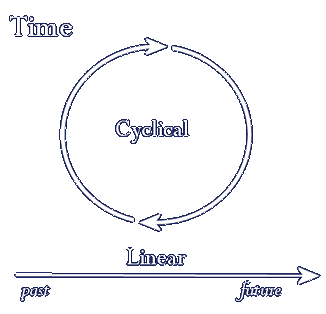
Resurrection is a powerful story, especially when it moves beyond the debate of historicity. When viewed typologically resurrection alters stories from linear to cyclical. A typical western story is from birth->life->death. When one considers resurrection, there is the potential to add the cyclical dimension of from death-> rebirth->life.
http://www.signsofthetimeshistory.com/graphics/time1.png
For more on the importance of cyclical stories watch Naomi Klein in her TED talk:
As Naomi argues, our culture is trapped in linear stories, ones with endless growth, where rationality never fails (but wait it has and does, welcome post-modernity). Despite her slight against Christianity, I think Christianity, specifically the resurrection, can assist us in telling cyclical stories. However, we must consider the larger story, to see that the resurrection story of death->life was not a one-off story (sure physical resurrection was a one-off event).
Viewing resurrection as a story, we look back at other stories and some of them, specifically in the Judeo-Christian tradition have always been resurrection stories. These stories participated in cycles, in-so-doing they invite the reader/hearer to participate in the story.
• Garden - Day and Night (life and death) -> kicked out of Garden AND clothed (offered a new beginning)
• Noah – death of the world and New life in the olive branch
• Joseph (See Joseph CYOA) – Death of a people in Egypt -> new life in exodus
• Cycles of death and resurrection in Judges
• Life and death of Davidic Kingdom -> Jesus pulls the people out of death, and offers himself as King (Israel’s tangible resurrection – Duncan’s “What is the Gospel Post”)
• Jesus resurrects in person (just in case we had missed the theme throughout the entire narrative!)
What I want to show is that the story of Resurrection can be understood as a cyclical story. It is not a one-off in the narrative of the Bible. We run into danger theologically when our theology or our stories become too linear (as Naomi Klein so aptly demonstrates). We ought to consider this snare when we view linear logic as the top of the hierarchy of our understanding, or when we are too trapped in a western-worldview, which at its root is linear.
When individuals choose to live a resurrection story one will find it everywhere. We die daily into sleep and rise again in the morning. The seasons of the year are deaths and resurrections. Life on the planet is consistently dying and being born. We are born into journeys of school, and career, only to graduate or move-on. These deaths are the end, but also new beginnings. Resurrection is all around.
Within Christianity Resurrection is found also in our symbols. Death in baptism and new life beyond the water. Death in the bread and wine of Communion and new life lived by the partaker.
So where does resurrection fit into story? I would argue all over the place. I think when one begins to think in story, to see in story, to be persuaded by story, one will be able engage the world more fully then through solely a rational lens.


