This week I have been dwelling on the feeling of being expendable. The feeling or experience of being unimportant in a relationship. A feeling common to a plastic bag as it is being tossed away.
As I have pondered these feelings in my life, and witnessed similar experiences in those around me, I have begun to see this as a common experience within relationships. Ideally, it would not be a common experience, but it occurs none the less. Of all experiences, the feeling of worthlessness or feeling expendable must rank as one of the most painful emotional experiences. There is a certain lack/absence of feeling that occurs. The same absence does not occur when someone directly insults you, or has the initiative to actively hurt you. The experience of expendability comes with an emotion rooted in not even being worth the others time/energy/acknowledgement to hurt you outright. It does not dignify you or the relationship at all.
Personally, I retreat into myself when these experiences occur. I find an uneasy comfort in isolation. It is turmoil, but at least I cannot leave myself, at least I cannot harm myself in the same way. Yes, I can harm myself, I can perpetuate spirals of anger, depression, and self loathing but I cannot divorce myself in an expendable way. The unity of the self does not allow it.
Now, we are in Passion Week. A time of triumph/subversion of Palm Sunday through the pain and break of relationship of Maundy Thursday, Isolation of Friday, death/ internalization/realization on Saturday, resurrection and doubt on Sunday and Monday.
As I bring my thoughts and feelings of expendability to Passion Week, I see them throughout it.
Here are some of the circumstances and relationships where I perceive emotions of expendability:
The disciples must have felt a growing distance as Jesus retreats into himself throughout last supper. The language grows more confusing. It is a funeral with everyone present. I have never imagined that it was a jubilant celebration like many of the other meals depicted throughout the Gospels.
The disciples get a second dose in the Garden. Jesus rejects disciples as he goes to be alone to pray. The disciples fall into an uncomfortable sleep. They cannot be near their friend; he seems to have no relational need. Rejection, disposal.
Jesus gets an equal dose. He returns repeatedly, as if desiring relational/tangible presence, but he does not ask for continued nearness. To his dismay, his friends are asleep. He feels expendable as if not worthy of their continued watchfulness.
I think Judas had a solid/overwhelming feeling of being a disposable pawn. Jesus tells him to go from the supper. How worthless was their friendship? Jesus does not try to persuade him otherwise. Was it ever worth anything? As he enters the garden, I imagine Judas feeling the relationships snap between him and the other disciples. He is more alone then ever before, even while he is physically surrounded by the soldiers there to arrest Jesus. He finds himself in a place of ultimate rejection. I continue to imagine him spiraling out of control as he watches what takes place next. He has no friends and nowhere in himself to rest. Nowhere but an abyss of self-loathing. He played his part as the pawn, now disposed of, he commits suicide, by the garbage dump, as if his final statement to the world.
Eloi Eloi Lama Sabacthani
My God, My God, Why have you expended me?
I will continue to ponder this as I wait for Sunday. I hope you join me in pondering and waiting.
Showing posts with label resurrection. Show all posts
Showing posts with label resurrection. Show all posts
Wednesday, April 4, 2012

Wednesday, March 21, 2012
Stories Pt. 3 - In Defense of Story - Cyclical and Resurrecting
This post follows up ideas articulated in Story Pt. 1 and Story Pt. 2, specifically responding to some of the clarification Duncan and Josh have teased out.
I openly state the irony of this post: I use the form of argumentation to discuss story. I apologize that I could not come up with a story that will articulate what I wanted to say.
My most basic defense of story is that it is innately human. Children go to bed to stories, youth interact telling stories, partners share the stories of their days after work. Many great teachers have taught through story; the Old Testament narratives, prophets telling the story of Israel, lived stories (Jeremiah and Hosea), Jesus’ parables, Paul/Peter preach the story of Jesus, Aesop tells fables, Tolkien, Lewis, Bunyan, Augustine’s life narrative. We are surrounded by stories, we are drawn into story. From sitting around the fire telling stories to the present movie industry, we communicate and interact via story. I am reminded of the stereotypical elderly woman about to watch the afternoon soap operas “it is time for my stories”. This has provoked me to look at my epistemology and attempt to shape it around story.
To begin I want to address Josh’s comment about “argument and rationality” used as a catch all for Christians wanting to “do away with” the modern era and its affects on us/theology/contemporary culture.
First, I want to affirm Duncan’s answer: the question ought not to be “rational” vs. “irrational”, but how are we to understand the relationship between the rational and the irrational. To explore this I look back to Socrates and Plato. Plato records Socrates in “The Republic” where he states the three parts of the soul are rationality, spirit and desire/appetite. (These divisions are imposed, therefore it is most likely an incomplete/limiting list, nevertheless we will work with these). Socrates states that it is reason’s role to keep spirit and desire in check; in essence, he sets up a hierarchy within the self. I, however, choose to reject hierarchy, and therefore am attempting to work toward a more balanced and holistic understanding of self, as well as how that self relates to the public world. My choice to reject hierarchy comes from my Christian convictions. I ponder: What if the self is modeled after the trinity? What if the self is a threefold oneness, maybe then I could relate to the world better. This rejection of hierarchy fits with a community hermeneutic, equality, and egalitarianism. Subsequently, I find it fitting to reject rationality’s role of keeping the rest of the human inline. Instead to attempt to view desire, spirit, and logic being in relation to one another, yielding and asserting, a give and take, a harmonious self.
One might respond to this with an argument in favour of the priority of logic, supporting it with John 1. The Logos of God is explored in this passage. Without becoming tied up in all of the argumentation (see Ladd’s “A Theology of the New Testament” for an overview), I will summarize it saying that the Logos/Logic is Part of God, but God/Christ is MORE than logic. Thus, one can absolutely affirm logic without it becoming hierarchical in its relation to other segments of life. I think it is fine to say that we need more than logic in how we relate to the world, and that this would be affirmed by the biblical text. (Here I do not address the idea the God’s logic is different then man’s, an idea I think Paul speaks to).
“I guess my question is where any sort of metaphysics fits into a narrative?”
I think narrative is the location to wrestle with appropriate syncretisation/integration of the metaphysical/historical portions, in the same way logic can be integrated into story. Hopefully, narrative can be more inclusive in its stance than methodologies that begin with logic/historic/or metaphysical approaches. Narrative, I attempted to show is inclusivity in its stance (Stories Pt. 2), whereas I find the others to be inherently exclusivist.
Regarding Josh’s pondering, “what gives story credence?” Here I think he answers his own question, “What is so special about compassion? Why should I accept it as some sort of criteria in a personal hermeneutic, other than it feels good to practice and also that I like having nice people around?” It is exactly those feelings and experiences that story frees us to validate. Whereas Socrates would have us use rationality to integrate or explain such feelings in order to justify their validity, narrative by its very nature cultivates these feelings and in-so-doing validates them. Yet, they are more difficult to communicate because we have limited ourselves to rational argumentation for so long that we find it difficult to express other aspects of life. What feels good? What type of people do you enjoy? These are valuable aspects of story; they are played on every time we go to the movies. The great majority of people support the protagonist, not because they are rationally told to do so, but because we allow ourselves to inhabit the story for a period. It is this inhabiting of the story that draws out our own desires and spirit and we syncretise ourselves into the story. Thus, we root for justice and the protagonist; we want things to turn out “right”.
A tangent: to illustrate rooting for what is right. If you have watched all the seasons of Sex and the City, one moment may stick out in your mind. Carrie Bradshaw, the first time she dates Aidan, cheats on him with Big. Watching it unfold is painful; the viewer cannot help but think she is making a huge mistake. The story unfolds and Carrie ends up telling Aidan and asking his forgiveness outside a church, it is Charlotte’s wedding. As one watches Carrie’s confession and desire to be forgiven, one hopes there will be restorative justice, one desires forgiveness and reconciliation. It is these emotions and desires that are ignored when reality is reduced into logic/argument/rationality. One knows that by the “rules” Carrie is in the wrong, but one hopes against the odds that Aidan will take the higher road. He does not and their relationship ends for a while.
“What does the resurrection have to do with story?... But how do we go as far as saying the story is more important than resurrection?” Resurrection IS a story! It is a powerful one at that. It can also be a TYPE of story that we tell.
(Please do not say I am using reductionist language when saying that the resurrection is story, I can just as easily flip it and say that to view the resurrection as history is to be reductionist! It depends on what one views as macro and guiding, which this whole series of posts has been about - an argument that story ought to be viewed as the macro and not the micro)
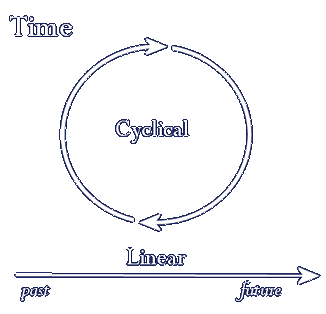
Resurrection is a powerful story, especially when it moves beyond the debate of historicity. When viewed typologically resurrection alters stories from linear to cyclical. A typical western story is from birth->life->death. When one considers resurrection, there is the potential to add the cyclical dimension of from death-> rebirth->life.
http://www.signsofthetimeshistory.com/graphics/time1.png
For more on the importance of cyclical stories watch Naomi Klein in her TED talk:
As Naomi argues, our culture is trapped in linear stories, ones with endless growth, where rationality never fails (but wait it has and does, welcome post-modernity). Despite her slight against Christianity, I think Christianity, specifically the resurrection, can assist us in telling cyclical stories. However, we must consider the larger story, to see that the resurrection story of death->life was not a one-off story (sure physical resurrection was a one-off event).
Viewing resurrection as a story, we look back at other stories and some of them, specifically in the Judeo-Christian tradition have always been resurrection stories. These stories participated in cycles, in-so-doing they invite the reader/hearer to participate in the story.
• Garden - Day and Night (life and death) -> kicked out of Garden AND clothed (offered a new beginning)
• Noah – death of the world and New life in the olive branch
• Joseph (See Joseph CYOA) – Death of a people in Egypt -> new life in exodus
• Cycles of death and resurrection in Judges
• Life and death of Davidic Kingdom -> Jesus pulls the people out of death, and offers himself as King (Israel’s tangible resurrection – Duncan’s “What is the Gospel Post”)
• Jesus resurrects in person (just in case we had missed the theme throughout the entire narrative!)
What I want to show is that the story of Resurrection can be understood as a cyclical story. It is not a one-off in the narrative of the Bible. We run into danger theologically when our theology or our stories become too linear (as Naomi Klein so aptly demonstrates). We ought to consider this snare when we view linear logic as the top of the hierarchy of our understanding, or when we are too trapped in a western-worldview, which at its root is linear.
When individuals choose to live a resurrection story one will find it everywhere. We die daily into sleep and rise again in the morning. The seasons of the year are deaths and resurrections. Life on the planet is consistently dying and being born. We are born into journeys of school, and career, only to graduate or move-on. These deaths are the end, but also new beginnings. Resurrection is all around.
Within Christianity Resurrection is found also in our symbols. Death in baptism and new life beyond the water. Death in the bread and wine of Communion and new life lived by the partaker.
So where does resurrection fit into story? I would argue all over the place. I think when one begins to think in story, to see in story, to be persuaded by story, one will be able engage the world more fully then through solely a rational lens.
I openly state the irony of this post: I use the form of argumentation to discuss story. I apologize that I could not come up with a story that will articulate what I wanted to say.
My most basic defense of story is that it is innately human. Children go to bed to stories, youth interact telling stories, partners share the stories of their days after work. Many great teachers have taught through story; the Old Testament narratives, prophets telling the story of Israel, lived stories (Jeremiah and Hosea), Jesus’ parables, Paul/Peter preach the story of Jesus, Aesop tells fables, Tolkien, Lewis, Bunyan, Augustine’s life narrative. We are surrounded by stories, we are drawn into story. From sitting around the fire telling stories to the present movie industry, we communicate and interact via story. I am reminded of the stereotypical elderly woman about to watch the afternoon soap operas “it is time for my stories”. This has provoked me to look at my epistemology and attempt to shape it around story.
To begin I want to address Josh’s comment about “argument and rationality” used as a catch all for Christians wanting to “do away with” the modern era and its affects on us/theology/contemporary culture.
First, I want to affirm Duncan’s answer: the question ought not to be “rational” vs. “irrational”, but how are we to understand the relationship between the rational and the irrational. To explore this I look back to Socrates and Plato. Plato records Socrates in “The Republic” where he states the three parts of the soul are rationality, spirit and desire/appetite. (These divisions are imposed, therefore it is most likely an incomplete/limiting list, nevertheless we will work with these). Socrates states that it is reason’s role to keep spirit and desire in check; in essence, he sets up a hierarchy within the self. I, however, choose to reject hierarchy, and therefore am attempting to work toward a more balanced and holistic understanding of self, as well as how that self relates to the public world. My choice to reject hierarchy comes from my Christian convictions. I ponder: What if the self is modeled after the trinity? What if the self is a threefold oneness, maybe then I could relate to the world better. This rejection of hierarchy fits with a community hermeneutic, equality, and egalitarianism. Subsequently, I find it fitting to reject rationality’s role of keeping the rest of the human inline. Instead to attempt to view desire, spirit, and logic being in relation to one another, yielding and asserting, a give and take, a harmonious self.
One might respond to this with an argument in favour of the priority of logic, supporting it with John 1. The Logos of God is explored in this passage. Without becoming tied up in all of the argumentation (see Ladd’s “A Theology of the New Testament” for an overview), I will summarize it saying that the Logos/Logic is Part of God, but God/Christ is MORE than logic. Thus, one can absolutely affirm logic without it becoming hierarchical in its relation to other segments of life. I think it is fine to say that we need more than logic in how we relate to the world, and that this would be affirmed by the biblical text. (Here I do not address the idea the God’s logic is different then man’s, an idea I think Paul speaks to).
“I guess my question is where any sort of metaphysics fits into a narrative?”
I think narrative is the location to wrestle with appropriate syncretisation/integration of the metaphysical/historical portions, in the same way logic can be integrated into story. Hopefully, narrative can be more inclusive in its stance than methodologies that begin with logic/historic/or metaphysical approaches. Narrative, I attempted to show is inclusivity in its stance (Stories Pt. 2), whereas I find the others to be inherently exclusivist.
Regarding Josh’s pondering, “what gives story credence?” Here I think he answers his own question, “What is so special about compassion? Why should I accept it as some sort of criteria in a personal hermeneutic, other than it feels good to practice and also that I like having nice people around?” It is exactly those feelings and experiences that story frees us to validate. Whereas Socrates would have us use rationality to integrate or explain such feelings in order to justify their validity, narrative by its very nature cultivates these feelings and in-so-doing validates them. Yet, they are more difficult to communicate because we have limited ourselves to rational argumentation for so long that we find it difficult to express other aspects of life. What feels good? What type of people do you enjoy? These are valuable aspects of story; they are played on every time we go to the movies. The great majority of people support the protagonist, not because they are rationally told to do so, but because we allow ourselves to inhabit the story for a period. It is this inhabiting of the story that draws out our own desires and spirit and we syncretise ourselves into the story. Thus, we root for justice and the protagonist; we want things to turn out “right”.
A tangent: to illustrate rooting for what is right. If you have watched all the seasons of Sex and the City, one moment may stick out in your mind. Carrie Bradshaw, the first time she dates Aidan, cheats on him with Big. Watching it unfold is painful; the viewer cannot help but think she is making a huge mistake. The story unfolds and Carrie ends up telling Aidan and asking his forgiveness outside a church, it is Charlotte’s wedding. As one watches Carrie’s confession and desire to be forgiven, one hopes there will be restorative justice, one desires forgiveness and reconciliation. It is these emotions and desires that are ignored when reality is reduced into logic/argument/rationality. One knows that by the “rules” Carrie is in the wrong, but one hopes against the odds that Aidan will take the higher road. He does not and their relationship ends for a while.
“What does the resurrection have to do with story?... But how do we go as far as saying the story is more important than resurrection?” Resurrection IS a story! It is a powerful one at that. It can also be a TYPE of story that we tell.
(Please do not say I am using reductionist language when saying that the resurrection is story, I can just as easily flip it and say that to view the resurrection as history is to be reductionist! It depends on what one views as macro and guiding, which this whole series of posts has been about - an argument that story ought to be viewed as the macro and not the micro)
Resurrection is a powerful story, especially when it moves beyond the debate of historicity. When viewed typologically resurrection alters stories from linear to cyclical. A typical western story is from birth->life->death. When one considers resurrection, there is the potential to add the cyclical dimension of from death-> rebirth->life.
http://www.signsofthetimeshistory.com/graphics/time1.png
For more on the importance of cyclical stories watch Naomi Klein in her TED talk:
As Naomi argues, our culture is trapped in linear stories, ones with endless growth, where rationality never fails (but wait it has and does, welcome post-modernity). Despite her slight against Christianity, I think Christianity, specifically the resurrection, can assist us in telling cyclical stories. However, we must consider the larger story, to see that the resurrection story of death->life was not a one-off story (sure physical resurrection was a one-off event).
Viewing resurrection as a story, we look back at other stories and some of them, specifically in the Judeo-Christian tradition have always been resurrection stories. These stories participated in cycles, in-so-doing they invite the reader/hearer to participate in the story.
• Garden - Day and Night (life and death) -> kicked out of Garden AND clothed (offered a new beginning)
• Noah – death of the world and New life in the olive branch
• Joseph (See Joseph CYOA) – Death of a people in Egypt -> new life in exodus
• Cycles of death and resurrection in Judges
• Life and death of Davidic Kingdom -> Jesus pulls the people out of death, and offers himself as King (Israel’s tangible resurrection – Duncan’s “What is the Gospel Post”)
• Jesus resurrects in person (just in case we had missed the theme throughout the entire narrative!)
What I want to show is that the story of Resurrection can be understood as a cyclical story. It is not a one-off in the narrative of the Bible. We run into danger theologically when our theology or our stories become too linear (as Naomi Klein so aptly demonstrates). We ought to consider this snare when we view linear logic as the top of the hierarchy of our understanding, or when we are too trapped in a western-worldview, which at its root is linear.
When individuals choose to live a resurrection story one will find it everywhere. We die daily into sleep and rise again in the morning. The seasons of the year are deaths and resurrections. Life on the planet is consistently dying and being born. We are born into journeys of school, and career, only to graduate or move-on. These deaths are the end, but also new beginnings. Resurrection is all around.
Within Christianity Resurrection is found also in our symbols. Death in baptism and new life beyond the water. Death in the bread and wine of Communion and new life lived by the partaker.
So where does resurrection fit into story? I would argue all over the place. I think when one begins to think in story, to see in story, to be persuaded by story, one will be able engage the world more fully then through solely a rational lens.
Monday, February 20, 2012
Stories Collide. Pt. 1
What is reality, what shapes it, and how do I understand my experiences? These questions have been prodding me towards story. Story has been a journey of a thousand miles, begun a long time ago. I grew up a scientific modernist giving lip-service to the possibility of the supernatural, then passing through fundamentalist, and into “biblical”, now I find myself somewhere in a matrix of post-modern/modern/undecided/conglomerate. What I have learned through this development is that the story one lives into shapes all arguments, experience, actions, and epistemology.
I was blessed with a lot of dissonance in my life. I grew up in a “Christian North American” story. It was a story that held to a scientific modernist understanding of the world, but refused to take it to the extreme of excluding the supernatural. This, however, was brutally interrupted by a jaunt to a post-religious/secular/European worldview and story when I lived in England; I was twelve and thirteen years old. The stories clashed, I was too young to understand the significance of such an experience. It is hard to describe the clash of story, they do not battle openly with argumentation that is easy to follow, but a feeling is evident. A feeling of being unsettled. A story is supposed to follow a plot, but when the first story is interrupted and a second story enters in the middle, there is a sense of loss. The flow is incomplete, there is no past and the present seems to have no grounding.
Upon returning to North America, I attempted to pick up my old story, but it was now disjointed. One attempts to reconcile the themes, motifs, and symbols of a different story. It was with this muddled story I entered Bible College. Little did I know I was about to disturb my story in unimaginable ways. Coming from the Christian Reformed Story, I entered the Anabaptist Story. I attempted to “argue” the stories, but I ran into the same problem as before, stories do not respond well to argument. They are different with different pasts. Instead, stories syncretise, usually to the detriment of both. Stories have a funny way of picking the worst of both, rather than the best. It is not that the best parts cannot come together to make a better story, but that takes active participation by the character (you and me). I saw an example of bad syncretism in East Africa where Christianity comes with consumerism, modernity, and hyper-spirituality, but does not get rid of the tribalism, thus blending the negatives (tribalism, consumerism, and modernity) and the positive seem negligible (loyalty, direction, hope). Similar awful syncretism led me to a brief period as a fundamentalist. I syncretised the scientific absolutism of modernism with the Bible. It resulted with a “data quest” into the Bible. I attempted to pull out the absolutes. (This is my critique of Systematic Theology, even when not “fundamentalist”, it is a syncretism of a scientific method with a story. It does not ask the questions of the story, rather it imposes the questions of another story – Greek influenced scientific thought – onto the biblical story).
In reaction to fundamentalism, I attempted to become a purist. For a few years, I attempted to understand the biblical story, attempting to read it on its own terms. This was going well, but then I went to East Africa. This cross-cultural experience rattled my “bible only” conception of truth and reality. The “same” Christian stories clashed, this shook my naïve understanding that one’s private experience is able to arrive at a purist Biblical understanding. Rather one’s private experience and story will completely subvert the entire story. Our private experiences ultimately determine our stories, what flows in and that which is discarded. I came to this conclusion as I sat across from another reading the same text, we both claimed it as authoritative, and we would come to completely different understandings, each significantly shaped by our cultures. The common ground seemed negligible compared to the differences. Everything is relative. Thus ended my purist pursuit.
Where does one go from complete relativity? N.T. Wright goes to critical realism, a noble option, but a method still rooted in a Greek history. Others walk forward into post-modernity with their arm open come what may. Yet others revert, either back into modernity, fundamentalism and its syncretism, or even to a pre-modern-esque type of understanding. This is the crossroads many of us encounter; it is a crossroad I continue to navigate. It is here Story becomes significant. Newbigin’s book “The Gospel in a Pluralist Society” argues for the church as the agent telling the Gospel story and thus persuading the world. Here Duncan’s articulation of Gospel becomes incredibly important; for if Gospel is a part of the story it can be persuasive and syncretised into our stories becoming a story changer. However, if it is a coercive, totalizing, story it co-opts our stories and leads to bad syncretism.
I am attempting to create some hermeneutics for myself as I wallow through this nebulous crossroad. First, honesty. It does me no good to neglect my past or the biases I know I hold. I must be as honest as possible, lay my cards out and attempt to proceed with all the guidance there. Second, virtue. What do I want to become? What do I want my story to look like? Here I lay down my card of compassion. If it is not compassionate, I ought to consider alternatives. Third, story. I must continually remind myself not to argue myself into the “correct” option, because by doing so I have already been co-opted by one story, that of rational argumentation arising out of the modernist era I grew up in (thus following the first hermeneutic). I must continually open myself to persuasion. What story persuades me to follow hermeneutic two? Fourth, keep the biblical text as authoritative. Thus, as the stories blend together I want the narrative of scripture to have significant weight, specifically life, death, and resurrection, as living, dying, and rising throughout my life, even daily, and hopefully in the cosmos, lead me towards greater compassion (hermeneutic two). Fifth, choose wisely. The ability to choose, to choose what is authoritative, choosing the story one lives into, choosing to ones hermeneutics, I must choose contemplatively.
With that, I find myself at the point of syncretising stories. None of them can be “taken out” as they have all entered into my story, but I can mix and mould. I can choose the back-story of the Bible. Therefore, I can incorporate the Gospel (as Duncan articulated) into my story. I can affirm the story of modernism, its conclusion, and collapse into post-modernism. I can look relativism in the face and walk forward with the most persuasive story I can compile, given my experience, which includes the Gospel and compassion. Further, when I am confronted with other stories, such as in East-Africa, I can affirm the parts that blend, while persuading the parts that clash. This has significant influence on my thoughts on pluralism, because if I truly believe that the story I tell and the parts I have chosen to incorporate, it is honestly the best possible story and the most persuasive, there is reduced fear of bad syncretism if I choose to tackle it head-on.
Some of those reading this might be more than a little bit uncomfortable with my choice of words, specifically syncretism. But you see, I have no choice but to syncretise if I wanted out of (or to change) my original story. Since I cannot erase my past and my mode of though, remembering my first story was that of a scientific modernist in North America and NOT a first century Jew in Palestine, I must syncretise the stories I encounter. If I want to change story it involves delicate syncretism. Or to use more “Christian” words I might choose “conversion”, understanding conversion to be the continued gradual change of my story into one I desire.
I was blessed with a lot of dissonance in my life. I grew up in a “Christian North American” story. It was a story that held to a scientific modernist understanding of the world, but refused to take it to the extreme of excluding the supernatural. This, however, was brutally interrupted by a jaunt to a post-religious/secular/European worldview and story when I lived in England; I was twelve and thirteen years old. The stories clashed, I was too young to understand the significance of such an experience. It is hard to describe the clash of story, they do not battle openly with argumentation that is easy to follow, but a feeling is evident. A feeling of being unsettled. A story is supposed to follow a plot, but when the first story is interrupted and a second story enters in the middle, there is a sense of loss. The flow is incomplete, there is no past and the present seems to have no grounding.
Upon returning to North America, I attempted to pick up my old story, but it was now disjointed. One attempts to reconcile the themes, motifs, and symbols of a different story. It was with this muddled story I entered Bible College. Little did I know I was about to disturb my story in unimaginable ways. Coming from the Christian Reformed Story, I entered the Anabaptist Story. I attempted to “argue” the stories, but I ran into the same problem as before, stories do not respond well to argument. They are different with different pasts. Instead, stories syncretise, usually to the detriment of both. Stories have a funny way of picking the worst of both, rather than the best. It is not that the best parts cannot come together to make a better story, but that takes active participation by the character (you and me). I saw an example of bad syncretism in East Africa where Christianity comes with consumerism, modernity, and hyper-spirituality, but does not get rid of the tribalism, thus blending the negatives (tribalism, consumerism, and modernity) and the positive seem negligible (loyalty, direction, hope). Similar awful syncretism led me to a brief period as a fundamentalist. I syncretised the scientific absolutism of modernism with the Bible. It resulted with a “data quest” into the Bible. I attempted to pull out the absolutes. (This is my critique of Systematic Theology, even when not “fundamentalist”, it is a syncretism of a scientific method with a story. It does not ask the questions of the story, rather it imposes the questions of another story – Greek influenced scientific thought – onto the biblical story).
In reaction to fundamentalism, I attempted to become a purist. For a few years, I attempted to understand the biblical story, attempting to read it on its own terms. This was going well, but then I went to East Africa. This cross-cultural experience rattled my “bible only” conception of truth and reality. The “same” Christian stories clashed, this shook my naïve understanding that one’s private experience is able to arrive at a purist Biblical understanding. Rather one’s private experience and story will completely subvert the entire story. Our private experiences ultimately determine our stories, what flows in and that which is discarded. I came to this conclusion as I sat across from another reading the same text, we both claimed it as authoritative, and we would come to completely different understandings, each significantly shaped by our cultures. The common ground seemed negligible compared to the differences. Everything is relative. Thus ended my purist pursuit.
Where does one go from complete relativity? N.T. Wright goes to critical realism, a noble option, but a method still rooted in a Greek history. Others walk forward into post-modernity with their arm open come what may. Yet others revert, either back into modernity, fundamentalism and its syncretism, or even to a pre-modern-esque type of understanding. This is the crossroads many of us encounter; it is a crossroad I continue to navigate. It is here Story becomes significant. Newbigin’s book “The Gospel in a Pluralist Society” argues for the church as the agent telling the Gospel story and thus persuading the world. Here Duncan’s articulation of Gospel becomes incredibly important; for if Gospel is a part of the story it can be persuasive and syncretised into our stories becoming a story changer. However, if it is a coercive, totalizing, story it co-opts our stories and leads to bad syncretism.
I am attempting to create some hermeneutics for myself as I wallow through this nebulous crossroad. First, honesty. It does me no good to neglect my past or the biases I know I hold. I must be as honest as possible, lay my cards out and attempt to proceed with all the guidance there. Second, virtue. What do I want to become? What do I want my story to look like? Here I lay down my card of compassion. If it is not compassionate, I ought to consider alternatives. Third, story. I must continually remind myself not to argue myself into the “correct” option, because by doing so I have already been co-opted by one story, that of rational argumentation arising out of the modernist era I grew up in (thus following the first hermeneutic). I must continually open myself to persuasion. What story persuades me to follow hermeneutic two? Fourth, keep the biblical text as authoritative. Thus, as the stories blend together I want the narrative of scripture to have significant weight, specifically life, death, and resurrection, as living, dying, and rising throughout my life, even daily, and hopefully in the cosmos, lead me towards greater compassion (hermeneutic two). Fifth, choose wisely. The ability to choose, to choose what is authoritative, choosing the story one lives into, choosing to ones hermeneutics, I must choose contemplatively.
With that, I find myself at the point of syncretising stories. None of them can be “taken out” as they have all entered into my story, but I can mix and mould. I can choose the back-story of the Bible. Therefore, I can incorporate the Gospel (as Duncan articulated) into my story. I can affirm the story of modernism, its conclusion, and collapse into post-modernism. I can look relativism in the face and walk forward with the most persuasive story I can compile, given my experience, which includes the Gospel and compassion. Further, when I am confronted with other stories, such as in East-Africa, I can affirm the parts that blend, while persuading the parts that clash. This has significant influence on my thoughts on pluralism, because if I truly believe that the story I tell and the parts I have chosen to incorporate, it is honestly the best possible story and the most persuasive, there is reduced fear of bad syncretism if I choose to tackle it head-on.
Some of those reading this might be more than a little bit uncomfortable with my choice of words, specifically syncretism. But you see, I have no choice but to syncretise if I wanted out of (or to change) my original story. Since I cannot erase my past and my mode of though, remembering my first story was that of a scientific modernist in North America and NOT a first century Jew in Palestine, I must syncretise the stories I encounter. If I want to change story it involves delicate syncretism. Or to use more “Christian” words I might choose “conversion”, understanding conversion to be the continued gradual change of my story into one I desire.
Wednesday, November 30, 2011
Why not?

As of tomorrow, we enter the last month of 2011. A year marked by the motto "why not?" as established last new years in New York. A trip which was made possible by the phrase it was to inspire. It has been a year of travel, transition, creativity, and new endeavours. Do a super intense internship? Why not? Be homeless for the summer? Why not? Embrace unemployment? Why not? Start a blog? Why not? Write a book? Why not? Shoot a painting? Why not? Start Grad School? Why Not? Move to Vancouver? Why not? Occupy Everywhere? Why not? Stay up all night doing home work? Why not?
In the course of these adventures I have discovered many excellent responses to our courageous question which launched us daringly into many new, difficult, challenging, and rewarding circumstances... However, as I begin to reflect on a year that has been filled with extremes and as I anticipate rest, renewal and rejoicing over the Christmas season, I am moved almost immediately to nostalgia. It has been a year of life shared deeply, with deep friends. Beginning as we slept 3 or 4 to a bed stumbling on top of each other in a tiny apartment in New York, an experience I'm we were sure had deepened or destroyed our relationships, to graduation, to Israel, to unemployment, from artistic endeavours, new jobs, to weddings, to new schools... memories have congealed into a glassy rose coloured past to be reminisced over as we return to favourite restaurants, share a cigar, and in either slurred or perfectly enunciated speech share the deep love and respect we hold for each other. Friendship is about life lived together and that is something that has happened significantly and deeply this year.

The questions to be answered in the coming month is what will next years motto be? How do our relationships transition as life moves us to different place? Will there be the new friends that we will journey, laugh and cry with, and how will they change us?
I anticipate this Christmas season as being celebratory with with old friends and new, with family, with wine, with food and champagne...
May we celebrate both the glory and misery of our lives, holding hands and cuddled together,
with shouting, laughter and tears,
with kisses and hugs,
with both hope and sorrow, grieving and joy...
May there always be pizza...
May water turn into wine...
May death give way to new life...
May life be lived together...
Amen.
Wednesday, August 10, 2011
CYOA - Look to the Snake

6 Then the LORD sent venomous snakes among them; they bit the people and many Israelites died. 7 The people came to Moses and said, “We sinned when we spoke against the LORD and against you. Pray that the LORD will take the snakes away from us.” So Moses prayed for the people.
8 The LORD said to Moses, “Make a snake and put it up on a pole; anyone who is bitten can look at it and live.” 9 So Moses made a bronze snake and put it up on a pole. Then when anyone was bitten by a snake and looked at the bronze snake, they lived.
I was so excited to write on this passage because it is so bizarre! I mean the snakes are obviously no fun but then the bronze snake blows my mind!!!??? I mean why not have Moses' staff turn into a snake again and eat all the other snakes or maybe stick the ten commandments on a pole... or a bronze replica of the ten commandments... or a statue of Moses... But no, a bronze snake. Literally, looking to the snake was to receive God's salvation... Reflect on that statement for a moment. Does it creep anyone else out? That one looked to God by looking at the snake... Ok but maybe it makes sense because they are being attacked by snakes. So by having the symbol of salvation be a snake, no one will get confused and think God is a snake... they will remember Yahweh and the his deliverance from the snakes... Maybe? Nope: by 2 Kings 18:4, Israel is offering incense to the thing.
I did a word search on snake and serpent and it is a surprising common way of talking about something bad, being used mostly in a negative sense. However, the bronze snake is a weird kind of exception/non exception. There is also Gen 49:17 which is a prophecy about Dan in which snake imagery is kind of used as a positive negative and the staff into a snake trick in Exodus. In Matthew 10:16 we have Jesus command to be as shrewd as snakes. And you have Jesus' statement in John 3:14-15 directly referencing Numbers 21:
Just as Moses lifted up the snake in the wilderness, so the Son of Man must be lifted up, that everyone who believes may have eternal life in him.
And that is it.
Ok, now I want to give you the part that really freaks me out. Perhaps you have heard of Asclepius. The Greek God of medicine and healing.... Symbolized as a snake entwined on a staff... Still the common symbol for medicine/medical stuff...
So the Israelites are dying from snake bites and they need healing and they look to a bronze snake on a pole, i.e. Asclepius and they are healed. Except that Yahweh instructs this action and timeline-wise the connection must be from Israel to Greece and not the other way around if a real connection exists at all. To push this just a bit further, Asclepius is killed by Zeus for... raising people from the dead!!! Early church father Justin Martyr presented Asclepius as explicitly foreshadowing Jesus' ability to heal for the Greeks and is used as an example to show how Jesus' resurrection and ascension was not in any way unbelievable because this is already what Greeks believed about Asclepius!
OK. So we have the bronze serpent, to Asclepius, to Jesus. Furthermore, there is some scholarship and strong archaeological evidence to suggest that the Bathesda healing (John 5:1-15) was a confrontation with the pagan cult of Asclepius. So the question then... is this all part of God's glorious plan to save people in confusing ways that wind up getting people side tracked but eventually somehow lead to Jesus? Is the story of the snake which gives/offers life but ultimately leads people astray merely an extension of Eden? How do we reconcile the snake as both a symbol of judgement/punishment and salvation? Are we doomed to a story of redemptive violence? Are we supposed to not notice the phallic undertone in the descriptions of snakes and poles being lifted into the air?
Tuesday, August 2, 2011
Harry Potter is Jesus - Part 1 (spoiler alert)


Ok, I am one of the ignorant masses that Silas is disappointed in for having not actually read the Harry Potter books. So unfortunately my comment can only extend definitively to the movies, which I have watched. However, it is my assumption that what is true of the movies is only more so and better in the books, for that is the nature of books.
Harry Potter is a phenomenon that has occurred as I have grown up and I have witnessed the back lash and debates regarding witchcraft and wizardry and the appropriate response of a Christian parent to these black magic books, which have bewitched the world... With that being said, I never shared that perspective. A child reading Harry Potter and becoming involved in the occult is as much Harry Potter's fault as someone reading the Bible and becoming a nudist, or attacking animals with a jawbone, trying to walk on water at Niagra Falls, or killing someone because of sexual orientation, or bombing an abortion clinic... damn those last two hit kinda close to home don't they? Maybe we should boycott the Bible? NO! This is the whole point: books and what you read are not responsible for what you do - that's your responsibility. Do they have influence? Yes, but you are in control of that influence as I believe my Bible example highlights. Two people can read the same book and have wildly different reactions and wildly different lives... So what can we conclude? That clearly the book is in no way definitively responsible for a person's actions. Furthermore, of all of the dangers of influence in Harry Potter, my father has concluded that far and away the worst one is that Harry and Ron never really do any homework and don't take school seriously. That's right my dad has read Harry Potter and I haven't.
The reason that I have not read Harry Potter is because I am skeptical of cultural phenomena and don't like getting swept away in hype. The TV series "Lost" is another example of this occurring where I regret not becoming and avid and devoted fan. I was just a touch too old for Harry Potter; it was the book that the kids I was babysitting were reading and dressing up as for Halloween and I wrote it off as a kids book and never really got over that. I knew that people loved the books, including my wife Amy, for whom I bought the sixth or seventh book the day it came out at a 7-11 the summer we started dating. But now having seen the last movie, I get it. Harry Potter is Jesus. The whole series is possibly more Christian than Lord of the Rings. Not only does Harry die a sacrificial death but it is an anticipated and planned sacrificial death. "Now you tell me you have been raising him like a pig for slaughter" Snape says this to Dumbledore in the final film. All one needs to do is change the word pig to lamb and it could be straight out of the Bible. The themes of reconciliation, redemption, self saacrifice and good triumphing over evil are primary themes in the final movie and series as a whole. What we have is not merely a story, and not merely good vs evil but a full blown atonement theory - Christus Victor with a twist...
What do you think? Does Harry Potter offer an alternative perspective on atonement that is compatible with Christianity? What are the key nuances?
Just in case you weren't convinced... Harry Potter - "The boy who lives"... yeah he dies in the last film but he comes back to life too.
Read Harry Potter is Jesus Pt. 2
Read Harry Potter is Jesus Pt. 2
Wednesday, July 20, 2011
CYOA - Avoidance - John 20:1-10
John 20 (The Message)
Resurrection!
1-2 Early in the morning on the first day of the week, while it was still dark, Mary Magdalene came to the tomb and saw that the stone was moved away from the entrance. She ran at once to Simon Peter and the other disciple, the one Jesus loved, breathlessly panting, "They took the Master from the tomb. We don't know where they've put him."
3-10Peter and the other disciple left immediately for the tomb. They ran, neck and neck. The other disciple got to the tomb first, outrunning Peter. Stooping to look in, he saw the pieces of linen cloth lying there, but he didn't go in. Simon Peter arrived after him, entered the tomb, observed the linen cloths lying there, and the kerchief used to cover his head not lying with the linen cloths but separate, neatly folded by itself. Then the other disciple, the one who had gotten there first, went into the tomb, took one look at the evidence, and believed. No one yet knew from the Scripture that he had to rise from the dead. The disciples then went back home.
Last week we all wrote our articles without reading each others'. This week I have read both other articles before writing this. I feel pressure to present a different adventure for you to choose as that is in part the point of this exercise. When I read scripture, I try and ask good or at least useful questions, so I will list my questions:
What is the first day of the week?
Who is the unnamed disciple?
What were the first century rules for moving bodies?
Why does the unnamed disciple not enter immediately but only Simon Peter does?
What did Simon Peter think?
What Scripture is being referred to?
Where is "home"?
Now allow me to leave these questions to you and avoid them entirely. What I want to write about is theology. What happens theologically in the resurrection of Jesus? Obviously this is a huge and defining moment in the Christian faith - perhaps the moment. One thing that occurs is that death is defeated. Where as previously people had been raised from the dead but died later and we have a couple examples of people who didn't die (Enoch and Elijah), Jesus is the only case where death both occurs and is then fully defeated. This is the only story in which death has a say but not the last say; the grave is not the final word; the story doesn't end in the tomb. This is then my understanding of the Christian hope: that the grave is not the end, that God has the last word, and the God's word creates life.
I would now like to draw a connection I was made aware of on our recent trip to Israel.
Matthew 16:18
I will build my church, and the gates of hell shall not prevail against it
In this passage Jesus makes this famous declaration. The word for hell is the Greek 'hades' and is the place of the dead, Sheol, or the grave. Therefore, our instructor suggested, a better understanding is to understand Jesus to be declaring victory over death rather than demonic hordes. What is it that the gates of hell do? Well they keep people in of course! Nobody comes back from the dead! Nobody escapes hades! There is no way back after crossing the river Styx! Jesus' church will not be stopped by death but triumph over and beyond it.
It is also interesting to note that the Gates of hell was also a physical place as depicted above and the location of pagan worship including, more specifically, the emperor cult. Therefore, one could also understand this to be a reference to the Roman empire, and the emperor in particular, not prevailing against Jesus building his church (which is certainly true in retrospect).
In either case, Jesus' resurrection is the down payment of power, the deposit of new life, the game changer, the final twist, the surprise ending. God's word brings new life, Jesus defeats Empire, Jesus defeats death, defeat is swallowed up in victory...
Resurrection!
1-2 Early in the morning on the first day of the week, while it was still dark, Mary Magdalene came to the tomb and saw that the stone was moved away from the entrance. She ran at once to Simon Peter and the other disciple, the one Jesus loved, breathlessly panting, "They took the Master from the tomb. We don't know where they've put him."
3-10Peter and the other disciple left immediately for the tomb. They ran, neck and neck. The other disciple got to the tomb first, outrunning Peter. Stooping to look in, he saw the pieces of linen cloth lying there, but he didn't go in. Simon Peter arrived after him, entered the tomb, observed the linen cloths lying there, and the kerchief used to cover his head not lying with the linen cloths but separate, neatly folded by itself. Then the other disciple, the one who had gotten there first, went into the tomb, took one look at the evidence, and believed. No one yet knew from the Scripture that he had to rise from the dead. The disciples then went back home.
Last week we all wrote our articles without reading each others'. This week I have read both other articles before writing this. I feel pressure to present a different adventure for you to choose as that is in part the point of this exercise. When I read scripture, I try and ask good or at least useful questions, so I will list my questions:
What is the first day of the week?
Who is the unnamed disciple?
What were the first century rules for moving bodies?
Why does the unnamed disciple not enter immediately but only Simon Peter does?
What did Simon Peter think?
What Scripture is being referred to?
Where is "home"?
Now allow me to leave these questions to you and avoid them entirely. What I want to write about is theology. What happens theologically in the resurrection of Jesus? Obviously this is a huge and defining moment in the Christian faith - perhaps the moment. One thing that occurs is that death is defeated. Where as previously people had been raised from the dead but died later and we have a couple examples of people who didn't die (Enoch and Elijah), Jesus is the only case where death both occurs and is then fully defeated. This is the only story in which death has a say but not the last say; the grave is not the final word; the story doesn't end in the tomb. This is then my understanding of the Christian hope: that the grave is not the end, that God has the last word, and the God's word creates life.
I would now like to draw a connection I was made aware of on our recent trip to Israel.
 |
| Gates of Hell - Caesera Phillipi |
Matthew 16:18
I will build my church, and the gates of hell shall not prevail against it
In this passage Jesus makes this famous declaration. The word for hell is the Greek 'hades' and is the place of the dead, Sheol, or the grave. Therefore, our instructor suggested, a better understanding is to understand Jesus to be declaring victory over death rather than demonic hordes. What is it that the gates of hell do? Well they keep people in of course! Nobody comes back from the dead! Nobody escapes hades! There is no way back after crossing the river Styx! Jesus' church will not be stopped by death but triumph over and beyond it.
It is also interesting to note that the Gates of hell was also a physical place as depicted above and the location of pagan worship including, more specifically, the emperor cult. Therefore, one could also understand this to be a reference to the Roman empire, and the emperor in particular, not prevailing against Jesus building his church (which is certainly true in retrospect).
In either case, Jesus' resurrection is the down payment of power, the deposit of new life, the game changer, the final twist, the surprise ending. God's word brings new life, Jesus defeats Empire, Jesus defeats death, defeat is swallowed up in victory...
Subscribe to:
Posts (Atom)