Abbotsford, British Columbia is known as a "bible belt", the murder capital of Canada and the City in the Country where delicious berries grow and all establishments close by 6:00 pm.
In my current position with Community Services, I am getting to know Abbotsford in a stereotype-shattering way. I was struck with a new fondness for Abbotsford this week after contributing to the planning and execution of the East to West City Tour, staffing the Multicultural and Immigrant Services booth at AbbyFest and attending the film screening of It's a Girl by GirlKIND Foundation.
The East to West City Tour was the kick off event of a 6 session Diversity Networking Series for businesses in Abbotsford. My colleagues and I, along with our community partners, have been working on the details of this series for months. A couple weeks ago, my nerves struck and I was worried about the timing of the event, who would actually show up, and whether or not I had interesting and relevant information to share. One of my colleagues helped put my worries into perspective by reminding me that this tour would not change the world. In the grand scheme of diversity awareness in Abbotsford this event would play a minimal role.
As it turned out, we reached capacity and created a wait-list. As a tour guide on the bus, sharing demographics and highlighting changes in housing and landscape, I could see our guests react with interest. The tour finished with lunch and an informal dialogue about what we had learned and experienced on the tour. The collected evaluation forms were packed with positive and appreciative feedback as well as interesting information about what was new for the participants including: that there are two reserves in Abbotsford, that there are more than 10 languages spoken in our city, that 25.8% of the population are immigrants, or that there are more than 24 different faith groups represented. This was a job well done.
The 5th annual AbbyFest, a multicultural celebration, opened with a parade of nations where community members representing over 50 countries, dressed in traditional clothing, carried flags of the world around the room. The parade was led by three women from different visible minority groups arm in arm. They were followed by members of Sto:lo Nation beating drums. Tears fell over my cheeks as this collective symbol of unity and peace passed before me. The rest of the day felt like a church gathering because I was reunited with many of the people involved on our Interfaith planning committee that had taken a summer break. I made new professional and personal connections and felt an incredible sense of belonging.
Its a Girl is a documentary about gendercide in India and China. The screening event took place at Matsqui Centenial Auditorium. Over 200 people were in attendance. It began with an hour of networking time where I was able to meet the founder of GirlKIND foundation and the performers, speakers and emcee of the evening. The stories in the film stirred a lot of emotion in me but what truly moved me was the community member who put this event on. This was the first community event that she had ever been involved in planning. This was her first engagement in community and global activism. She is the mother of a two year old, and a member of the South Asian community. I can not wait to work with her in the future.
In my college days, it was easy to talk poorly about Abbotsford because I was from the big city of Vancouver with endless opportunity and a wide breadth of diverse people. Today, I am proud to live and work in Abbotsford because I am getting to know the people that live here. I am thrilled to continue investing in this city.
Showing posts with label community. Show all posts
Showing posts with label community. Show all posts
Thursday, September 20, 2012

Tuesday, September 4, 2012
Wax On
Last summer, Duncan and I, along with Silas, Amy and Papa Ris, created Beautiful Destruction. This year, as my roommate and I brainstormed possible activities for our summer fun list, I insisted on including an art project. This is what we made.
Friday, June 8, 2012
Lamenting
Why is it that theology, faith, and opinions divide and cause harm to the extent they do? Where is our ability to differ and tolerate those with whom we disagree?
Are we so afraid of differences that we are willing to attack others, assassinate his or her character, and cause turmoil? To what do we owe this "high ground"? Is this finger pointing, reacting out of fear, not exactly what the pharisees did when they encountered a radical Jesus? Look where that got them; bloodied hands, hardened hearts, and a dead Jew. Is history so veiled that it will play on repeat as if no-one is watching?
Why is it easier for me to accept being blackballed than it is to watch someone else experience being blackballed? If only the label "Heretic" was mine to bear alone. For then others would not need to bear such a weighty chain.
So I pray:
Be slow to point fingers,
be slow to speak,
for the role of accuser is not ours to bear.
Be calm in danger,
be patient in trials,
for they have been journeyed before.
Open yourself to another,
open your mind to possibilities,
for as we dethrone ourselves we meet a God who did.
Enact charity,
enact compassion,
for the accusers think they are well intentioned.
I grieve these things for a friend under attack.
Are we so afraid of differences that we are willing to attack others, assassinate his or her character, and cause turmoil? To what do we owe this "high ground"? Is this finger pointing, reacting out of fear, not exactly what the pharisees did when they encountered a radical Jesus? Look where that got them; bloodied hands, hardened hearts, and a dead Jew. Is history so veiled that it will play on repeat as if no-one is watching?
Why is it easier for me to accept being blackballed than it is to watch someone else experience being blackballed? If only the label "Heretic" was mine to bear alone. For then others would not need to bear such a weighty chain.
So I pray:
Be slow to point fingers,
be slow to speak,
for the role of accuser is not ours to bear.
Be calm in danger,
be patient in trials,
for they have been journeyed before.
Open yourself to another,
open your mind to possibilities,
for as we dethrone ourselves we meet a God who did.
Enact charity,
enact compassion,
for the accusers think they are well intentioned.
I grieve these things for a friend under attack.
Wednesday, March 21, 2012
Stories Pt. 3 - In Defense of Story - Cyclical and Resurrecting
This post follows up ideas articulated in Story Pt. 1 and Story Pt. 2, specifically responding to some of the clarification Duncan and Josh have teased out.
I openly state the irony of this post: I use the form of argumentation to discuss story. I apologize that I could not come up with a story that will articulate what I wanted to say.
My most basic defense of story is that it is innately human. Children go to bed to stories, youth interact telling stories, partners share the stories of their days after work. Many great teachers have taught through story; the Old Testament narratives, prophets telling the story of Israel, lived stories (Jeremiah and Hosea), Jesus’ parables, Paul/Peter preach the story of Jesus, Aesop tells fables, Tolkien, Lewis, Bunyan, Augustine’s life narrative. We are surrounded by stories, we are drawn into story. From sitting around the fire telling stories to the present movie industry, we communicate and interact via story. I am reminded of the stereotypical elderly woman about to watch the afternoon soap operas “it is time for my stories”. This has provoked me to look at my epistemology and attempt to shape it around story.
To begin I want to address Josh’s comment about “argument and rationality” used as a catch all for Christians wanting to “do away with” the modern era and its affects on us/theology/contemporary culture.
First, I want to affirm Duncan’s answer: the question ought not to be “rational” vs. “irrational”, but how are we to understand the relationship between the rational and the irrational. To explore this I look back to Socrates and Plato. Plato records Socrates in “The Republic” where he states the three parts of the soul are rationality, spirit and desire/appetite. (These divisions are imposed, therefore it is most likely an incomplete/limiting list, nevertheless we will work with these). Socrates states that it is reason’s role to keep spirit and desire in check; in essence, he sets up a hierarchy within the self. I, however, choose to reject hierarchy, and therefore am attempting to work toward a more balanced and holistic understanding of self, as well as how that self relates to the public world. My choice to reject hierarchy comes from my Christian convictions. I ponder: What if the self is modeled after the trinity? What if the self is a threefold oneness, maybe then I could relate to the world better. This rejection of hierarchy fits with a community hermeneutic, equality, and egalitarianism. Subsequently, I find it fitting to reject rationality’s role of keeping the rest of the human inline. Instead to attempt to view desire, spirit, and logic being in relation to one another, yielding and asserting, a give and take, a harmonious self.
One might respond to this with an argument in favour of the priority of logic, supporting it with John 1. The Logos of God is explored in this passage. Without becoming tied up in all of the argumentation (see Ladd’s “A Theology of the New Testament” for an overview), I will summarize it saying that the Logos/Logic is Part of God, but God/Christ is MORE than logic. Thus, one can absolutely affirm logic without it becoming hierarchical in its relation to other segments of life. I think it is fine to say that we need more than logic in how we relate to the world, and that this would be affirmed by the biblical text. (Here I do not address the idea the God’s logic is different then man’s, an idea I think Paul speaks to).
“I guess my question is where any sort of metaphysics fits into a narrative?”
I think narrative is the location to wrestle with appropriate syncretisation/integration of the metaphysical/historical portions, in the same way logic can be integrated into story. Hopefully, narrative can be more inclusive in its stance than methodologies that begin with logic/historic/or metaphysical approaches. Narrative, I attempted to show is inclusivity in its stance (Stories Pt. 2), whereas I find the others to be inherently exclusivist.
Regarding Josh’s pondering, “what gives story credence?” Here I think he answers his own question, “What is so special about compassion? Why should I accept it as some sort of criteria in a personal hermeneutic, other than it feels good to practice and also that I like having nice people around?” It is exactly those feelings and experiences that story frees us to validate. Whereas Socrates would have us use rationality to integrate or explain such feelings in order to justify their validity, narrative by its very nature cultivates these feelings and in-so-doing validates them. Yet, they are more difficult to communicate because we have limited ourselves to rational argumentation for so long that we find it difficult to express other aspects of life. What feels good? What type of people do you enjoy? These are valuable aspects of story; they are played on every time we go to the movies. The great majority of people support the protagonist, not because they are rationally told to do so, but because we allow ourselves to inhabit the story for a period. It is this inhabiting of the story that draws out our own desires and spirit and we syncretise ourselves into the story. Thus, we root for justice and the protagonist; we want things to turn out “right”.
A tangent: to illustrate rooting for what is right. If you have watched all the seasons of Sex and the City, one moment may stick out in your mind. Carrie Bradshaw, the first time she dates Aidan, cheats on him with Big. Watching it unfold is painful; the viewer cannot help but think she is making a huge mistake. The story unfolds and Carrie ends up telling Aidan and asking his forgiveness outside a church, it is Charlotte’s wedding. As one watches Carrie’s confession and desire to be forgiven, one hopes there will be restorative justice, one desires forgiveness and reconciliation. It is these emotions and desires that are ignored when reality is reduced into logic/argument/rationality. One knows that by the “rules” Carrie is in the wrong, but one hopes against the odds that Aidan will take the higher road. He does not and their relationship ends for a while.
“What does the resurrection have to do with story?... But how do we go as far as saying the story is more important than resurrection?” Resurrection IS a story! It is a powerful one at that. It can also be a TYPE of story that we tell.
(Please do not say I am using reductionist language when saying that the resurrection is story, I can just as easily flip it and say that to view the resurrection as history is to be reductionist! It depends on what one views as macro and guiding, which this whole series of posts has been about - an argument that story ought to be viewed as the macro and not the micro)
Resurrection is a powerful story, especially when it moves beyond the debate of historicity. When viewed typologically resurrection alters stories from linear to cyclical. A typical western story is from birth->life->death. When one considers resurrection, there is the potential to add the cyclical dimension of from death-> rebirth->life.
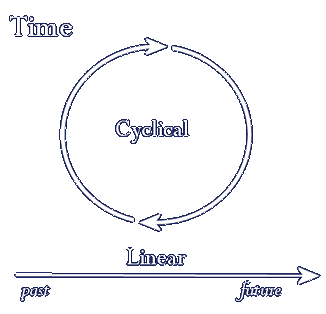
http://www.signsofthetimeshistory.com/graphics/time1.png
For more on the importance of cyclical stories watch Naomi Klein in her TED talk:
As Naomi argues, our culture is trapped in linear stories, ones with endless growth, where rationality never fails (but wait it has and does, welcome post-modernity). Despite her slight against Christianity, I think Christianity, specifically the resurrection, can assist us in telling cyclical stories. However, we must consider the larger story, to see that the resurrection story of death->life was not a one-off story (sure physical resurrection was a one-off event).
Viewing resurrection as a story, we look back at other stories and some of them, specifically in the Judeo-Christian tradition have always been resurrection stories. These stories participated in cycles, in-so-doing they invite the reader/hearer to participate in the story.
• Garden - Day and Night (life and death) -> kicked out of Garden AND clothed (offered a new beginning)
• Noah – death of the world and New life in the olive branch
• Joseph (See Joseph CYOA) – Death of a people in Egypt -> new life in exodus
• Cycles of death and resurrection in Judges
• Life and death of Davidic Kingdom -> Jesus pulls the people out of death, and offers himself as King (Israel’s tangible resurrection – Duncan’s “What is the Gospel Post”)
• Jesus resurrects in person (just in case we had missed the theme throughout the entire narrative!)
What I want to show is that the story of Resurrection can be understood as a cyclical story. It is not a one-off in the narrative of the Bible. We run into danger theologically when our theology or our stories become too linear (as Naomi Klein so aptly demonstrates). We ought to consider this snare when we view linear logic as the top of the hierarchy of our understanding, or when we are too trapped in a western-worldview, which at its root is linear.
When individuals choose to live a resurrection story one will find it everywhere. We die daily into sleep and rise again in the morning. The seasons of the year are deaths and resurrections. Life on the planet is consistently dying and being born. We are born into journeys of school, and career, only to graduate or move-on. These deaths are the end, but also new beginnings. Resurrection is all around.
Within Christianity Resurrection is found also in our symbols. Death in baptism and new life beyond the water. Death in the bread and wine of Communion and new life lived by the partaker.
So where does resurrection fit into story? I would argue all over the place. I think when one begins to think in story, to see in story, to be persuaded by story, one will be able engage the world more fully then through solely a rational lens.
I openly state the irony of this post: I use the form of argumentation to discuss story. I apologize that I could not come up with a story that will articulate what I wanted to say.
My most basic defense of story is that it is innately human. Children go to bed to stories, youth interact telling stories, partners share the stories of their days after work. Many great teachers have taught through story; the Old Testament narratives, prophets telling the story of Israel, lived stories (Jeremiah and Hosea), Jesus’ parables, Paul/Peter preach the story of Jesus, Aesop tells fables, Tolkien, Lewis, Bunyan, Augustine’s life narrative. We are surrounded by stories, we are drawn into story. From sitting around the fire telling stories to the present movie industry, we communicate and interact via story. I am reminded of the stereotypical elderly woman about to watch the afternoon soap operas “it is time for my stories”. This has provoked me to look at my epistemology and attempt to shape it around story.
To begin I want to address Josh’s comment about “argument and rationality” used as a catch all for Christians wanting to “do away with” the modern era and its affects on us/theology/contemporary culture.
First, I want to affirm Duncan’s answer: the question ought not to be “rational” vs. “irrational”, but how are we to understand the relationship between the rational and the irrational. To explore this I look back to Socrates and Plato. Plato records Socrates in “The Republic” where he states the three parts of the soul are rationality, spirit and desire/appetite. (These divisions are imposed, therefore it is most likely an incomplete/limiting list, nevertheless we will work with these). Socrates states that it is reason’s role to keep spirit and desire in check; in essence, he sets up a hierarchy within the self. I, however, choose to reject hierarchy, and therefore am attempting to work toward a more balanced and holistic understanding of self, as well as how that self relates to the public world. My choice to reject hierarchy comes from my Christian convictions. I ponder: What if the self is modeled after the trinity? What if the self is a threefold oneness, maybe then I could relate to the world better. This rejection of hierarchy fits with a community hermeneutic, equality, and egalitarianism. Subsequently, I find it fitting to reject rationality’s role of keeping the rest of the human inline. Instead to attempt to view desire, spirit, and logic being in relation to one another, yielding and asserting, a give and take, a harmonious self.
One might respond to this with an argument in favour of the priority of logic, supporting it with John 1. The Logos of God is explored in this passage. Without becoming tied up in all of the argumentation (see Ladd’s “A Theology of the New Testament” for an overview), I will summarize it saying that the Logos/Logic is Part of God, but God/Christ is MORE than logic. Thus, one can absolutely affirm logic without it becoming hierarchical in its relation to other segments of life. I think it is fine to say that we need more than logic in how we relate to the world, and that this would be affirmed by the biblical text. (Here I do not address the idea the God’s logic is different then man’s, an idea I think Paul speaks to).
“I guess my question is where any sort of metaphysics fits into a narrative?”
I think narrative is the location to wrestle with appropriate syncretisation/integration of the metaphysical/historical portions, in the same way logic can be integrated into story. Hopefully, narrative can be more inclusive in its stance than methodologies that begin with logic/historic/or metaphysical approaches. Narrative, I attempted to show is inclusivity in its stance (Stories Pt. 2), whereas I find the others to be inherently exclusivist.
Regarding Josh’s pondering, “what gives story credence?” Here I think he answers his own question, “What is so special about compassion? Why should I accept it as some sort of criteria in a personal hermeneutic, other than it feels good to practice and also that I like having nice people around?” It is exactly those feelings and experiences that story frees us to validate. Whereas Socrates would have us use rationality to integrate or explain such feelings in order to justify their validity, narrative by its very nature cultivates these feelings and in-so-doing validates them. Yet, they are more difficult to communicate because we have limited ourselves to rational argumentation for so long that we find it difficult to express other aspects of life. What feels good? What type of people do you enjoy? These are valuable aspects of story; they are played on every time we go to the movies. The great majority of people support the protagonist, not because they are rationally told to do so, but because we allow ourselves to inhabit the story for a period. It is this inhabiting of the story that draws out our own desires and spirit and we syncretise ourselves into the story. Thus, we root for justice and the protagonist; we want things to turn out “right”.
A tangent: to illustrate rooting for what is right. If you have watched all the seasons of Sex and the City, one moment may stick out in your mind. Carrie Bradshaw, the first time she dates Aidan, cheats on him with Big. Watching it unfold is painful; the viewer cannot help but think she is making a huge mistake. The story unfolds and Carrie ends up telling Aidan and asking his forgiveness outside a church, it is Charlotte’s wedding. As one watches Carrie’s confession and desire to be forgiven, one hopes there will be restorative justice, one desires forgiveness and reconciliation. It is these emotions and desires that are ignored when reality is reduced into logic/argument/rationality. One knows that by the “rules” Carrie is in the wrong, but one hopes against the odds that Aidan will take the higher road. He does not and their relationship ends for a while.
“What does the resurrection have to do with story?... But how do we go as far as saying the story is more important than resurrection?” Resurrection IS a story! It is a powerful one at that. It can also be a TYPE of story that we tell.
(Please do not say I am using reductionist language when saying that the resurrection is story, I can just as easily flip it and say that to view the resurrection as history is to be reductionist! It depends on what one views as macro and guiding, which this whole series of posts has been about - an argument that story ought to be viewed as the macro and not the micro)
Resurrection is a powerful story, especially when it moves beyond the debate of historicity. When viewed typologically resurrection alters stories from linear to cyclical. A typical western story is from birth->life->death. When one considers resurrection, there is the potential to add the cyclical dimension of from death-> rebirth->life.
http://www.signsofthetimeshistory.com/graphics/time1.png
For more on the importance of cyclical stories watch Naomi Klein in her TED talk:
As Naomi argues, our culture is trapped in linear stories, ones with endless growth, where rationality never fails (but wait it has and does, welcome post-modernity). Despite her slight against Christianity, I think Christianity, specifically the resurrection, can assist us in telling cyclical stories. However, we must consider the larger story, to see that the resurrection story of death->life was not a one-off story (sure physical resurrection was a one-off event).
Viewing resurrection as a story, we look back at other stories and some of them, specifically in the Judeo-Christian tradition have always been resurrection stories. These stories participated in cycles, in-so-doing they invite the reader/hearer to participate in the story.
• Garden - Day and Night (life and death) -> kicked out of Garden AND clothed (offered a new beginning)
• Noah – death of the world and New life in the olive branch
• Joseph (See Joseph CYOA) – Death of a people in Egypt -> new life in exodus
• Cycles of death and resurrection in Judges
• Life and death of Davidic Kingdom -> Jesus pulls the people out of death, and offers himself as King (Israel’s tangible resurrection – Duncan’s “What is the Gospel Post”)
• Jesus resurrects in person (just in case we had missed the theme throughout the entire narrative!)
What I want to show is that the story of Resurrection can be understood as a cyclical story. It is not a one-off in the narrative of the Bible. We run into danger theologically when our theology or our stories become too linear (as Naomi Klein so aptly demonstrates). We ought to consider this snare when we view linear logic as the top of the hierarchy of our understanding, or when we are too trapped in a western-worldview, which at its root is linear.
When individuals choose to live a resurrection story one will find it everywhere. We die daily into sleep and rise again in the morning. The seasons of the year are deaths and resurrections. Life on the planet is consistently dying and being born. We are born into journeys of school, and career, only to graduate or move-on. These deaths are the end, but also new beginnings. Resurrection is all around.
Within Christianity Resurrection is found also in our symbols. Death in baptism and new life beyond the water. Death in the bread and wine of Communion and new life lived by the partaker.
So where does resurrection fit into story? I would argue all over the place. I think when one begins to think in story, to see in story, to be persuaded by story, one will be able engage the world more fully then through solely a rational lens.
Monday, October 17, 2011
#OccupyVancouver - On the ground
Ok so I have attended two general assemblies, went on the march on Saturday and just hung out a bit. On the first day there was 3-5000 people who showed up. Which was both amazing and I think overwhelming. We had great weather and a great march and the village was established. People are learning on the ground why democracy is slow and not everyone is excited. But there was another significant turnout on Sunday as the group continues to work to nail down a consensus process. Part of this process involved breakout groups which allow crowd discussion and ideas to happen and move to the mic. This was the best part of the day. People worked hard at actually communicating - speaking and listening - it was respectful, empowering and effective. There was also an interesting win for free speech when a participant was able to disagree with the movement's non violent position from the microphone reasonably articulately.

I had the opportunity to talk about #OccupyVancouver last night to a friend and failed miserably to communicate the fascinating and inspiring and moral nature of this movement. While in some respects so far it has been a protester convention, everyone with their own pet project and priorities, protesting is not the primary focus of what the group is trying to do. #OccupyVancouver is literally recreating society in microcosm, from scratch. While they are united in discontent, the movement is incredibly proactive. I say movement because occupy camps now exist in 900+ cities globally. By looking at the created microcosm societies in New York and Vancouver (the only two I have significant information on) it is easy to see what they/we want.
Consensus participatory direct democracy is the format in which the community thinks through and decides things. What does this say? I believe it is a critique of partisan politics and Canadian elected dictatorships, which is effectively what a majority government is. Furthermore, it is the demand for greater direct access, control or voice in our communities and countries. I think there is a sense that the ballot once every few years has become an ineffective way of voicing political opinions or communal desires. I think that the successful overturning of the HST is a clear indication that citizens want clear accurate information and a voice and will not have things foisted on them any longer. Regardless of your opinion on the HST, the results demonstrate the power of direct democracy, people's willingness to participate and their distrust of government. Furthermore, the consensus model emphasizes the desire for unity and the good of everyone AND a belief that this is possible. It fairly questions the idea a 51% majority in the house of commons should have the right to make decisions for everyone. Interestingly, the other places where consensus models of governance and decision making exist are the Orthodox Church, a number of First Nations tribes and the Quakers (Please add more that you know of in the comments). There is the political question at stake: Do we just want stuff to happen or do we want the right stuff to happen? And also how do we know or find out what the right stuff is? I think the financial, and environmental crisis highlight the increased perception that taking the time to really make good decisions that really represent everyone and the good of the planet are what is needed, rather than efficient political structures that exempt personal voice or responsibility, encourage passivity and apathy and are influenced by corporate voices more than community voices. Furthermore, the democratic ideals are founded on the belief that together we can make better decisions - if you think that the majority of people are stupid and shouldn't have a voice then go live in China because that's how they run things over there.
To the end of creating a community that is safe and inclusive and takes care of everyone, #OccupyVancouver provides free food - everyone is fed, everyone is kept warm, everyone has a voice, everyone participates. They claim they are the 99% and they offer a vision of what society could look like if the 99% re-evaluated their goals of wealth and luxury, continually chasing that 1%. #OccupyVancouver, minus some prayers and songs, looks more like the Acts 2 church than any church I know of...
The #Occupy movement has successfully imagined the possibility of imagining a better society with economic and social justice. They are actively working to not just offer ideas and suggestions, which there are lots of, but to also actually create it on the ground. This is exciting and inspiring I encourage you to find out more and get involved.

I had the opportunity to talk about #OccupyVancouver last night to a friend and failed miserably to communicate the fascinating and inspiring and moral nature of this movement. While in some respects so far it has been a protester convention, everyone with their own pet project and priorities, protesting is not the primary focus of what the group is trying to do. #OccupyVancouver is literally recreating society in microcosm, from scratch. While they are united in discontent, the movement is incredibly proactive. I say movement because occupy camps now exist in 900+ cities globally. By looking at the created microcosm societies in New York and Vancouver (the only two I have significant information on) it is easy to see what they/we want.
Consensus participatory direct democracy is the format in which the community thinks through and decides things. What does this say? I believe it is a critique of partisan politics and Canadian elected dictatorships, which is effectively what a majority government is. Furthermore, it is the demand for greater direct access, control or voice in our communities and countries. I think there is a sense that the ballot once every few years has become an ineffective way of voicing political opinions or communal desires. I think that the successful overturning of the HST is a clear indication that citizens want clear accurate information and a voice and will not have things foisted on them any longer. Regardless of your opinion on the HST, the results demonstrate the power of direct democracy, people's willingness to participate and their distrust of government. Furthermore, the consensus model emphasizes the desire for unity and the good of everyone AND a belief that this is possible. It fairly questions the idea a 51% majority in the house of commons should have the right to make decisions for everyone. Interestingly, the other places where consensus models of governance and decision making exist are the Orthodox Church, a number of First Nations tribes and the Quakers (Please add more that you know of in the comments). There is the political question at stake: Do we just want stuff to happen or do we want the right stuff to happen? And also how do we know or find out what the right stuff is? I think the financial, and environmental crisis highlight the increased perception that taking the time to really make good decisions that really represent everyone and the good of the planet are what is needed, rather than efficient political structures that exempt personal voice or responsibility, encourage passivity and apathy and are influenced by corporate voices more than community voices. Furthermore, the democratic ideals are founded on the belief that together we can make better decisions - if you think that the majority of people are stupid and shouldn't have a voice then go live in China because that's how they run things over there.
To the end of creating a community that is safe and inclusive and takes care of everyone, #OccupyVancouver provides free food - everyone is fed, everyone is kept warm, everyone has a voice, everyone participates. They claim they are the 99% and they offer a vision of what society could look like if the 99% re-evaluated their goals of wealth and luxury, continually chasing that 1%. #OccupyVancouver, minus some prayers and songs, looks more like the Acts 2 church than any church I know of...
Friday, October 14, 2011
#OccupyWallStreet - "the right to peaceful assembly"
As I am intending on going to the art gallery tomorrow to visit/participate in #OccupyVancouver I thought I should check into some of the legal issues at stake in protesting. As Canadians we have the right to peacefully assemble. Note that we do not have the right to assemble as such, only peacefully assemble. In fact even the right to peaceful assembly may limited with "good reasons." The way all this is written up in both the charter and related legal documentation results in the reality that the police have HUGE amounts of discretion in both their interpretation of the laws regarding protests as well as the physical situational realities.
Laws regulating protests in Canada give the police a lot of discretion in deciding, first, what assemblies are peaceful, and second, when peaceful protests are not allowed. Police discretion contradicts the values of accessibility and precision that gave rise to the s. 1 requirement that limits on Charter rights be prescribed by law. The idea is that citizens should have a “reasonable opportunity to know what is prohibited” (Peter W. Hogg,Constitutional Law of Canada, Student Ed. 2007 at p. 798)—that’s accessibility of law, and that officials must not engage in discriminatory and arbitrary breaches of rights—that’s precision of law.
But in R. v. Hufsky and R. v. Ladouceur, the Supreme Court held that as long as police discretion comes from law, it meets the s. 1 standard of “prescribed by law,” even if the discretion is unfettered. - lawiscool.com
Does anyone else find this disconcerting? Throughout the related legal documents the ambiguous terms like peace, reasonable, justified, tumultuous, are used repeatedly. The result of Canada's failure to more specifically define words like peace and tumultuous is that the police have all the power in protest situations because it is at their personal and corporate discretion whether your actions and language are peaceful... The bottom line is that they can effectively disperse a protest or assembly whenever they want because they are granted enough discretion under the law to be able to act first and explain later. The result is that they may be influenced significantly by personal or government or even corporate influence rather than the public or social good or opinion. When in doubt the police enforce "peace" not freedom but peace without freedom is no peace at all, it is soulless mandatory order. Real peace, the peace that we want and need, must be more than a lack of physical violence.
The final analysis by lawiscool.com:
Canada is not a police state—far from it. Our ideal is the rule of law and protection of civil liberties. But just like with ideals, we shouldn’t take our eyes off frightening possibilities. In a police state, armed agents of the state are free to limit freedoms and rights as they please. Their discretion is completely unfettered, almost like the discretion our laws grant to the police in dealing with street protests.
Our police forces are professional, highly trained, and generally honest. But it is not their job to determine the content of the Charter freedom of peaceful assembly. Provincial legislatures and the federal parliament must step in and give clear guidance to the police when they can break up street protests. The police can make mistakes and may have its own institutional interests that are not necessarily the same as the public interest. The people have a right to clear notice of what is lawful, and we all have a fundamental freedom of peaceful assembly. Our legislators must set out with much greater precision what the police powers are in regulating street protests.
All of this is particularly interesting due to recent Vancouver riots and the Toronto G20 fiasco... Tomorrow will be interesting. I'll be out there in the morning, Silas and Danielle are hopefully driving in after work, let us know if you will be there. Get your church involved.
Laws regulating protests in Canada give the police a lot of discretion in deciding, first, what assemblies are peaceful, and second, when peaceful protests are not allowed. Police discretion contradicts the values of accessibility and precision that gave rise to the s. 1 requirement that limits on Charter rights be prescribed by law. The idea is that citizens should have a “reasonable opportunity to know what is prohibited” (Peter W. Hogg,Constitutional Law of Canada, Student Ed. 2007 at p. 798)—that’s accessibility of law, and that officials must not engage in discriminatory and arbitrary breaches of rights—that’s precision of law.
But in R. v. Hufsky and R. v. Ladouceur, the Supreme Court held that as long as police discretion comes from law, it meets the s. 1 standard of “prescribed by law,” even if the discretion is unfettered. - lawiscool.com
Does anyone else find this disconcerting? Throughout the related legal documents the ambiguous terms like peace, reasonable, justified, tumultuous, are used repeatedly. The result of Canada's failure to more specifically define words like peace and tumultuous is that the police have all the power in protest situations because it is at their personal and corporate discretion whether your actions and language are peaceful... The bottom line is that they can effectively disperse a protest or assembly whenever they want because they are granted enough discretion under the law to be able to act first and explain later. The result is that they may be influenced significantly by personal or government or even corporate influence rather than the public or social good or opinion. When in doubt the police enforce "peace" not freedom but peace without freedom is no peace at all, it is soulless mandatory order. Real peace, the peace that we want and need, must be more than a lack of physical violence.
The final analysis by lawiscool.com:
Canada is not a police state—far from it. Our ideal is the rule of law and protection of civil liberties. But just like with ideals, we shouldn’t take our eyes off frightening possibilities. In a police state, armed agents of the state are free to limit freedoms and rights as they please. Their discretion is completely unfettered, almost like the discretion our laws grant to the police in dealing with street protests.
Our police forces are professional, highly trained, and generally honest. But it is not their job to determine the content of the Charter freedom of peaceful assembly. Provincial legislatures and the federal parliament must step in and give clear guidance to the police when they can break up street protests. The police can make mistakes and may have its own institutional interests that are not necessarily the same as the public interest. The people have a right to clear notice of what is lawful, and we all have a fundamental freedom of peaceful assembly. Our legislators must set out with much greater precision what the police powers are in regulating street protests.
All of this is particularly interesting due to recent Vancouver riots and the Toronto G20 fiasco... Tomorrow will be interesting. I'll be out there in the morning, Silas and Danielle are hopefully driving in after work, let us know if you will be there. Get your church involved.
Tuesday, October 4, 2011
Safety
Thanks to Mark Klausen for coming over for breakfast and inspiring this post.

Life is filled with risk, uncertainty and randomness. In North America we have insurance to try and create a sense of safety amidst the chaos. However, those of you who have dealt with insurance companies will know that they may or may not actually be the source of comfort and support they claim to be since they are likely to make every effort to avoid paying (hooray capitalism). I think that we often can become obsessed with safety and that this leads us probably into isolation, and either anxious paranoia or delusion. Ultimately, no matter how much insurance you have, things can still go wrong in ways that will screw over your entire life. What did people do before there was insurance? Well two things: sacrifice to the gods, and depend on family/community. Before the false community that insurance companies created through the corporate idolatry of money - before that, people relied on real communities and actual relationships to support, protect and help them.
Safety can become a debilitating obsession. However, we also often use safety measures in order to take risks. It is interesting that often safety measures fail to make life safer because there is a tendency for us to absorb the risk. So if we are in a car with a five point harness, wearing a helmet, with a roll cage we are more likely to drive 'more dangerously.' This was statistically demonstrated during study of the addition of ABS brakes to a fleet of trucks. While in theory, if everyone were to drive the same, the new brakes ought to prevent some accidents and thus decrease the accidents overall. However, it takes very little time for drivers to adjust there driving to the new technology and thus the benefit is absorbed into efficiency rather than safety.
What we discussed over breakfast was the usually required social support to take the risks required to pursue dreams or even dream them to begin with. Without a safe community to dream in and be encouraged by it is all too easy to get stuck in the dead end job - because dead end jobs, more than anything else, provide safety.
We escape dead ends with the help of friends.
Also since insurance companies are like churches, in that they don't really sell anything tangible and often prey on people's fear, they should, like churches, be not for profit organizations.
Life is filled with risk, uncertainty and randomness. In North America we have insurance to try and create a sense of safety amidst the chaos. However, those of you who have dealt with insurance companies will know that they may or may not actually be the source of comfort and support they claim to be since they are likely to make every effort to avoid paying (hooray capitalism). I think that we often can become obsessed with safety and that this leads us probably into isolation, and either anxious paranoia or delusion. Ultimately, no matter how much insurance you have, things can still go wrong in ways that will screw over your entire life. What did people do before there was insurance? Well two things: sacrifice to the gods, and depend on family/community. Before the false community that insurance companies created through the corporate idolatry of money - before that, people relied on real communities and actual relationships to support, protect and help them.
Safety can become a debilitating obsession. However, we also often use safety measures in order to take risks. It is interesting that often safety measures fail to make life safer because there is a tendency for us to absorb the risk. So if we are in a car with a five point harness, wearing a helmet, with a roll cage we are more likely to drive 'more dangerously.' This was statistically demonstrated during study of the addition of ABS brakes to a fleet of trucks. While in theory, if everyone were to drive the same, the new brakes ought to prevent some accidents and thus decrease the accidents overall. However, it takes very little time for drivers to adjust there driving to the new technology and thus the benefit is absorbed into efficiency rather than safety.
What we discussed over breakfast was the usually required social support to take the risks required to pursue dreams or even dream them to begin with. Without a safe community to dream in and be encouraged by it is all too easy to get stuck in the dead end job - because dead end jobs, more than anything else, provide safety.
We escape dead ends with the help of friends.
Also since insurance companies are like churches, in that they don't really sell anything tangible and often prey on people's fear, they should, like churches, be not for profit organizations.
Subscribe to:
Comments (Atom)