Read Luke 19:11-27…
Ok, you are done? Now we can proceed.
The Parable of the Ten Investments
JC, a man of dignified lineage went out and traveled far and wide. He learned a great deal, and soon became personable and well liked. His understanding of business was unmatched and his reputation went before him. He grew in standing and his business flourished. He became known as a tough boss, however, there were always opportunities for advancement within his businesses.
One fall JC decided to venture into a new market, he purchased an investment bank. To everyone’s delight, JC did not fire a single soul. He in no way spoke of downsizing only growth, growth of his “Kingdom”. It was an odd name for his mega-corporation, but it inspired hard work, loyalty, and a sense of honour in his employees.
JC took a special interest in this new venture. He decided that because of the economic woes of the time he would invest new capital to the bank. For the occasion, he made the trip from his home in Aspen to New York to be present for the announcement.
JC was a man of immeasurable means, yet everyone was still shocked by what transpired next. During the public announcement about the “new era” for “Kingdom” - an era that would be shaped by investment banking and full participation in the global market – JC stunned everyone when he brought forward the ten-member board of the bank he had recently purchased. As JC shook their hands - while the camera’s snapped photos that would grace the covers of newspapers, tabloids, and blogs within hours - he announced that each of these ten individuals would be entrusted with a One Billion dollar stock portfolio to be managed. For a moment no one moved, not a single photo was taken; no one in living memory had treated former competition in such a way.
With the instruction to put the money to work, the announcement ceremony ended, and everyone slowly dispersed and JC returned to Aspen. The enormity of the event continued to buzz in the media for the next few days, but was eventually drowned out by more pressing news events. The act of favour, however, was not soon forgotten. Yet, the ten-member board loathed JC in their hearts. They felt doubly patronized. Not only had they lost control of their company, they felt condescended to by JC’s sensational generosity that made a mockery of their best attempts to salvage their company. Like resistant puppets, they reviled their puppeteer.
Upon a subsequent trip to New York, to watch a new Broadway show, JC dropped by his new investment bank. He gathered the ten board members to hear reports about each of their portfolios.
The first report was given. To JC’s great delight, the One Billion was now Ten Billion. This had been accomplished through high-risk speculation, which paid off because of careful oversight by the member of the board.
“Well done! You truly understand what it takes to succeed in this business”, exclaimed JC. “Since you have been trustworthy with the small task of direct investment, I am now placing you in change of the entire investment banking portion of “Kingdom”.
The second report was then presented. The One Billion was now Five Billion. Through diversification and investment into new sustainable fuels, the investments had grown at a fantastic rate.
JC was so impressed with the ingenuity and visionary tendencies of this board member he promoted him to CFO of the alternative recourse division of “Kingdom”.
The third board member approached JC, he told JC how the One Billion Dollars was a stable 1.02 Billion Dollars. He had liquidated the stocks and invested the money into a bank account that was slowly gaining interest.
The third board member said, “JC, I know you are a tough boss and I was in fear of what you might do, you take what is not yours and build wealth on those who cannot defend their work. Thus, knowing my fallibility I chose to take the safe route and maintain that which was entrusted to me through stable and guaranteed investment”.
JC replied, “You stupid and ignorant investor! You are correct in your perception of me, and thus will receive what is due to you! Are you so ignorant, and so uninformed, that you do not know that the inflation rate is 3.9%! You have devalued my money and made a mockery of “Kingdom”.
JC then turned to the other board members around him and said, “Take his investments and amalgamate them into the funds of the first board member who presented”.
Shocked and appalled, the nine board members spoke with one voice, “JC, the first of us already has Ten Billion in investments and now also controls the entire banking sector of “Kingdom”, while the third to present will be left with nothing!”
Not missing a beat, JC replied, “I tell you that to everyone who has and succeeds, more will be given. But to those who have little and do not grow their investments, even what they have will be taken away”.
With this statement JC completed his character and career assassination of the third board member. The third board member was reduced to live in squalor as a bank teller earning minimum wage for the rest of his days.
It was at this point Lucifer leaned over and whispered in Julius Caesar’s ear, “Well done, my good and faithful servant!”
Commentary
Writing a parable in this style and format was inspired by Peter Rollins. I finished reading his book The Orthodox Heretic earlier this week. It is a series of parables, which push one to think beyond the norm/typical understandings of faith and God. I have not read a book like this one before. It challenged me to grow and explore my faith in new and exciting ways, to an extent I had not been challenged to go to in the past few years. I highly recommend it, with the caveat that it is not for the faint of heart.
I chose to mimic the text of Luke 19:12-27 because it has been a text I loath and love. This specific text was the springboard for me into an exploration of Empire versus Kingdom in the narrative of Luke-Acts, an exploration that continues to pervade my mind. In the past, I have attempted to communicate my reading of the text to friends and professors, with moderate success. This parable is my attempt to articulate this understanding through the mode of story.
About the parable: The clinching line of the parable is of course the last line. By placing words attributed to Jesus into the mouth of Lucifer, one is forced to reconsider the actions of JC throughout the parable. Do we/should we condone the actions that have taken place up until this point? This challenge is doubly issued when I change the protagonist’s identity from Jesus Christ/God (which is not explicitly stated in the original parable but often assumed) to that of Julius Caesar. One must be confronted by the horrendous actions of the protagonist.
Also raised by this parable is the question of whether one views God as being on the side of the oppressor or the oppressed? One’s gut reaction is claim God is on the side of the oppressed, but is this true in how we commonly read the parable? I always thought not.
A final question, one that ultimately determines one’s understanding of the protagonist, is what does God’s economic theory look like? When one ponders this question one is forced into a corner, either to affirm a god whose economic dealings looks remarkably similar to that of the world we experience daily OR whether one truly believes in a god who abides by gift economics, therefore one who is incompatible with the protagonist in the parable.
Showing posts with label stories. Show all posts
Showing posts with label stories. Show all posts
Tuesday, March 27, 2012

Wednesday, March 21, 2012
Stories Pt. 3 - In Defense of Story - Cyclical and Resurrecting
This post follows up ideas articulated in Story Pt. 1 and Story Pt. 2, specifically responding to some of the clarification Duncan and Josh have teased out.
I openly state the irony of this post: I use the form of argumentation to discuss story. I apologize that I could not come up with a story that will articulate what I wanted to say.
My most basic defense of story is that it is innately human. Children go to bed to stories, youth interact telling stories, partners share the stories of their days after work. Many great teachers have taught through story; the Old Testament narratives, prophets telling the story of Israel, lived stories (Jeremiah and Hosea), Jesus’ parables, Paul/Peter preach the story of Jesus, Aesop tells fables, Tolkien, Lewis, Bunyan, Augustine’s life narrative. We are surrounded by stories, we are drawn into story. From sitting around the fire telling stories to the present movie industry, we communicate and interact via story. I am reminded of the stereotypical elderly woman about to watch the afternoon soap operas “it is time for my stories”. This has provoked me to look at my epistemology and attempt to shape it around story.
To begin I want to address Josh’s comment about “argument and rationality” used as a catch all for Christians wanting to “do away with” the modern era and its affects on us/theology/contemporary culture.
First, I want to affirm Duncan’s answer: the question ought not to be “rational” vs. “irrational”, but how are we to understand the relationship between the rational and the irrational. To explore this I look back to Socrates and Plato. Plato records Socrates in “The Republic” where he states the three parts of the soul are rationality, spirit and desire/appetite. (These divisions are imposed, therefore it is most likely an incomplete/limiting list, nevertheless we will work with these). Socrates states that it is reason’s role to keep spirit and desire in check; in essence, he sets up a hierarchy within the self. I, however, choose to reject hierarchy, and therefore am attempting to work toward a more balanced and holistic understanding of self, as well as how that self relates to the public world. My choice to reject hierarchy comes from my Christian convictions. I ponder: What if the self is modeled after the trinity? What if the self is a threefold oneness, maybe then I could relate to the world better. This rejection of hierarchy fits with a community hermeneutic, equality, and egalitarianism. Subsequently, I find it fitting to reject rationality’s role of keeping the rest of the human inline. Instead to attempt to view desire, spirit, and logic being in relation to one another, yielding and asserting, a give and take, a harmonious self.
One might respond to this with an argument in favour of the priority of logic, supporting it with John 1. The Logos of God is explored in this passage. Without becoming tied up in all of the argumentation (see Ladd’s “A Theology of the New Testament” for an overview), I will summarize it saying that the Logos/Logic is Part of God, but God/Christ is MORE than logic. Thus, one can absolutely affirm logic without it becoming hierarchical in its relation to other segments of life. I think it is fine to say that we need more than logic in how we relate to the world, and that this would be affirmed by the biblical text. (Here I do not address the idea the God’s logic is different then man’s, an idea I think Paul speaks to).
“I guess my question is where any sort of metaphysics fits into a narrative?”
I think narrative is the location to wrestle with appropriate syncretisation/integration of the metaphysical/historical portions, in the same way logic can be integrated into story. Hopefully, narrative can be more inclusive in its stance than methodologies that begin with logic/historic/or metaphysical approaches. Narrative, I attempted to show is inclusivity in its stance (Stories Pt. 2), whereas I find the others to be inherently exclusivist.
Regarding Josh’s pondering, “what gives story credence?” Here I think he answers his own question, “What is so special about compassion? Why should I accept it as some sort of criteria in a personal hermeneutic, other than it feels good to practice and also that I like having nice people around?” It is exactly those feelings and experiences that story frees us to validate. Whereas Socrates would have us use rationality to integrate or explain such feelings in order to justify their validity, narrative by its very nature cultivates these feelings and in-so-doing validates them. Yet, they are more difficult to communicate because we have limited ourselves to rational argumentation for so long that we find it difficult to express other aspects of life. What feels good? What type of people do you enjoy? These are valuable aspects of story; they are played on every time we go to the movies. The great majority of people support the protagonist, not because they are rationally told to do so, but because we allow ourselves to inhabit the story for a period. It is this inhabiting of the story that draws out our own desires and spirit and we syncretise ourselves into the story. Thus, we root for justice and the protagonist; we want things to turn out “right”.
A tangent: to illustrate rooting for what is right. If you have watched all the seasons of Sex and the City, one moment may stick out in your mind. Carrie Bradshaw, the first time she dates Aidan, cheats on him with Big. Watching it unfold is painful; the viewer cannot help but think she is making a huge mistake. The story unfolds and Carrie ends up telling Aidan and asking his forgiveness outside a church, it is Charlotte’s wedding. As one watches Carrie’s confession and desire to be forgiven, one hopes there will be restorative justice, one desires forgiveness and reconciliation. It is these emotions and desires that are ignored when reality is reduced into logic/argument/rationality. One knows that by the “rules” Carrie is in the wrong, but one hopes against the odds that Aidan will take the higher road. He does not and their relationship ends for a while.
“What does the resurrection have to do with story?... But how do we go as far as saying the story is more important than resurrection?” Resurrection IS a story! It is a powerful one at that. It can also be a TYPE of story that we tell.
(Please do not say I am using reductionist language when saying that the resurrection is story, I can just as easily flip it and say that to view the resurrection as history is to be reductionist! It depends on what one views as macro and guiding, which this whole series of posts has been about - an argument that story ought to be viewed as the macro and not the micro)
Resurrection is a powerful story, especially when it moves beyond the debate of historicity. When viewed typologically resurrection alters stories from linear to cyclical. A typical western story is from birth->life->death. When one considers resurrection, there is the potential to add the cyclical dimension of from death-> rebirth->life.

http://www.signsofthetimeshistory.com/graphics/time1.png
For more on the importance of cyclical stories watch Naomi Klein in her TED talk:
As Naomi argues, our culture is trapped in linear stories, ones with endless growth, where rationality never fails (but wait it has and does, welcome post-modernity). Despite her slight against Christianity, I think Christianity, specifically the resurrection, can assist us in telling cyclical stories. However, we must consider the larger story, to see that the resurrection story of death->life was not a one-off story (sure physical resurrection was a one-off event).
Viewing resurrection as a story, we look back at other stories and some of them, specifically in the Judeo-Christian tradition have always been resurrection stories. These stories participated in cycles, in-so-doing they invite the reader/hearer to participate in the story.
• Garden - Day and Night (life and death) -> kicked out of Garden AND clothed (offered a new beginning)
• Noah – death of the world and New life in the olive branch
• Joseph (See Joseph CYOA) – Death of a people in Egypt -> new life in exodus
• Cycles of death and resurrection in Judges
• Life and death of Davidic Kingdom -> Jesus pulls the people out of death, and offers himself as King (Israel’s tangible resurrection – Duncan’s “What is the Gospel Post”)
• Jesus resurrects in person (just in case we had missed the theme throughout the entire narrative!)
What I want to show is that the story of Resurrection can be understood as a cyclical story. It is not a one-off in the narrative of the Bible. We run into danger theologically when our theology or our stories become too linear (as Naomi Klein so aptly demonstrates). We ought to consider this snare when we view linear logic as the top of the hierarchy of our understanding, or when we are too trapped in a western-worldview, which at its root is linear.
When individuals choose to live a resurrection story one will find it everywhere. We die daily into sleep and rise again in the morning. The seasons of the year are deaths and resurrections. Life on the planet is consistently dying and being born. We are born into journeys of school, and career, only to graduate or move-on. These deaths are the end, but also new beginnings. Resurrection is all around.
Within Christianity Resurrection is found also in our symbols. Death in baptism and new life beyond the water. Death in the bread and wine of Communion and new life lived by the partaker.
So where does resurrection fit into story? I would argue all over the place. I think when one begins to think in story, to see in story, to be persuaded by story, one will be able engage the world more fully then through solely a rational lens.
I openly state the irony of this post: I use the form of argumentation to discuss story. I apologize that I could not come up with a story that will articulate what I wanted to say.
My most basic defense of story is that it is innately human. Children go to bed to stories, youth interact telling stories, partners share the stories of their days after work. Many great teachers have taught through story; the Old Testament narratives, prophets telling the story of Israel, lived stories (Jeremiah and Hosea), Jesus’ parables, Paul/Peter preach the story of Jesus, Aesop tells fables, Tolkien, Lewis, Bunyan, Augustine’s life narrative. We are surrounded by stories, we are drawn into story. From sitting around the fire telling stories to the present movie industry, we communicate and interact via story. I am reminded of the stereotypical elderly woman about to watch the afternoon soap operas “it is time for my stories”. This has provoked me to look at my epistemology and attempt to shape it around story.
To begin I want to address Josh’s comment about “argument and rationality” used as a catch all for Christians wanting to “do away with” the modern era and its affects on us/theology/contemporary culture.
First, I want to affirm Duncan’s answer: the question ought not to be “rational” vs. “irrational”, but how are we to understand the relationship between the rational and the irrational. To explore this I look back to Socrates and Plato. Plato records Socrates in “The Republic” where he states the three parts of the soul are rationality, spirit and desire/appetite. (These divisions are imposed, therefore it is most likely an incomplete/limiting list, nevertheless we will work with these). Socrates states that it is reason’s role to keep spirit and desire in check; in essence, he sets up a hierarchy within the self. I, however, choose to reject hierarchy, and therefore am attempting to work toward a more balanced and holistic understanding of self, as well as how that self relates to the public world. My choice to reject hierarchy comes from my Christian convictions. I ponder: What if the self is modeled after the trinity? What if the self is a threefold oneness, maybe then I could relate to the world better. This rejection of hierarchy fits with a community hermeneutic, equality, and egalitarianism. Subsequently, I find it fitting to reject rationality’s role of keeping the rest of the human inline. Instead to attempt to view desire, spirit, and logic being in relation to one another, yielding and asserting, a give and take, a harmonious self.
One might respond to this with an argument in favour of the priority of logic, supporting it with John 1. The Logos of God is explored in this passage. Without becoming tied up in all of the argumentation (see Ladd’s “A Theology of the New Testament” for an overview), I will summarize it saying that the Logos/Logic is Part of God, but God/Christ is MORE than logic. Thus, one can absolutely affirm logic without it becoming hierarchical in its relation to other segments of life. I think it is fine to say that we need more than logic in how we relate to the world, and that this would be affirmed by the biblical text. (Here I do not address the idea the God’s logic is different then man’s, an idea I think Paul speaks to).
“I guess my question is where any sort of metaphysics fits into a narrative?”
I think narrative is the location to wrestle with appropriate syncretisation/integration of the metaphysical/historical portions, in the same way logic can be integrated into story. Hopefully, narrative can be more inclusive in its stance than methodologies that begin with logic/historic/or metaphysical approaches. Narrative, I attempted to show is inclusivity in its stance (Stories Pt. 2), whereas I find the others to be inherently exclusivist.
Regarding Josh’s pondering, “what gives story credence?” Here I think he answers his own question, “What is so special about compassion? Why should I accept it as some sort of criteria in a personal hermeneutic, other than it feels good to practice and also that I like having nice people around?” It is exactly those feelings and experiences that story frees us to validate. Whereas Socrates would have us use rationality to integrate or explain such feelings in order to justify their validity, narrative by its very nature cultivates these feelings and in-so-doing validates them. Yet, they are more difficult to communicate because we have limited ourselves to rational argumentation for so long that we find it difficult to express other aspects of life. What feels good? What type of people do you enjoy? These are valuable aspects of story; they are played on every time we go to the movies. The great majority of people support the protagonist, not because they are rationally told to do so, but because we allow ourselves to inhabit the story for a period. It is this inhabiting of the story that draws out our own desires and spirit and we syncretise ourselves into the story. Thus, we root for justice and the protagonist; we want things to turn out “right”.
A tangent: to illustrate rooting for what is right. If you have watched all the seasons of Sex and the City, one moment may stick out in your mind. Carrie Bradshaw, the first time she dates Aidan, cheats on him with Big. Watching it unfold is painful; the viewer cannot help but think she is making a huge mistake. The story unfolds and Carrie ends up telling Aidan and asking his forgiveness outside a church, it is Charlotte’s wedding. As one watches Carrie’s confession and desire to be forgiven, one hopes there will be restorative justice, one desires forgiveness and reconciliation. It is these emotions and desires that are ignored when reality is reduced into logic/argument/rationality. One knows that by the “rules” Carrie is in the wrong, but one hopes against the odds that Aidan will take the higher road. He does not and their relationship ends for a while.
“What does the resurrection have to do with story?... But how do we go as far as saying the story is more important than resurrection?” Resurrection IS a story! It is a powerful one at that. It can also be a TYPE of story that we tell.
(Please do not say I am using reductionist language when saying that the resurrection is story, I can just as easily flip it and say that to view the resurrection as history is to be reductionist! It depends on what one views as macro and guiding, which this whole series of posts has been about - an argument that story ought to be viewed as the macro and not the micro)
Resurrection is a powerful story, especially when it moves beyond the debate of historicity. When viewed typologically resurrection alters stories from linear to cyclical. A typical western story is from birth->life->death. When one considers resurrection, there is the potential to add the cyclical dimension of from death-> rebirth->life.
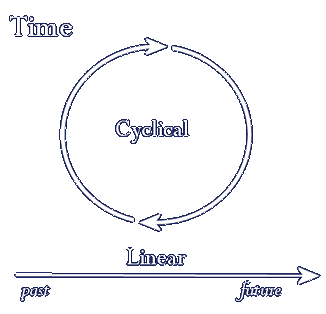
http://www.signsofthetimeshistory.com/graphics/time1.png
For more on the importance of cyclical stories watch Naomi Klein in her TED talk:
As Naomi argues, our culture is trapped in linear stories, ones with endless growth, where rationality never fails (but wait it has and does, welcome post-modernity). Despite her slight against Christianity, I think Christianity, specifically the resurrection, can assist us in telling cyclical stories. However, we must consider the larger story, to see that the resurrection story of death->life was not a one-off story (sure physical resurrection was a one-off event).
Viewing resurrection as a story, we look back at other stories and some of them, specifically in the Judeo-Christian tradition have always been resurrection stories. These stories participated in cycles, in-so-doing they invite the reader/hearer to participate in the story.
• Garden - Day and Night (life and death) -> kicked out of Garden AND clothed (offered a new beginning)
• Noah – death of the world and New life in the olive branch
• Joseph (See Joseph CYOA) – Death of a people in Egypt -> new life in exodus
• Cycles of death and resurrection in Judges
• Life and death of Davidic Kingdom -> Jesus pulls the people out of death, and offers himself as King (Israel’s tangible resurrection – Duncan’s “What is the Gospel Post”)
• Jesus resurrects in person (just in case we had missed the theme throughout the entire narrative!)
What I want to show is that the story of Resurrection can be understood as a cyclical story. It is not a one-off in the narrative of the Bible. We run into danger theologically when our theology or our stories become too linear (as Naomi Klein so aptly demonstrates). We ought to consider this snare when we view linear logic as the top of the hierarchy of our understanding, or when we are too trapped in a western-worldview, which at its root is linear.
When individuals choose to live a resurrection story one will find it everywhere. We die daily into sleep and rise again in the morning. The seasons of the year are deaths and resurrections. Life on the planet is consistently dying and being born. We are born into journeys of school, and career, only to graduate or move-on. These deaths are the end, but also new beginnings. Resurrection is all around.
Within Christianity Resurrection is found also in our symbols. Death in baptism and new life beyond the water. Death in the bread and wine of Communion and new life lived by the partaker.
So where does resurrection fit into story? I would argue all over the place. I think when one begins to think in story, to see in story, to be persuaded by story, one will be able engage the world more fully then through solely a rational lens.
Wednesday, February 22, 2012
Stories. Pt. 2. The Fire Chicken.
The Fire Chicken resides above the entrance to my kitchen. The Fire Chicken arrived sometime in 2009. The chicken was drawn by a friend and was pinned to our wall with great pride, and minimal ceremony. Had I know the staying power of The Fire Chicken, I would have celebrated its arrival with trumpets and cymbals.
Like all stories, it changed with time. It shifted from a fun drawing, to a picture with history and some form of meaning. The shift was based on jokes about the position of prominence it holds, where other home might place a crucifix, we have The Fire Chicken. It now lays claim to being “The Deity of the House” (Please do not take this too seriously – It is a Fire Chicken).

Today, The Fire Chicken was dethroned. I took The Fire Chicken off the wall to scan it. I know all my previous roommates felt a shutter in the force, as The Fire Chicken moved for the first time in years. Do not be too alarmed, The Fire Chicken has been returned to it proper place.
As I ponder The Fire Chicken, I think off the number of people who have lived under its “Diety” or those who have visited its shrine (my home). I count at least ten people who have lived here, and countless people have asked us about The Fire Chicken. Its story continues to propagate and the influence of its story spreads far wider than its local impact. Roommates move on, friends change, and stories spread; such is the nature of life and stories.
What prompted this post? The Fire Chicken now has a new story to tell. It was my birthday earlier this month, and my roommate Sam commissioned his younger sister, Laurel, in New York, to write a story about The Fire Chicken. He gave her the title, she created, and I received. The story is excellent! It now hangs on the wall near my desk. It took me two or three readings to fully appreciate the story. So without further ado:


In my previous post about stories, I began to argue that we all live interrupted stories. I think “the Story of a fire Chicken that went Skiing” can help us understand this. The postmodern genius of this story arrives in the third frame. It is here we have a choice, either dismiss everything because a new story breaks in, or accept the interruption and move on with a syncretised understanding. We cannot ignore that we see bunnies and not a fire Chicken in the third frame. Thus, we must conclude that in this story world either a fire Chicken can shape shift, or the story world contains more animals and more spectacular creativity that one originally anticipated. The interruption spurs us on to better understandings, more creative understandings, and more holistic understandings.
There is, however, another option. One may conclude that “the Story of a fire Chicken that went Skiing” is the only story. One may refuse to accept that there has been an interruption in panel three. One may deem panel three “wrong”. I, however, cannot make such claims. I respect the creativity of the author. I acknowledge the limited scope of my understanding of the story. I look to the interruptions for a greater understanding of the story. The story reflects on me, showing my own limitations, while simultaneously showing others (specifically the author) do not have the same limitations. Consequently, I find panel three not to be “wrong”, but to be the best panel in the story because of the immense discovery that goes along with it. The discovery that leads to a great ending. An ending directed at home. Home!
So now. I want to make it abundantly clear. As much as I was talking about “the Story of a fire Chicken that went Skiing” I was also NOT talking about “the Story of a fire Chicken that went Skiing”. Levels, so many levels ;) Stories are great at levels.
Like all stories, it changed with time. It shifted from a fun drawing, to a picture with history and some form of meaning. The shift was based on jokes about the position of prominence it holds, where other home might place a crucifix, we have The Fire Chicken. It now lays claim to being “The Deity of the House” (Please do not take this too seriously – It is a Fire Chicken).

Today, The Fire Chicken was dethroned. I took The Fire Chicken off the wall to scan it. I know all my previous roommates felt a shutter in the force, as The Fire Chicken moved for the first time in years. Do not be too alarmed, The Fire Chicken has been returned to it proper place.
As I ponder The Fire Chicken, I think off the number of people who have lived under its “Diety” or those who have visited its shrine (my home). I count at least ten people who have lived here, and countless people have asked us about The Fire Chicken. Its story continues to propagate and the influence of its story spreads far wider than its local impact. Roommates move on, friends change, and stories spread; such is the nature of life and stories.
What prompted this post? The Fire Chicken now has a new story to tell. It was my birthday earlier this month, and my roommate Sam commissioned his younger sister, Laurel, in New York, to write a story about The Fire Chicken. He gave her the title, she created, and I received. The story is excellent! It now hangs on the wall near my desk. It took me two or three readings to fully appreciate the story. So without further ado:


In my previous post about stories, I began to argue that we all live interrupted stories. I think “the Story of a fire Chicken that went Skiing” can help us understand this. The postmodern genius of this story arrives in the third frame. It is here we have a choice, either dismiss everything because a new story breaks in, or accept the interruption and move on with a syncretised understanding. We cannot ignore that we see bunnies and not a fire Chicken in the third frame. Thus, we must conclude that in this story world either a fire Chicken can shape shift, or the story world contains more animals and more spectacular creativity that one originally anticipated. The interruption spurs us on to better understandings, more creative understandings, and more holistic understandings.
There is, however, another option. One may conclude that “the Story of a fire Chicken that went Skiing” is the only story. One may refuse to accept that there has been an interruption in panel three. One may deem panel three “wrong”. I, however, cannot make such claims. I respect the creativity of the author. I acknowledge the limited scope of my understanding of the story. I look to the interruptions for a greater understanding of the story. The story reflects on me, showing my own limitations, while simultaneously showing others (specifically the author) do not have the same limitations. Consequently, I find panel three not to be “wrong”, but to be the best panel in the story because of the immense discovery that goes along with it. The discovery that leads to a great ending. An ending directed at home. Home!
So now. I want to make it abundantly clear. As much as I was talking about “the Story of a fire Chicken that went Skiing” I was also NOT talking about “the Story of a fire Chicken that went Skiing”. Levels, so many levels ;) Stories are great at levels.
Monday, February 20, 2012
Stories Collide. Pt. 1
What is reality, what shapes it, and how do I understand my experiences? These questions have been prodding me towards story. Story has been a journey of a thousand miles, begun a long time ago. I grew up a scientific modernist giving lip-service to the possibility of the supernatural, then passing through fundamentalist, and into “biblical”, now I find myself somewhere in a matrix of post-modern/modern/undecided/conglomerate. What I have learned through this development is that the story one lives into shapes all arguments, experience, actions, and epistemology.
I was blessed with a lot of dissonance in my life. I grew up in a “Christian North American” story. It was a story that held to a scientific modernist understanding of the world, but refused to take it to the extreme of excluding the supernatural. This, however, was brutally interrupted by a jaunt to a post-religious/secular/European worldview and story when I lived in England; I was twelve and thirteen years old. The stories clashed, I was too young to understand the significance of such an experience. It is hard to describe the clash of story, they do not battle openly with argumentation that is easy to follow, but a feeling is evident. A feeling of being unsettled. A story is supposed to follow a plot, but when the first story is interrupted and a second story enters in the middle, there is a sense of loss. The flow is incomplete, there is no past and the present seems to have no grounding.
Upon returning to North America, I attempted to pick up my old story, but it was now disjointed. One attempts to reconcile the themes, motifs, and symbols of a different story. It was with this muddled story I entered Bible College. Little did I know I was about to disturb my story in unimaginable ways. Coming from the Christian Reformed Story, I entered the Anabaptist Story. I attempted to “argue” the stories, but I ran into the same problem as before, stories do not respond well to argument. They are different with different pasts. Instead, stories syncretise, usually to the detriment of both. Stories have a funny way of picking the worst of both, rather than the best. It is not that the best parts cannot come together to make a better story, but that takes active participation by the character (you and me). I saw an example of bad syncretism in East Africa where Christianity comes with consumerism, modernity, and hyper-spirituality, but does not get rid of the tribalism, thus blending the negatives (tribalism, consumerism, and modernity) and the positive seem negligible (loyalty, direction, hope). Similar awful syncretism led me to a brief period as a fundamentalist. I syncretised the scientific absolutism of modernism with the Bible. It resulted with a “data quest” into the Bible. I attempted to pull out the absolutes. (This is my critique of Systematic Theology, even when not “fundamentalist”, it is a syncretism of a scientific method with a story. It does not ask the questions of the story, rather it imposes the questions of another story – Greek influenced scientific thought – onto the biblical story).
In reaction to fundamentalism, I attempted to become a purist. For a few years, I attempted to understand the biblical story, attempting to read it on its own terms. This was going well, but then I went to East Africa. This cross-cultural experience rattled my “bible only” conception of truth and reality. The “same” Christian stories clashed, this shook my naïve understanding that one’s private experience is able to arrive at a purist Biblical understanding. Rather one’s private experience and story will completely subvert the entire story. Our private experiences ultimately determine our stories, what flows in and that which is discarded. I came to this conclusion as I sat across from another reading the same text, we both claimed it as authoritative, and we would come to completely different understandings, each significantly shaped by our cultures. The common ground seemed negligible compared to the differences. Everything is relative. Thus ended my purist pursuit.
Where does one go from complete relativity? N.T. Wright goes to critical realism, a noble option, but a method still rooted in a Greek history. Others walk forward into post-modernity with their arm open come what may. Yet others revert, either back into modernity, fundamentalism and its syncretism, or even to a pre-modern-esque type of understanding. This is the crossroads many of us encounter; it is a crossroad I continue to navigate. It is here Story becomes significant. Newbigin’s book “The Gospel in a Pluralist Society” argues for the church as the agent telling the Gospel story and thus persuading the world. Here Duncan’s articulation of Gospel becomes incredibly important; for if Gospel is a part of the story it can be persuasive and syncretised into our stories becoming a story changer. However, if it is a coercive, totalizing, story it co-opts our stories and leads to bad syncretism.
I am attempting to create some hermeneutics for myself as I wallow through this nebulous crossroad. First, honesty. It does me no good to neglect my past or the biases I know I hold. I must be as honest as possible, lay my cards out and attempt to proceed with all the guidance there. Second, virtue. What do I want to become? What do I want my story to look like? Here I lay down my card of compassion. If it is not compassionate, I ought to consider alternatives. Third, story. I must continually remind myself not to argue myself into the “correct” option, because by doing so I have already been co-opted by one story, that of rational argumentation arising out of the modernist era I grew up in (thus following the first hermeneutic). I must continually open myself to persuasion. What story persuades me to follow hermeneutic two? Fourth, keep the biblical text as authoritative. Thus, as the stories blend together I want the narrative of scripture to have significant weight, specifically life, death, and resurrection, as living, dying, and rising throughout my life, even daily, and hopefully in the cosmos, lead me towards greater compassion (hermeneutic two). Fifth, choose wisely. The ability to choose, to choose what is authoritative, choosing the story one lives into, choosing to ones hermeneutics, I must choose contemplatively.
With that, I find myself at the point of syncretising stories. None of them can be “taken out” as they have all entered into my story, but I can mix and mould. I can choose the back-story of the Bible. Therefore, I can incorporate the Gospel (as Duncan articulated) into my story. I can affirm the story of modernism, its conclusion, and collapse into post-modernism. I can look relativism in the face and walk forward with the most persuasive story I can compile, given my experience, which includes the Gospel and compassion. Further, when I am confronted with other stories, such as in East-Africa, I can affirm the parts that blend, while persuading the parts that clash. This has significant influence on my thoughts on pluralism, because if I truly believe that the story I tell and the parts I have chosen to incorporate, it is honestly the best possible story and the most persuasive, there is reduced fear of bad syncretism if I choose to tackle it head-on.
Some of those reading this might be more than a little bit uncomfortable with my choice of words, specifically syncretism. But you see, I have no choice but to syncretise if I wanted out of (or to change) my original story. Since I cannot erase my past and my mode of though, remembering my first story was that of a scientific modernist in North America and NOT a first century Jew in Palestine, I must syncretise the stories I encounter. If I want to change story it involves delicate syncretism. Or to use more “Christian” words I might choose “conversion”, understanding conversion to be the continued gradual change of my story into one I desire.
I was blessed with a lot of dissonance in my life. I grew up in a “Christian North American” story. It was a story that held to a scientific modernist understanding of the world, but refused to take it to the extreme of excluding the supernatural. This, however, was brutally interrupted by a jaunt to a post-religious/secular/European worldview and story when I lived in England; I was twelve and thirteen years old. The stories clashed, I was too young to understand the significance of such an experience. It is hard to describe the clash of story, they do not battle openly with argumentation that is easy to follow, but a feeling is evident. A feeling of being unsettled. A story is supposed to follow a plot, but when the first story is interrupted and a second story enters in the middle, there is a sense of loss. The flow is incomplete, there is no past and the present seems to have no grounding.
Upon returning to North America, I attempted to pick up my old story, but it was now disjointed. One attempts to reconcile the themes, motifs, and symbols of a different story. It was with this muddled story I entered Bible College. Little did I know I was about to disturb my story in unimaginable ways. Coming from the Christian Reformed Story, I entered the Anabaptist Story. I attempted to “argue” the stories, but I ran into the same problem as before, stories do not respond well to argument. They are different with different pasts. Instead, stories syncretise, usually to the detriment of both. Stories have a funny way of picking the worst of both, rather than the best. It is not that the best parts cannot come together to make a better story, but that takes active participation by the character (you and me). I saw an example of bad syncretism in East Africa where Christianity comes with consumerism, modernity, and hyper-spirituality, but does not get rid of the tribalism, thus blending the negatives (tribalism, consumerism, and modernity) and the positive seem negligible (loyalty, direction, hope). Similar awful syncretism led me to a brief period as a fundamentalist. I syncretised the scientific absolutism of modernism with the Bible. It resulted with a “data quest” into the Bible. I attempted to pull out the absolutes. (This is my critique of Systematic Theology, even when not “fundamentalist”, it is a syncretism of a scientific method with a story. It does not ask the questions of the story, rather it imposes the questions of another story – Greek influenced scientific thought – onto the biblical story).
In reaction to fundamentalism, I attempted to become a purist. For a few years, I attempted to understand the biblical story, attempting to read it on its own terms. This was going well, but then I went to East Africa. This cross-cultural experience rattled my “bible only” conception of truth and reality. The “same” Christian stories clashed, this shook my naïve understanding that one’s private experience is able to arrive at a purist Biblical understanding. Rather one’s private experience and story will completely subvert the entire story. Our private experiences ultimately determine our stories, what flows in and that which is discarded. I came to this conclusion as I sat across from another reading the same text, we both claimed it as authoritative, and we would come to completely different understandings, each significantly shaped by our cultures. The common ground seemed negligible compared to the differences. Everything is relative. Thus ended my purist pursuit.
Where does one go from complete relativity? N.T. Wright goes to critical realism, a noble option, but a method still rooted in a Greek history. Others walk forward into post-modernity with their arm open come what may. Yet others revert, either back into modernity, fundamentalism and its syncretism, or even to a pre-modern-esque type of understanding. This is the crossroads many of us encounter; it is a crossroad I continue to navigate. It is here Story becomes significant. Newbigin’s book “The Gospel in a Pluralist Society” argues for the church as the agent telling the Gospel story and thus persuading the world. Here Duncan’s articulation of Gospel becomes incredibly important; for if Gospel is a part of the story it can be persuasive and syncretised into our stories becoming a story changer. However, if it is a coercive, totalizing, story it co-opts our stories and leads to bad syncretism.
I am attempting to create some hermeneutics for myself as I wallow through this nebulous crossroad. First, honesty. It does me no good to neglect my past or the biases I know I hold. I must be as honest as possible, lay my cards out and attempt to proceed with all the guidance there. Second, virtue. What do I want to become? What do I want my story to look like? Here I lay down my card of compassion. If it is not compassionate, I ought to consider alternatives. Third, story. I must continually remind myself not to argue myself into the “correct” option, because by doing so I have already been co-opted by one story, that of rational argumentation arising out of the modernist era I grew up in (thus following the first hermeneutic). I must continually open myself to persuasion. What story persuades me to follow hermeneutic two? Fourth, keep the biblical text as authoritative. Thus, as the stories blend together I want the narrative of scripture to have significant weight, specifically life, death, and resurrection, as living, dying, and rising throughout my life, even daily, and hopefully in the cosmos, lead me towards greater compassion (hermeneutic two). Fifth, choose wisely. The ability to choose, to choose what is authoritative, choosing the story one lives into, choosing to ones hermeneutics, I must choose contemplatively.
With that, I find myself at the point of syncretising stories. None of them can be “taken out” as they have all entered into my story, but I can mix and mould. I can choose the back-story of the Bible. Therefore, I can incorporate the Gospel (as Duncan articulated) into my story. I can affirm the story of modernism, its conclusion, and collapse into post-modernism. I can look relativism in the face and walk forward with the most persuasive story I can compile, given my experience, which includes the Gospel and compassion. Further, when I am confronted with other stories, such as in East-Africa, I can affirm the parts that blend, while persuading the parts that clash. This has significant influence on my thoughts on pluralism, because if I truly believe that the story I tell and the parts I have chosen to incorporate, it is honestly the best possible story and the most persuasive, there is reduced fear of bad syncretism if I choose to tackle it head-on.
Some of those reading this might be more than a little bit uncomfortable with my choice of words, specifically syncretism. But you see, I have no choice but to syncretise if I wanted out of (or to change) my original story. Since I cannot erase my past and my mode of though, remembering my first story was that of a scientific modernist in North America and NOT a first century Jew in Palestine, I must syncretise the stories I encounter. If I want to change story it involves delicate syncretism. Or to use more “Christian” words I might choose “conversion”, understanding conversion to be the continued gradual change of my story into one I desire.
Wednesday, February 1, 2012
Evangelizing Worldview
Playing off Duncan’s word usage and re-definition, witnessing begins to articulate my understanding of evangelism. Actions, words, life, story, intellectual ascent to dogma, a person, a religion, an understanding of history, a mode of thought, a disposition toward life, what is evangelism and then what is the purpose of evangelism? To what/ from what/ to whom/ from where are we evangelizing? I think often the conversation is too narrow in scope. By narrow I mean evangelism, as commonly understood, is an us vs. them disposition towards life. It is altogether too simple, too binary, to bland, for me to actually believe that it is “true” in the sense it reflects my reality. My reality is almost never binary, and hopefully growing in a direction that is less “us and them”.
Yet, I am leaning more to conversion now than ever before, but not probably in the sense you hear me say it. I think overall our conversions, our speech acts (preaching), even our witnessing is far too limited. We default to “is it actions or is it words”? This becomes the “go to” argument within Christian circles. I am becoming more and more convinced that a true conversion to Christianity is a radical redefining of worldview; it is not a “conversion” of intellectual assents (eg. I am an atheist -> now I believe in a God). Often when we speak of preaching, the resultant action on the part of the other is to change “belief” statements in their head. This, however, leads to a dangerously shallow faith. The problems are evident when this faith is too narrowly defined; life becomes what would commonly be called “spiritual” segments of ones worldview. The danger I perceive is that this can lead to a compartmentalization of the individual. This can obviously happen in the orthopraxis of the individual, which is easy to see: e.g. no vulgarity in church, but openly vulgar at the job site. This, however, is a mere symptom of a much larger problem. The church all too often becomes a behaviour cult, as it attempts to crush outward inconsistencies through behaviour modification.
Behaviour modification can and does occur, but if only dealt with at the action level one risks splitting his or her person. This split arises from the problem, a compartmentalized worldview. The answer then is consistency, and a decompartmentalization. If God truly desires all of us, the entire world, our spirits, body, mind, soul (one and the same thing), then we cannot only change the mental assent components of our “spiritual” portion of our worldview (even if this looks good in numbers of those “converted”). Conversion is a life ripping, story shattering, destructive process and restructuring; it is hardly something to be done flippantly through a quick prayer and “poof” you are saved. Think about it, you just asked someone who was raised and indoctrinated with an enlightenment worldview, for over 12 years of education, to accept that some man was raised from the dead. Further, that somehow that event changes the rules of the cosmos and he/she is directly affected. That goes against every hypothesis on which our current system and technological worldview rests. (This is why the soapbox scares me. Not that the Spirit cannot use it, but the potential harm and the absolute lack of compassion evident in such an action nears the unforgivable).
Duncan is absolutely right, evangelism and discipleship must go hand in hand. For me it took four years (or more) of careful delicate (sometimes blatantly destructive) deconstruction to near an understanding of the worldview shift that is required of me. So we in turn must not presume speedy evangelism or conversion, especially in a time of growingly complex worldviews. To respond to a question posed by Duncan a number of posts ago, “Is it better to be right or rational?” I must conclude it is better to be right (and that may be the nearest to anti-intellectualism I have ever stated before). Rationality is not bad, but I would also argue it is not the entirety of the Christian worldview. Therefore, it might need to be left behind at points, as specific actions of leaving an enlightenment worldview behind.
We live in a difficult time, but an exciting time none the less. We are experiencing the end of the modern age, the rise of postmodern thought, and the collapse of empires that have thrived on a modernist worldview. The worldviews that were compartmentalized are collapsing and we see the destruction in personality disorders, increased struggles with mental health, and pervasive fracturing of relationships throughout society. The church has struggled, and continues to struggle, with how to negotiate topics and discussions. These are often no longer about the topic, but the conflict is within the underlying worldview. Thus, evangelism at a time such as this will necessitate striving to consistency and virtue, something Paul argues endlessly for in his letters. Lists of vices to be abandoned and virtues to pursue are blasphemed if they are read as “to do” and “not to do” lists, as such a reading neuters the underlying consistency. The lists are direction pointers in the way of consistency. If, it is this consistency that we seek, with a God who acts, into a story that surrounds the climax that is Christ, then, we are evangelising every moment of every day, awake or asleep. Neither action nor inaction will define one’s evangelism, and when the Spirit empowers, such as is recorded in the Acts segment of the narrative, then the “preaching” or speaking portions will occur.
I believe it is this same underlying worldview that Duncan speaks to when he states evangelism/discipleship is “The process of learning and also living in God's story”. It is complicated, and simple, a story as ageless as time itself, and as adaptable as culture is diverse, and as powerful as the God who backs it.
But…How then is worldview change accomplished? My answer is simply, and at a great cost. Simply, in that it is relational, whether a long-term friendship, or the relationship between myself and an animal, or even myself and my garbage. We relate with everything, and everything relates back. Therefore, worldview is constantly being shifted and shaped. At great cost, means that the changing of a worldview can be emotionally, physically, and spiritually painful. We may run into a barrier of compartmentalization that is reluctant to be assimilated, or altered. This process of deconstruction into deeper levels of relationship preys on our own vulnerabilities.
You may still think I have not answered the question: How do we evangelize/disciple others who are not part of our Christian group? I will respond again that this us vs. them mentality is more detrimental than beneficial. It leads to argument, debate, and the entrenching of positions. Thus, we must relate, converse, dialogue, listen to other stories, this I believe is what Danielle’s job does so effectively by banning proselytizing. I was talking last night with my roommate who is reading Peter Rollins, and Peter’s position is that to most effectively evangelize others we must open ourselves to be evangelized by them. If we are unable to hear, we do more harm than good, we entrench in positions, we may even be entrenching in the wrong positions, those of modernity or even postmodernity. Without allowing ourselves to be evangelized, we refuse to let the stories interact, and how is one story supposed to show that it is more righteous, noble, true, powerful, and just, if we never let the stories intersect?
Yet, I am leaning more to conversion now than ever before, but not probably in the sense you hear me say it. I think overall our conversions, our speech acts (preaching), even our witnessing is far too limited. We default to “is it actions or is it words”? This becomes the “go to” argument within Christian circles. I am becoming more and more convinced that a true conversion to Christianity is a radical redefining of worldview; it is not a “conversion” of intellectual assents (eg. I am an atheist -> now I believe in a God). Often when we speak of preaching, the resultant action on the part of the other is to change “belief” statements in their head. This, however, leads to a dangerously shallow faith. The problems are evident when this faith is too narrowly defined; life becomes what would commonly be called “spiritual” segments of ones worldview. The danger I perceive is that this can lead to a compartmentalization of the individual. This can obviously happen in the orthopraxis of the individual, which is easy to see: e.g. no vulgarity in church, but openly vulgar at the job site. This, however, is a mere symptom of a much larger problem. The church all too often becomes a behaviour cult, as it attempts to crush outward inconsistencies through behaviour modification.
Behaviour modification can and does occur, but if only dealt with at the action level one risks splitting his or her person. This split arises from the problem, a compartmentalized worldview. The answer then is consistency, and a decompartmentalization. If God truly desires all of us, the entire world, our spirits, body, mind, soul (one and the same thing), then we cannot only change the mental assent components of our “spiritual” portion of our worldview (even if this looks good in numbers of those “converted”). Conversion is a life ripping, story shattering, destructive process and restructuring; it is hardly something to be done flippantly through a quick prayer and “poof” you are saved. Think about it, you just asked someone who was raised and indoctrinated with an enlightenment worldview, for over 12 years of education, to accept that some man was raised from the dead. Further, that somehow that event changes the rules of the cosmos and he/she is directly affected. That goes against every hypothesis on which our current system and technological worldview rests. (This is why the soapbox scares me. Not that the Spirit cannot use it, but the potential harm and the absolute lack of compassion evident in such an action nears the unforgivable).
Duncan is absolutely right, evangelism and discipleship must go hand in hand. For me it took four years (or more) of careful delicate (sometimes blatantly destructive) deconstruction to near an understanding of the worldview shift that is required of me. So we in turn must not presume speedy evangelism or conversion, especially in a time of growingly complex worldviews. To respond to a question posed by Duncan a number of posts ago, “Is it better to be right or rational?” I must conclude it is better to be right (and that may be the nearest to anti-intellectualism I have ever stated before). Rationality is not bad, but I would also argue it is not the entirety of the Christian worldview. Therefore, it might need to be left behind at points, as specific actions of leaving an enlightenment worldview behind.
We live in a difficult time, but an exciting time none the less. We are experiencing the end of the modern age, the rise of postmodern thought, and the collapse of empires that have thrived on a modernist worldview. The worldviews that were compartmentalized are collapsing and we see the destruction in personality disorders, increased struggles with mental health, and pervasive fracturing of relationships throughout society. The church has struggled, and continues to struggle, with how to negotiate topics and discussions. These are often no longer about the topic, but the conflict is within the underlying worldview. Thus, evangelism at a time such as this will necessitate striving to consistency and virtue, something Paul argues endlessly for in his letters. Lists of vices to be abandoned and virtues to pursue are blasphemed if they are read as “to do” and “not to do” lists, as such a reading neuters the underlying consistency. The lists are direction pointers in the way of consistency. If, it is this consistency that we seek, with a God who acts, into a story that surrounds the climax that is Christ, then, we are evangelising every moment of every day, awake or asleep. Neither action nor inaction will define one’s evangelism, and when the Spirit empowers, such as is recorded in the Acts segment of the narrative, then the “preaching” or speaking portions will occur.
I believe it is this same underlying worldview that Duncan speaks to when he states evangelism/discipleship is “The process of learning and also living in God's story”. It is complicated, and simple, a story as ageless as time itself, and as adaptable as culture is diverse, and as powerful as the God who backs it.
But…How then is worldview change accomplished? My answer is simply, and at a great cost. Simply, in that it is relational, whether a long-term friendship, or the relationship between myself and an animal, or even myself and my garbage. We relate with everything, and everything relates back. Therefore, worldview is constantly being shifted and shaped. At great cost, means that the changing of a worldview can be emotionally, physically, and spiritually painful. We may run into a barrier of compartmentalization that is reluctant to be assimilated, or altered. This process of deconstruction into deeper levels of relationship preys on our own vulnerabilities.
You may still think I have not answered the question: How do we evangelize/disciple others who are not part of our Christian group? I will respond again that this us vs. them mentality is more detrimental than beneficial. It leads to argument, debate, and the entrenching of positions. Thus, we must relate, converse, dialogue, listen to other stories, this I believe is what Danielle’s job does so effectively by banning proselytizing. I was talking last night with my roommate who is reading Peter Rollins, and Peter’s position is that to most effectively evangelize others we must open ourselves to be evangelized by them. If we are unable to hear, we do more harm than good, we entrench in positions, we may even be entrenching in the wrong positions, those of modernity or even postmodernity. Without allowing ourselves to be evangelized, we refuse to let the stories interact, and how is one story supposed to show that it is more righteous, noble, true, powerful, and just, if we never let the stories intersect?
Tuesday, September 6, 2011
Getting into story
How we read a story determines what it says. We all presuppose things of each story, and much of the time the presuppositions will determine the outcome or interpretation of the story. This is inevitable, thus we must recognize it and explicitly state that the result rests on our presupposition. One might take this knowledge and say that it makes reading the Bible irrelevant, as our conclusion will by predetermined by our presuppositions. How then can one come to the text?
This was something I wanted the students, I was teaching, to see, but not in a cynical disheartening way. I wanted to show the brilliance and excitement the text can reveal when one cogitatively changes one’s presuppositions and is willing to see an alternative result/interpretation. So change your presupposition to that of suspense…
Do we let ourselves to enter into the story and be vulnerable?
This is a question we need to entertain. With what ears are we listening to this story? With what eyes are we seeing this story? When was the last time you were held in suspense by the plot, when were you entertained by the action, when were you emotionally invested in the Character of Jesus or one of the disciples?
Often I think we experience the story the way we experience the latest action movie, or the latest Quentin Terintio movie. We know what to expect, we still enjoy the show but we await the final plot twist. When the twist arrives we do not revel in its brilliance, instead we sit back and point out to those around us “Hey there it was, classic Quentin twist that was”. We smile, relax, and detach ourselves from the characters, often not experiencing the ramification to the twists and suspense in the way the character would have felt or experienced the twist.
When have you pondered the vulnerability of Christ? A man who put himself on the line, who face rejection when he offered the question “Come follow me”. He offers himself, offers friendship. He puts himself at the feet of his disciples, so to speak. He positions himself humbly, in a position of weakness. The disciples could have said no, they could reject, and many did. There are accounts of disciples leaving. So do we allow ourselves to feel that vulnerability in the text? Do we allow Jesus to have human emotions?
I want you to read two passages. I want you to clear you mind of the ending. I want you to enter the story as if for the first time. I know this is impossible, but it is an exercise in experience. Then reflect on what new insights you saw in the texts. These texts specifically offer something about the humanity of Christ. If you are willing, post any insights in the comments section below.
Matthew 13:53-58
New International Version (NIV)
A Prophet Without Honor
53 When Jesus had finished these parables, he moved on from there. 54 Coming to his hometown, he began teaching the people in their synagogue, and they were amazed. “Where did this man get this wisdom and these miraculous powers?” they asked. 55 “Isn’t this the carpenter’s son? Isn’t his mother’s name Mary, and aren’t his brothers James, Joseph, Simon and Judas? 56 Aren’t all his sisters with us? Where then did this man get all these things?” 57 And they took offense at him.
But Jesus said to them, “A prophet is not without honor except in his own town and in his own home.”
58 And he did not do many miracles there because of their lack of faith.
Mark 11:1-19
New International Version (NIV)
Jesus Comes to Jerusalem as King
1 As they approached Jerusalem and came to Bethphage and Bethany at the Mount of Olives, Jesus sent two of his disciples, 2 saying to them, “Go to the village ahead of you, and just as you enter it, you will find a colt tied there, which no one has ever ridden. Untie it and bring it here. 3 If anyone asks you, ‘Why are you doing this?’ say, ‘The Lord needs it and will send it back here shortly.’”
4 They went and found a colt outside in the street, tied at a doorway. As they untied it, 5 some people standing there asked, “What are you doing, untying that colt?” 6 They answered as Jesus had told them to, and the people let them go. 7 When they brought the colt to Jesus and threw their cloaks over it, he sat on it. 8 Many people spread their cloaks on the road, while others spread branches they had cut in the fields. 9 Those who went ahead and those who followed shouted,
“Hosanna![a]”
“Blessed is he who comes in the name of the Lord!”[b]
10 “Blessed is the coming kingdom of our father David!”
“Hosanna in the highest heaven!”
11 Jesus entered Jerusalem and went into the temple courts. He looked around at everything, but since it was already late, he went out to Bethany with the Twelve.
Jesus Curses a Fig Tree and Clears the Temple Courts
12 The next day as they were leaving Bethany, Jesus was hungry. 13 Seeing in the distance a fig tree in leaf, he went to find out if it had any fruit. When he reached it, he found nothing but leaves, because it was not the season for figs. 14 Then he said to the tree, “May no one ever eat fruit from you again.” And his disciples heard him say it.
15 On reaching Jerusalem, Jesus entered the temple courts and began driving out those who were buying and selling there. He overturned the tables of the money changers and the benches of those selling doves, 16 and would not allow anyone to carry merchandise through the temple courts. 17 And as he taught them, he said, “Is it not written: ‘My house will be called a house of prayer for all nations’[c]? But you have made it ‘a den of robbers.’[d]”
18 The chief priests and the teachers of the law heard this and began looking for a way to kill him, for they feared him, because the whole crowd was amazed at his teaching.
19 When evening came, Jesus and his disciples[e] went out of the city.
This was something I wanted the students, I was teaching, to see, but not in a cynical disheartening way. I wanted to show the brilliance and excitement the text can reveal when one cogitatively changes one’s presuppositions and is willing to see an alternative result/interpretation. So change your presupposition to that of suspense…
Do we let ourselves to enter into the story and be vulnerable?
This is a question we need to entertain. With what ears are we listening to this story? With what eyes are we seeing this story? When was the last time you were held in suspense by the plot, when were you entertained by the action, when were you emotionally invested in the Character of Jesus or one of the disciples?
Often I think we experience the story the way we experience the latest action movie, or the latest Quentin Terintio movie. We know what to expect, we still enjoy the show but we await the final plot twist. When the twist arrives we do not revel in its brilliance, instead we sit back and point out to those around us “Hey there it was, classic Quentin twist that was”. We smile, relax, and detach ourselves from the characters, often not experiencing the ramification to the twists and suspense in the way the character would have felt or experienced the twist.
When have you pondered the vulnerability of Christ? A man who put himself on the line, who face rejection when he offered the question “Come follow me”. He offers himself, offers friendship. He puts himself at the feet of his disciples, so to speak. He positions himself humbly, in a position of weakness. The disciples could have said no, they could reject, and many did. There are accounts of disciples leaving. So do we allow ourselves to feel that vulnerability in the text? Do we allow Jesus to have human emotions?
I want you to read two passages. I want you to clear you mind of the ending. I want you to enter the story as if for the first time. I know this is impossible, but it is an exercise in experience. Then reflect on what new insights you saw in the texts. These texts specifically offer something about the humanity of Christ. If you are willing, post any insights in the comments section below.
Matthew 13:53-58
New International Version (NIV)
A Prophet Without Honor
53 When Jesus had finished these parables, he moved on from there. 54 Coming to his hometown, he began teaching the people in their synagogue, and they were amazed. “Where did this man get this wisdom and these miraculous powers?” they asked. 55 “Isn’t this the carpenter’s son? Isn’t his mother’s name Mary, and aren’t his brothers James, Joseph, Simon and Judas? 56 Aren’t all his sisters with us? Where then did this man get all these things?” 57 And they took offense at him.
But Jesus said to them, “A prophet is not without honor except in his own town and in his own home.”
58 And he did not do many miracles there because of their lack of faith.
Mark 11:1-19
New International Version (NIV)
Jesus Comes to Jerusalem as King
1 As they approached Jerusalem and came to Bethphage and Bethany at the Mount of Olives, Jesus sent two of his disciples, 2 saying to them, “Go to the village ahead of you, and just as you enter it, you will find a colt tied there, which no one has ever ridden. Untie it and bring it here. 3 If anyone asks you, ‘Why are you doing this?’ say, ‘The Lord needs it and will send it back here shortly.’”
4 They went and found a colt outside in the street, tied at a doorway. As they untied it, 5 some people standing there asked, “What are you doing, untying that colt?” 6 They answered as Jesus had told them to, and the people let them go. 7 When they brought the colt to Jesus and threw their cloaks over it, he sat on it. 8 Many people spread their cloaks on the road, while others spread branches they had cut in the fields. 9 Those who went ahead and those who followed shouted,
“Hosanna![a]”
“Blessed is he who comes in the name of the Lord!”[b]
10 “Blessed is the coming kingdom of our father David!”
“Hosanna in the highest heaven!”
11 Jesus entered Jerusalem and went into the temple courts. He looked around at everything, but since it was already late, he went out to Bethany with the Twelve.
Jesus Curses a Fig Tree and Clears the Temple Courts
12 The next day as they were leaving Bethany, Jesus was hungry. 13 Seeing in the distance a fig tree in leaf, he went to find out if it had any fruit. When he reached it, he found nothing but leaves, because it was not the season for figs. 14 Then he said to the tree, “May no one ever eat fruit from you again.” And his disciples heard him say it.
15 On reaching Jerusalem, Jesus entered the temple courts and began driving out those who were buying and selling there. He overturned the tables of the money changers and the benches of those selling doves, 16 and would not allow anyone to carry merchandise through the temple courts. 17 And as he taught them, he said, “Is it not written: ‘My house will be called a house of prayer for all nations’[c]? But you have made it ‘a den of robbers.’[d]”
18 The chief priests and the teachers of the law heard this and began looking for a way to kill him, for they feared him, because the whole crowd was amazed at his teaching.
19 When evening came, Jesus and his disciples[e] went out of the city.
Subscribe to:
Posts (Atom)